The Effectiveness of Schema Therapy and Cognitive-Behavioral Intolerance of Uncertainty Interventions on Worry States, Thought-Action Fusion, and Cognitive Avoidance in Adolescents with Generalized Anxiety Disorder
DOI:
https://doi.org/10.61838/kman.jayps.4335Keywords:
Schema therapy, cognitive-behavioral therapy, intolerance of uncertainty, worry states, thought-action fusion, generalized anxiety disorderAbstract
Objective: The aim of this study was to investigate the effectiveness of schema therapy and cognitive-behavioral interventions focused on intolerance of uncertainty in reducing worry states, thought-action fusion, and cognitive avoidance among adolescents diagnosed with GAD.
Methods and Materials: This study employed a quasi-experimental, pretest-posttest control group design. The statistical population consisted of all adolescents diagnosed with GAD who referred to 30 psychological counseling centers in District 17 of Tehran in 2025. A total of 36 participants were selected through convenience sampling and were randomly assigned to one of three groups: schema therapy, cognitive-behavioral therapy (CBT) targeting intolerance of uncertainty, and a control group. Measurement tools included the 7-item Generalized Anxiety Disorder Scale (Spitzer et al., 2006), the Intolerance of Uncertainty Scale (Freeston et al., 1994), the Penn State Worry Questionnaire (Meyer et al., 1990), the Thought-Action Fusion Questionnaire (Shafran et al., 1996), and the Cognitive Avoidance Questionnaire (Sexton & Dugas, 2009). The schema therapy intervention (Young, 1990) was delivered in 8 sessions of 90 minutes each. The CBT intervention was based on the Dugas model (Dugas & Chavot, 2007; Chavot et al., 2019) and was delivered over 12 sessions of 90 minutes each. The control group was placed on a waitlist. Following the intervention, a posttest was administered to all groups. Data were analyzed using multivariate analysis of covariance (MANCOVA) in SPSS version 24, including both descriptive and inferential statistics.
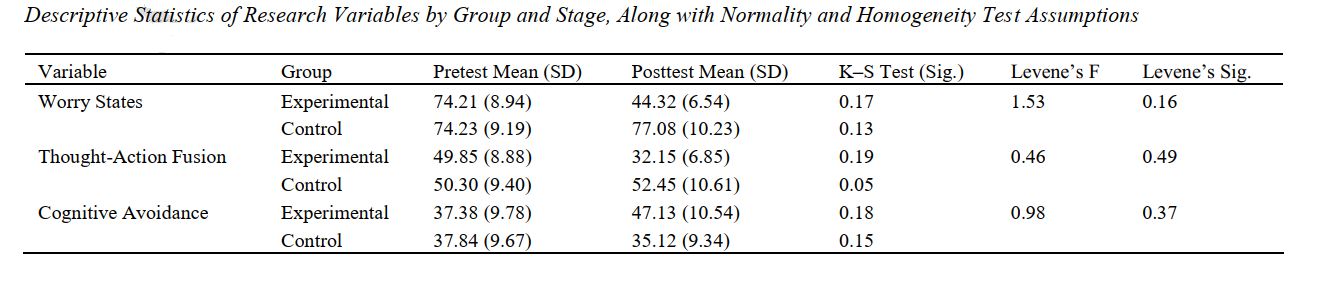
Findings: The results indicated that, based on the posttest mean scores of the experimental groups, both schema therapy and cognitive-behavioral therapy focused on intolerance of uncertainty had a significant effect on reducing worry states, thought-action fusion, and cognitive avoidance in adolescents with GAD.
Conclusion: Based on the findings of this study, both cognitive-behavioral therapy focused on intolerance of uncertainty and schema therapy can be considered effective interventions and may be utilized in clinical and healthcare settings to improve worry states, thought-action fusion, and cognitive avoidance.
Downloads
References
Baniasadi, K., Gerdooie, R., Gorji, M., Shahbazi, G., Babaahmadi, F., Ghafourian, G., & Pourmohammad Ghouchani, K. (2025). Comparison of Cognitive Behavioral Therapy and Acceptance and Commitment Therapy on Enhancing Resilience, Cognitive Flexibility, and Distress Tolerance in Adolescents with Obsessive-Compulsive Disorder. Journal of Adolescent and Youth Psychological Studies (JAYPS), 6(6), 1-10. https://doi.org/10.61838/kman.jayps.6.6.6
Behar, E., & Borkovec, T. D. (2020). The effects of verbal and imaginal worry on panic symptoms during an interoceptive exposure task. Behaviour Research and Therapy, 135, 103748. https://doi.org/10.1016/j.brat.2020.103748
Berle, D., & Starcevic, V. (2015). Thought - action fusion: Review of literature and future directions. Clinical psychology review, 25, 263-284. https://doi.org/10.1016/j.cpr.2004.12.001
Bomyea, J., Ramsawh, H., Ball, T. M., Taylor, C. T., Paulus, M. P., Lang, A. J., & Stein, M. B. (2015). Intolerance of uncertainty as a mediator of reductions in worry in a cognitive behavioral treatment program for generalized anxiety disorder. Journal of anxiety disorders, 33, 90-94. https://doi.org/10.1016/j.janxdis.2015.05.004
Borza, L. (2017). Cognitive-behavioral therapy for generalized anxiety. Dialogues in clinical neuroscience, 19(2), 203-208. https://doi.org/10.31887/DCNS.2017.19.2/lborza
Dehghani Soltani, M., & Rezaei Nasab, F. (2022). The effectiveness of schema therapy on metacognitive beliefs, cognitive fusion, and rumination in adolescents with generalized anxiety disorder. Journal of New Psychological Research, 17(66), 121-130. https://psychologyj.tabrizu.ac.ir/article_15282_en.html?lang=fa
Fassbinder, E., Brand-de Wilde, O., & Arntz, A. (2019). Case formulation in schema therapy: Working with the mode model. Academic Press. https://doi.org/10.1016/B978-0-12-813521-1.00005-9
Günther, V., Jahn, S., Webelhorst, C., Bodenschatz, C. M., Bujanow, A., Mucha, S., & Suslow, T. (2022). Coping with anxiety: brain structural correlates of vigilance and cognitive avoidance. Frontiers in Psychiatry, 13, 869367. https://doi.org/10.3389/fpsyt.2022.869367
Hayes-Skelton, S. A., & Lee, C. S. (2020). Decentering in mindfulness and cognitive restructuring for social anxiety: An experimental study of a potential common mechanism. Behavior Modification, 44(6), 817-840. https://doi.org/10.1177/0145445519850744
Hebert, E. A., & Dugas, M. J. (2019). Behavioral experiments for intolerance of uncertainty: Challenging the unknown in the treatment of generalized anxiety disorder. Cognitive and Behavioral Practice, 26(2), 421-436. https://doi.org/10.1016/j.cbpra.2018.07.007
Heffernan, M., Wilson, C., Keating, K., & McCarthy, K. (2021). "Why Isn't it going away?": a qualitative exploration of worry and pain experiences in adolescents with chronic pain. Pain Medicine, 22(2), 459-469. https://doi.org/10.1093/pm/pnaa245
Hosseini, S. M. D., Amiri, S., Namdari, K., & Molavi, H. (2021). The effectiveness of cognitive therapy based on dogas model of morbid morbidity, severity of symptoms and causative factors of diffuse anxiety disorder in patients with diffuse anxiety disorder. Journal of Psychological Science, 19(94), 1267-1279. https://www.academia.edu
Hosseinzadeh Firouzabad, Y., Basak Nejad, S., & Davoodi, I. (2017). Predicting components of exam anxiety based on behavioral procrastination, decision-making procrastination, and cognitive avoidance among students. Iranian Journal of Psychiatry and Clinical Psychology, 23(4), 424-437. https://doi.org/10.29252/nirp.ijpcp.23.4.424
Ikic, V., Belanger, C., Bouchard, S., Gosselin, P., Langlois, F., Labrecque, J., & Marchand, A. (2017). Reduction in Costs after Treating Comorbid Panic Disorder with Agoraphobia and Generalized Anxiety Disorder. The Journal of Mental Health Policy and Economics, 20(1), 11-20. https://europepmc.org/article/med/28418834
Izadi, Z., Shahabi Zadeh, F., Soleiman Nejad, K., & Nasri, M. (2022). The effectiveness of acceptance and commitment therapy interventions and cognitive-behavioral therapy for indecision on personality type D and sleep quality in patients with irritable bowel syndrome and generalized anxiety disorder. Journal of Cognitive Sciences, 21(17), 1838-1850. https://link.springer.com/article/10.1007/s11126-023-10058-3
Jacoby, R. J. (2020). Intolerance of uncertainty. https://doi.org/10.1037/0000150-003
Knouse, L. E., & Mitchell, J. T. (2015). Incautiously optimistic: Positively valenced cognitive avoidance in adults with ADHD. Cognitive and Behavioral Practice, 22(2), 192-202. https://www.sciencedirect.com/science/article/pii/S1077722914000923
Makhdoumi, M., Abolqasemi, S., & Khaneh Kashi, A. (2024). The effectiveness of schema therapy on worry states and indecision in individuals with generalized anxiety disorder. Journal of Psychological Sciences, 23(144), 83-95. https://doi.org/10.61186/jps.23.144.5
Marchetti, I., Mor, N., Chiorri, C., & Koster, E. H. (2018). The brief state rumination inventory (BSRI): Validation and psychometric evaluation. Cognitive therapy and research, 42, 1-14. https://doi.org/10.1007/s10608-018-9901-1
Mikaili, N., Yahyayi, S., & Taghavi, R. (2015). The role of metacognitive beliefs in predicting pathological worry in students with exam anxiety. School Psychology, 4(3), 86-101. https://www.frontiersin.org
Morrison, R., & Conner, R. C. (2019). A systematic review of the relationship between rumination and suicidality. Suicide and Life-Threatening Behavior, 38(5), 45-67. https://doi.org/10.1521/suli.2008.38.5.523
Rachman, S. (2016). The Treatment of Obsessions. Oxford University Press. https://academic.oup.com/book
Ranney, R. M., Bing‐Canar, H., & Behar, E. (2021). Effortful control moderates relationships between worry and symptoms of depression and anxious arousal. British Journal of Clinical Psychology, 60(3), 400-413. https://doi.org/10.1111/bjc.12289
Sagui-Henson, S. J. (2017). Cognitive avoidance. Encyclopedia of Personality and Individual Differences, 1-3. https://doi.org/10.1007/978-3-319-28099-8_964-1
Scotta, A. V., Cortez, M. V., & Miranda, A. R. (2022). Insomnia is associated with worry, cognitive avoidance and low academic engagement in Argentinian university students during the COVID-19 social isolation. Psychology, Health & Medicine, 27(1), 199-214. https://doi.org/10.1080/13548506.2020.1869796
Shah, A. Q., Prasad, D., Caropreso, L., Frey, B. N., & de Azevedo Cardoso, T. (2023). The comorbidity between Borderline Personality Disorder (BPD) and Generalized Anxiety Disorder (GAD): A systematic review and meta-analysis. Journal of psychiatric research, 164, 304-314. https://doi.org/10.1016/j.jpsychires.2023.06.009
Straarup, N. S., Renneberg, H. B., Farrell, J., & Younan, R. (2022). Group schema therapy for patients with severe anxiety disorders. Journal of Clinical Psychology, 78(8), 1590-1600. https://doi.org/10.1002/jclp.23351
Thiel, N., Jacob, G. A., Tuschen-Caffier, B., Herbst, N., Kuelz, A. K., Hertenstein, E., & Voderholzer, U. (2016). Schema therapy augmented exposure and response prevention in patients with obsessive compulsive disorder: Feasibility and efficacy of a pilot study. Journal of Behavior Therapy and Experimental Psychiatry, 52, 59-67. https://doi.org/10.1016/j.jbtep.2016.03.006
Vafadar, A., Mirzamani Bafghi, S. M., & Jafari Roshan, M. (2021). A comparison of the effectiveness of acceptance and commitment therapy and emotional schema therapy on attentional bias, indecision, and cognitive avoidance in adolescents with generalized anxiety disorder. Journal of Disability Studies, 11(194), 1-8. https://www.sid.ir/paper/1031071/en
Wahlund, T., Andersson, E., Jolstedt, M., Perrin, S., Vigerland, S., & Serlachius, E. (2020). Intolerance of uncertainty-focused treatment for adolescents with excessive worry: A pilot feasibility study. Cognitive and Behavioral Practice, 27(2), 215-230. https://doi.org/10.1016/j.cbpra.2019.06.002
Downloads
Additional Files
Publication Timeline
- Submitted
- Revised
- Accepted
Issue
Section
License
Copyright (c) 2025 Sanaz Pourgoli, Mohammad Talaei kahjugh, Elham Sargolzaei, Giti Shahbazi, Somaye Nazari (Author); Zeinab Baharestani (Corresponding Author); Kamran Pourmohammad Ghouchani (Author)

This work is licensed under a Creative Commons Attribution-NonCommercial 4.0 International License.