Predicting Resilience Based on Spiritual Health and Psychological Well-Being Among University Students
DOI:
https://doi.org/10.61838/kman.jayps.4291Keywords:
Psychological well-being, resilience, spiritual health, studentsAbstract
Objective: The present study aimed to predict resilience based on spiritual health and psychological well-being among university students.
Methods and Materials: The sample included 43 students from the Islamic Azad University, Khorasgan Branch, during the 2022 academic year. The research instruments used were the Spiritual Well-Being Scale (SWBS) developed by Paloutzian and Ellison (1982), the Connor-Davidson Resilience Scale (CD-RISC) (Connor & Davidson, 2003), and Ryff’s Psychological Well-Being Scales (Ryff, 1989). Data were analyzed using SPSS version 26.
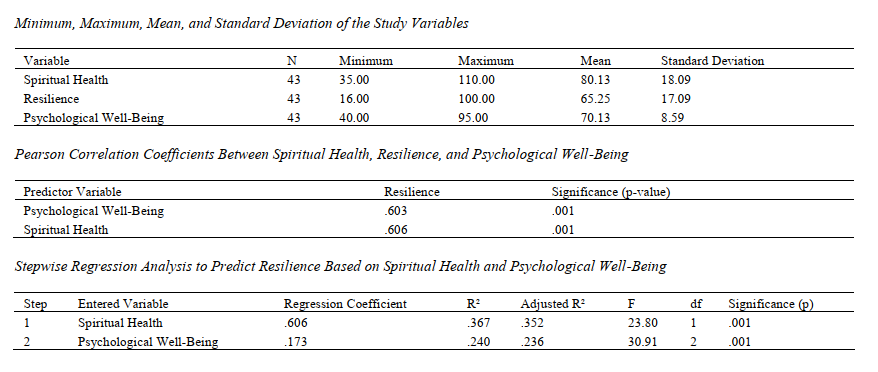
Findings: Pearson correlation and stepwise regression analyses were employed. The results indicated that the relationship between spiritual health and psychological well-being with resilience was statistically significant (p < .01). Additionally, the relationship between the dimensions of spiritual health and resilience was also significant (p < .01). Furthermore, the relationship between the dimensions of psychological well-being and resilience was statistically significant, confirming this hypothesis as well (p < .01).
Conclusion: The findings of the present study indicate that with an increase in spiritual health, individuals’ resilience increases by 54.6%. Moreover, with an increase in autonomy, resilience increases by 35.3%. Based on these results, special attention should be paid to these variables in efforts to promote resilience.
Downloads
References
Almurumudhe, L. K. A., Mahdad, A., Abdulkadhim Johni, A., & Yousefi, Z. (2024). The Mediating Role of Self-Esteem in the Relationship between Psychological Capital, Academic Engagement, and Academic Procrastination with Academic Performance among Students in Al-Diwaniyah, Iraq [Research Article]. Iranian Journal of Educational Sociology, 7(3), 1-9. https://doi.org/10.61838/kman.ijes.7.3.1
Asif, A., Yasin, H., & Iqrar, L. (2024). Personal Growth Initiative, Resilience and Psychological Wellbeing in Young Adults of Pakistan. J. Asian Dev. Studies, 13(1), 412-421. https://doi.org/10.62345/jads.2024.13.1.35
Chuning, A. E., Durham, M. R., Killgore, W. D., & Smith, R. (2024). Psychological resilience and hardiness as protective factors in the relationship between depression/anxiety and well-being: Exploratory and confirmatory evidence. Personality and individual differences, 225, 112664. https://doi.org/10.1016/j.paid.2024.112664
Foster, K., Shakespeare‐Finch, J., Shochet, I. M., Maybery, D., Bui, M. V., Steele, M., & Roche, M. (2024). Psychological Distress, Well‐being, Resilience, Posttraumatic Growth, and Turnover Intention of Mental Health Nurses During COVID‐19: A Cross‐sectional Study. International journal of mental health nursing, 33(5), 1543-1552. https://doi.org/10.1111/inm.13354
Hashemi, Z., Aghajani Heshjin, T., & Shokrgozar, A. (2024). The Relationship Between Spiritual Well-being, Mental Health, Resilience, and Hope in Cardiovascular Patients. Research in Religion and Health, 8(Fall 2021), 38-52. http://ensani.ir/fa/article/509232/
Hayati, A., Handari, S., Awaliah, F. K., Azizah, A. R., & Kurniad, I. B. A. (2025). Are Resilience, and Spirituality Related to Marital Peace? Explorations in Silver Age Couples. Edu Consilium Jurnal Bimbingan Dan Konseling Pendidikan Islam, 6(1), 1-14. https://doi.org/10.19105/ec.v6i1.17189
Hedayati Dana, S., Saberi, H., & Nasrollahi, B. (2023). Comparison of the effectiveness of mindfulness-based cognitive therapy and spirituality therapy on resilience. Behavioral Sciences Research Journal, 21(1), 1-10. http://rbs.mui.ac.ir/article-1-1431-fa.html
Karahan, M., Kiziltan Eliacik, B. B., & Baydili, K. N. (2024). The interplay of spiritual health, resilience, and happiness: an evaluation among a group of dental students at a state university in Turkey. BMC Oral Health, 24(1), 587. https://doi.org/10.1186/s12903-024-04297-4
Karimi Dastaki, A., & Mahmudi, M. (2024). The Effectiveness of Life Meaning Workshops on Resilience, Negative Affect, and Perceived Social Support in Students. Journal of Psychological Dynamics in Mood Disorders (PDMD), 3(1), 187-197. https://doi.org/10.22034/pdmd.2024.448984.1063
Karimi, F., & Nikmanesh, Z. (2023). The role of spiritual intelligence and emotion regulation on resilience in students. Educational Psychology Studies, 20(51), 105-117. https://www.noormags.ir
Mao, Y., Luo, X., Wang, S., Mao, Z. Q., Xie, M., & Bonaiuto, M. (2024). Flow Experience Fosters University Students' Well‐being Through Psychological Resilience: A longitudinal Design With Cross‐lagged Analysis. British Journal of Educational Psychology, 94(2), 518-538. https://doi.org/10.1111/bjep.12661
Marietta, D., Subida, P. D. R. R., Pamela, B. F., & Adrian, M. S. (2024). Understanding Psychological Well-being and Resilience among College Nursing Students. International Journal of Religion. https://doi.org/10.61707/rbpwfg58
Quyamuddin, M. (2025). Emotional Resilience and Psychological Well-Being in Junior Resident Doctor’s Professional Growth: A Conceptual Exploration Through the Lens of the “Triangular Theory of Love”. International Journal for Multidisciplinary Research, 7(2). https://doi.org/10.36948/ijfmr.2025.v07i02.39862
Sadati, S. Z., & Mahdavi, F. (2023). The Effectiveness of Spirituality Therapy with Emphasis on Islamic Teachings on Resilience, Religious Orientation, and Life Satisfaction of Divorced Women. Applied Family Therapy, 4(4), 317-330. https://doi.org/10.61838/kman.aftj.4.4.18
Sajjad, A., & Thakur, S. C. (2025). The Role of Resilience in Predicting Marital Adjustment and Psychological Well-Being Among Married People. Sra, 3(1), 214-223. https://doi.org/10.70670/sra.v3i1.300
Shabani, M. (2023). Resilience and Spirituality Mediate Anxiety and Life Satisfaction in Chronically Ill Older Adults. BMC psychology, 11(1). https://doi.org/10.1186/s40359-023-01279-z
Sheyvandi Chelicheh, K., Abdolmaleki, S., Ghalami, Z., & Nafar, Z. (2023). Explaining the Resilience Model Based on Life Purpose and Relationship Quality with the Mediating Role of Spiritual Health in Facing Psychological Pressure Due to COVID-19. Quarterly Journal of Counseling Culture and Psychotherapy, 14(54), 1-34. https://qccpc.atu.ac.ir/article_14612.html
Sood, M., & Gupta, A. (2024). Role of Spiritual Well-Being, Resilience and Affective State on Psychological Well-Being of Young Adults. Lpi. https://doi.org/10.53555/lpi.v44i3.1435
Villegas, M. T. D. (2025). Emotional Competencies and Psychological Well-Being in Costa Rican Emerging Adults: The Mediating Role of Self-Esteem and Resilience. European Journal of Investigation in Health Psychology and Education, 15(5), 89. https://doi.org/10.3390/ejihpe15050089
Downloads
Additional Files
Publication Timeline
- Submitted
- Revised
- Accepted
Issue
Section
License
Copyright (c) 2025 Heshmat Allah Eskandari Asl (Corresponding Author); Froozan Dolatyari, Hamed Alipor, Abdolmajid Mohammadi (Author)

This work is licensed under a Creative Commons Attribution-NonCommercial 4.0 International License.