Prediction of Generalized Anxiety Disorder Based on Self-Handicapping with the Mediating Role of Worry
DOI:
https://doi.org/10.61838/kman.jayps.4283Keywords:
Generalized Anxiety Disorder, Self-Handicapping, WorryAbstract
Objective: The objective of this study was to examine whether self-handicapping predicts generalized anxiety disorder (GAD) symptoms and to investigate the mediating role of worry in this relationship.
Methods and Materials: This descriptive-correlational study was conducted among 395 young adults in Tehran, selected through stratified random sampling based on the Morgan and Krejcie sample size table. Participants completed standardized self-report instruments including the Self-Handicapping Scale (SHS), the Penn State Worry Questionnaire (PSWQ), and the Generalized Anxiety Disorder 7-item Scale (GAD-7). Data were analyzed using SPSS-27 for descriptive and correlational statistics, and AMOS-21 for structural equation modeling (SEM). Model fit indices and standardized path coefficients were used to evaluate the adequacy of the proposed mediation model.
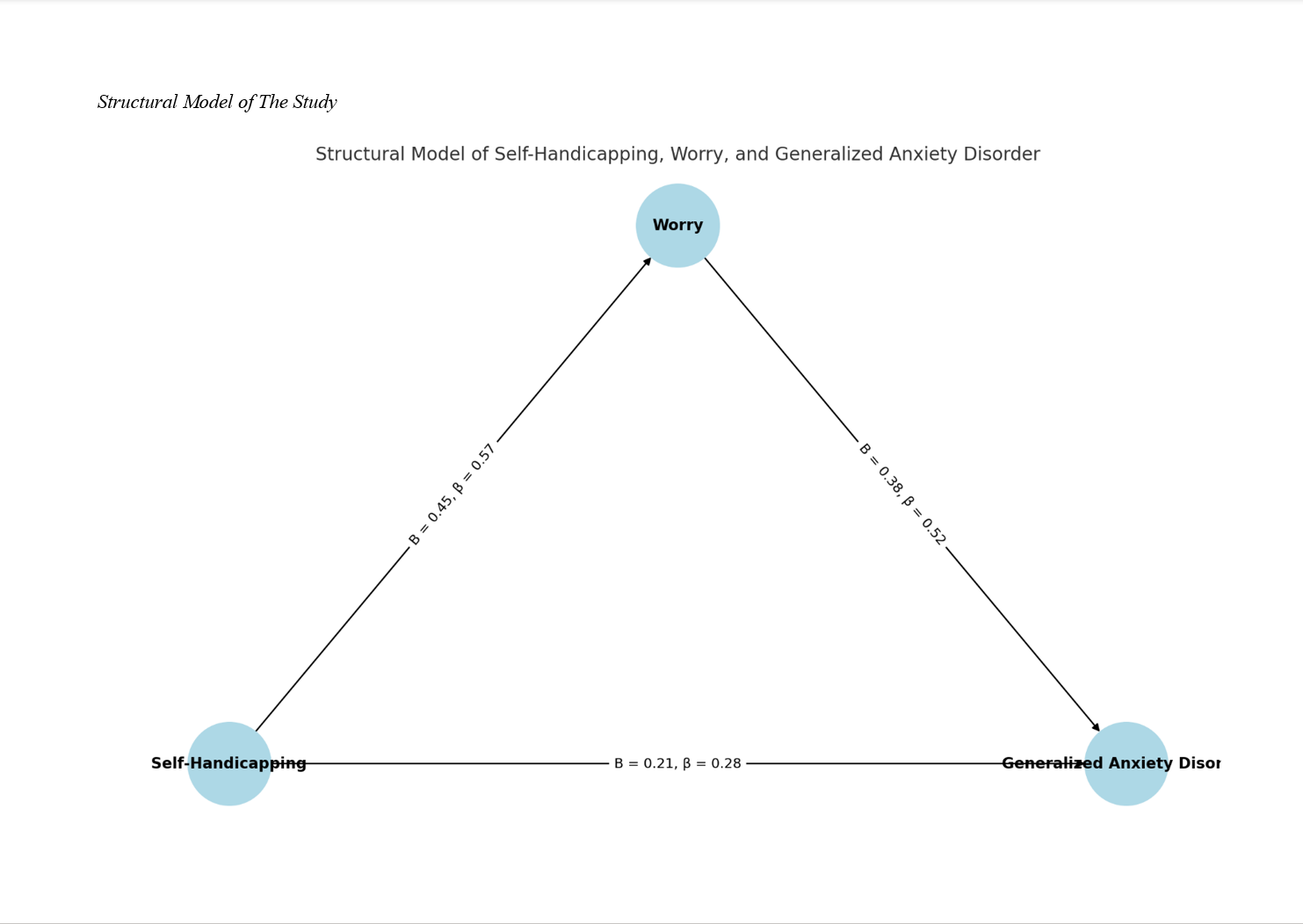
Findings: Results revealed that self-handicapping was significantly and positively correlated with both worry (r = .57, p < .001) and GAD symptoms (r = .49, p < .001). Worry was also strongly associated with GAD symptoms (r = .61, p < .001). SEM analysis showed good model fit (χ²/df = 2.35, RMSEA = 0.058, CFI = 0.96, TLI = 0.95). Path analysis indicated that self-handicapping had a significant direct effect on GAD (β = 0.28, p < .001), a significant indirect effect through worry (β = 0.30, p < .001), and a substantial total effect (β = 0.58, p < .001), confirming worry as a partial mediator.
Conclusion: Targeting both self-handicapping and worry in preventive and therapeutic interventions may enhance the effectiveness of anxiety disorder treatments, especially in performance-oriented and culturally collectivist contexts.
Downloads
References
Akpunne, B. C., & Akinnawo, O. E. (2019). Internet Addiction, Problematic Smartphone Use and Psychological Health of Nigerian University Undergraduates. International Neuropsychiatric Disease Journal, 1-13. https://doi.org/10.9734/indj/2018/v12i330093
Barutçu Yıldırım, F., & Demir, A. (2020). Self-handicapping among university students: The role of procrastination, test anxiety, self-esteem, and self-compassion. Psychological Reports, 123(3), 825-843. https://doi.org/10.1177/0033294118825099
Bokma, W. A., Zhutovsky, P., Giltay, E. J., Schoevers, R. A., Penninx, B. W., Anton, L. J. M. v. B., Batelaan, N. M., & Wingen, G. v. (2020). Predicting the Naturalistic Course in Anxiety Disorders Using Clinical and Biological Markers: A Machine Learning Approach. Psychological medicine, 52(1), 57-67. https://doi.org/10.1017/s0033291720001658
Carlier, I. V. E., Lotte, V. v. d. E., Jong, K. d., & Vliet, I. M. v. (2023). Treatment Course Comparison Between Anxiety-Related Disorders in Adult Outpatients. The Journal of Nervous and Mental Disease, 211(8), 601-612. https://doi.org/10.1097/nmd.0000000000001667
Carnevali, L., Mancini, M., Koenig, J., Makovac, E., Watson, D. R., Meeten, F., Critchley, H., & Ottaviani, C. (2019). Cortical Morphometric Predictors of Autonomic Dysfunction in Generalized Anxiety Disorder. Autonomic Neuroscience, 217, 41-48. https://doi.org/10.1016/j.autneu.2019.01.001
Chen, V. (2024). The Comorbidity of Anxiety-Related Disorders and Insomnia: An Analysis of Mechanisms. Theoretical and Natural Science, 29(1), 164-169. https://doi.org/10.54254/2753-8818/29/20240769
Davis, C. H., Carlson, C., Beaudreau, S. A., & Gould, C. E. (2024). The Influence of Anxiety and Perceived Control of Anxiety on Older Veterans’ Quality of Life. Innovation in Aging, 8(Supplement_1), 827-827. https://doi.org/10.1093/geroni/igae098.2680
Ferreira-Garcia, R., Mochcovitch, M. D., Cabo, M. C. d., Nardi, A. E., & Freire, R. C. (2017). Predictors of Pharmacotherapy Response in Generalized Anxiety Disorder: A Systematic Review. Harvard Review of Psychiatry, 25(2), 65-79. https://doi.org/10.1097/hrp.0000000000000127
Gerdan, G. (2025). Exploring the Role of Contrast Avoidance, Worry, and Rumination in the Relationship Between Intolerance of Uncertainty, Generalized Anxiety Disorder, and Panic Disorder Symptoms in a Clinical Sample. Current Psychology. https://doi.org/10.1007/s12144-025-07641-1
Jabeur, M., Gassab, L., Ayadi, A., Mohamed, B. B., Zaafrane, F., & Gaha, L. (2022). Clinical Correlates of Anxiety Disorders : Tunisian Study About 436 Subjects. European Psychiatry, 65(S1), S389-S390. https://doi.org/10.1192/j.eurpsy.2022.985
Jia, J., Jiang, Q., & Lin, X. H. (2020). Academic anxiety and self-handicapping among medical students during the COVID-19 pandemic: A moderated mediation model. https://europepmc.org/article/ppr/ppr219703
Jia, J., Wang, L.-l., Xu, J.-b., Lin, X.-h., Zhang, B., & Jiang, Q. (2021). Self-Handicapping in Chinese Medical Students During the COVID-19 Pandemic: The Role of Academic Anxiety, Procrastination and Hardiness [Original Research]. Frontiers in psychology, 12. https://doi.org/10.3389/fpsyg.2021.741821
Kelly, K., & Mezuk, B. (2017). Predictors of Remission From Generalized Anxiety Disorder and Major Depressive Disorder. Journal of affective disorders, 208, 467-474. https://doi.org/10.1016/j.jad.2016.10.042
Khaiyom, J. H. A., Mukhtar, F., & Oei, T. P. S. (2021). Anxiety Disorders in Malaysia From 2005 to 2015: A Scoping Review of Their Prevalence Rates, Associated Factors, and Predictors. Journal of Health and Translational Medicine, 24(2), 31-47. https://doi.org/10.22452/jummec.vol24no2.6
Lee, P. C., Zehgeer, A., Ginsburg, G. S., McCracken, J. T., Keeton, C., Kendall, P. C., Birmaher, B., Sakolsky, D., Walkup, J. T., Peris, T. S., Albano, A. M., & Compton, S. N. (2017). Child and Adolescent Adherence With Cognitive Behavioral Therapy for Anxiety: Predictors and Associations With Outcomes. Journal of Clinical Child & Adolescent Psychology, 48(sup1), S215-S226. https://doi.org/10.1080/15374416.2017.1310046
Melehin, A. (2023). Maladaptive Health Anxiety: The Application of Remedial Remote Cognitive Behavioral Therapy. Russian Journal of Telemedicine and E-Health, 9(2), 29-39. https://doi.org/10.29188/2712-9217-2023-9-2-29-39
Parvaneh, V. J., Modarres, S. a., Zahed, G., Shiari, R., & Rahmani, K. (2020). Prevalence of Generalized Joint Hypermobility in Children With Anxiety Disorders. https://doi.org/10.21203/rs.2.22347/v2
Picó‐Pérez, M., Fullana, M. À., Albajes‐Eizagirre, A., Vega, D., Marco‐Pallarés, J., Vilar, A., Chamorro, J., Felmingham, K. L., Harrison, B. J., Raduà, J., & Soriano‐Mas, C. (2022). Neural Predictors of Cognitive-Behavior Therapy Outcome in Anxiety-Related Disorders: A Meta-Analysis of Task-Based fMRI Studies. Psychological medicine, 53(8), 3387-3395. https://doi.org/10.1017/s0033291721005444
Scholten, W., Have, M. t., Geel, C. v., Balkom, A. J. v., Graaf, R. d., & Batelaan, N. M. (2021). Recurrence of Anxiety Disorders and Its Predictors in the General Population. Psychological medicine, 53(4), 1334-1342. https://doi.org/10.1017/s0033291721002877
Sugiura, Y. (2017). Metacognitive, Emotional, and Avoidance Predictors of Generalized Anxiety Disorder. Psychology, 08(04), 636-653. https://doi.org/10.4236/psych.2017.84041
Tyrer, P., Tyrer, H., & Yang, M. (2022). The Influence of Personality Disorder in Predicting Suicidal Behaviour in Common Mental Disorders: A 30‐year Study. Personality and Mental Health, 16(2), 111-119. https://doi.org/10.1002/pmh.1543
Xu, J. (2024). Psychodynamic Profiles of Major Depressive Disorder and Generalized Anxiety Disorder in China. Frontiers in Psychiatry, 15. https://doi.org/10.3389/fpsyt.2024.1312980
Ye, H., Li, Y., Huang, Y., Zhang, Y., Zhang, J., Wang, J., Liu, K., Yao, Y., Shi, X., Liu, Y., & Fan, F. (2025). Bidirectional Relationships Between Intolerance of Uncertainty and Generalized Anxiety Among Adolescents: Insights From Cross-Lagged Panel Network Analysis. Child and adolescent psychiatry and mental health, 19(1). https://doi.org/10.1186/s13034-025-00912-6
Yu, H., Shi, Z., & Zhao, M. (2024). The Relationship between Metacognition, Rumination, and Sleep in University Students with a Tendency toward Generalized Anxiety Disorder. Behavioral Sciences, 14(6), 444. https://doi.org/10.3390/bs14060444
Zhang, Z. (2024). A Comprehensive Overview on the Generalized Anxiety Disorder-Etiology and Treatment. SHS Web of Conferences, 193, 03008. https://doi.org/10.1051/shsconf/202419303008
Downloads
Additional Files
Publication Timeline
- Submitted
- Revised
- Accepted
Issue
Section
License
Copyright (c) 2025 Seyed Aliasghar SeyedEbrahimi (Corresponding Author); Seyed Alireza SeyedEbrahimi, Manijeh Firouzi (Author)

This work is licensed under a Creative Commons Attribution-NonCommercial 4.0 International License.