Comparison of the Effectiveness of Responsible Adolescent Psychoeducational Training and Narrative Therapy on Self-Regulation and Family Affection in Adolescents
DOI:
https://doi.org/10.61838/kman.jayps.4234Keywords:
responsible adolescent, self-regulation, narrative therapy, family affectionAbstract
Objective: The present study aimed to compare the effectiveness of the Responsible Adolescent Psychoeducational Training Package and Narrative Therapy on self-regulation and family affection among male adolescents.
Methods and Materials: This quasi-experimental research employed a pretest–posttest–follow-up design with two experimental groups and one control group. The statistical population included high school boys in Isfahan, Iran, from which 60 students were selected via purposive sampling based on inclusion and exclusion criteria. Participants were randomly assigned into three groups (two intervention groups and one control group). The Responsible Adolescent group received an eight-session training focused on behavioral responsibility, adaptive thinking, planning, self-control, and social empathy. The Narrative Therapy group underwent eight sessions based on poststructuralist therapeutic principles, including externalization, re-authoring, and preferred narrative construction. The control group remained on a waitlist. All participants were assessed at three time points using the Adolescent Self-Regulatory Inventory and the Family Affection Questionnaire. Data were analyzed using repeated measures ANOVA and Bonferroni post hoc tests after checking assumptions.
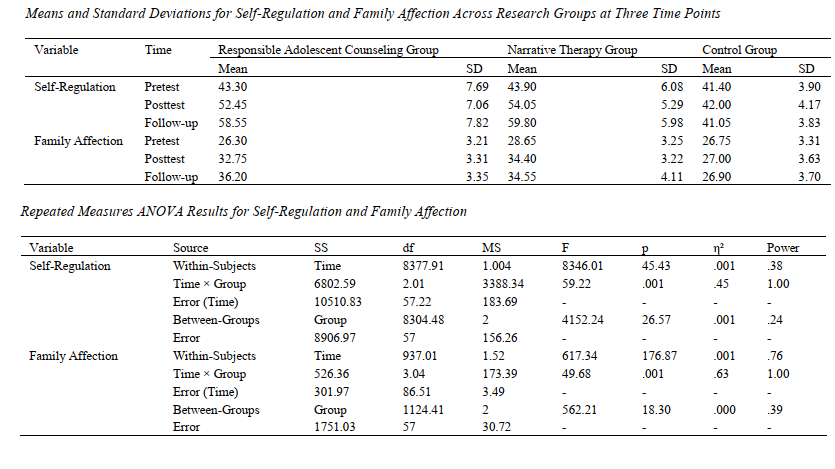
Findings: The results indicated significant improvements in both self-regulation and family affection for the intervention groups compared to the control group across posttest and follow-up phases (p < .001). Although both intervention methods were effective, no statistically significant difference was observed between the two experimental groups. Time and group × time interaction effects were significant for both variables, with large effect sizes (η² ranging from .24 to .76), indicating that changes were both statistically and practically meaningful.
Conclusion: Both narrative therapy and responsible adolescent psychoeducation are effective interventions for enhancing self-regulation and family affection in adolescents. Given their comparable efficacy, implementation may be based on context, accessibility, and practitioner training. These findings support the use of integrative and developmentally sensitive approaches in adolescent intervention programs.
Downloads
References
Baramake, Z., Fadavi, M., & Yousefi, Z. (2024). Comparison of the Effectiveness of the Successful Intelligence Training Package Focused on Risky Behaviors with the Executive Functioning Improvement Package on the Inclination to Risky Behavior and Family Affinity among Female Middle School Students Engaged in Risky Behaviors. Health Nexus, 2(1), 78-88. https://doi.org/10.61838/kman.hn.2.1.9
Combs, G., & Freedman, J. (2012). Narrative, poststructuralism, and social justice: Current practices in narrative therapy. The counseling psychologist, 40(7), 1033-1060. https://doi.org/10.1177/0011000012460662
Dafeian, F., & Yousefi, Z. (2024). The Effectiveness of Narrative Therapy on Meta-Emotion and Reflective Functioning Among Adolescent Girls in Isfahan. Journal of Sabzevar University of Medical Sciences, 31(2), 146-157. https://www.magiran.com/paper/2732857/the-effectiveness-of-narrative-therapy-on-meta-emotion-and-reflective-functioning-among-adolescent-girls-in-isfahan?lang=en
Eccles, J. S., Midgley, C., Wigfield, A., Buchanan, C. M., Reuman, D., Flanagan, C., & Mac Iver, D. (1993). Development during adolescence: The impact of stage-environment fit on young adolescents' experiences in schools and in families. In Adolescents and Their Families (Vol. 48, pp. 90). https://doi.org/10.1037/0003-066X.48.2.90
Fahimi, N., Kiamarthi, A., Kazemi, R., & Narimani, M. (2020). Comparison of the effectiveness of mindfulness training and emotion regulation along with diet on psychological flexibility and self-regulatory behavior of overweight adolescents. medical journal of mashhad university of medical sciences, 63(4), 2563-2574. https://mjms.mums.ac.ir/article_17830.html?lang=en
Fakhari Nejad, S., Mojtabaei, M., & Mirhashemi, M. (2021). Structural Comparison of the effectiveness of yoga training with emotion regulation training on students' self-management and active memory. Journal of Analitical-Cognitive Psychology, 12(45), 81-95. https://www.magiran.com/paper/2354293/structural-comparison-of-the-effectiveness-of-yoga-training-with-emotion-regulation-training-on-students-self-management-and-active-memory?lang=en
Fomina, T., Burmistrova-Savenkova, A., & Morosanova, V. (2020). Self-regulation and psychological well-being in early adolescence: A two-wave longitudinal study. Behavioral Sciences, 10(3), 67. https://doi.org/10.3390/bs10030067
Hadian, M., & Manavipour, D. (2022). The effectiveness of emotion model based on Dovanlo's psychodynamics on self-regulation and academic achievement. Applied Family Therapy, 3(2), 567-585. https://doi.org/10.61838/kman.aftj.3.2.30
Haefner, J. (2014). An Application of Bowen Family Systems Theory. Issues in Mental Health Nursing, 35(11), 835-841. https://doi.org/10.3109/01612840.2014.921257
Huang, C., Li, C., Zhao, F., Zhu, J., Wang, S., Yang, J., & Sun, G. (2023). Parental, teacher and peer effects on the social behaviors of Chinese adolescents: A structural equation modeling analysis. Brain Sciences, 13(2), 191. https://doi.org/10.3390/brainsci13020191
Inzlicht, M., Werner, K. M., Briskin, J. L., & Roberts, B. W. (2021). Integrating models of self-regulation. Annual review of psychology, 72, 319-345. https://doi.org/10.1146/annurev-psych-061020-105721
Karimi, A., Yousefi, Z., & Turkan, H. (2022). Compilation of the Psychological Enrichment Training Package for Soldiers and Comparing its Effectiveness with Psychotherapy Based on Improving Executive Function on Improving Emotional-Social Skills and Family Friendship of Soldiers: A Mixed Method Study. Military Caring Sciences, 9(4), 344-356. https://mcs.ajaums.ac.ir/article-1-595-en.html
Lyons, B. (2010). Dying to be responsible: adolescence, autonomy and responsibility. Legal Studies, 30(2), 257-278. https://doi.org/10.1111/j.1748-121X.2010.00153.x
Madigan, S., Ly, A., Rash, C. L., Van Ouytsel, J., & Temple, J. R. (2018). Prevalence of multiple forms of sexting behavior among youth: A systematic review and meta-analysis. JAMA Pediatrics, 172(4), 327-335. https://doi.org/10.1001/jamapediatrics.2017.5314
Mahmoodzadeh, A., Yousefi, Z., & Golparvar, M. (2019). Developing Family Sustainability Pattern Based on Islamic teachings in Ayatollah Khamenei's Thought. The Woman and Families Cultural-Educational, 14(46), 7-39. https://cwfs.ihu.ac.ir/article_204574.html?lang=en
McNeil, J., & Helwig, C. C. (2015). Balancing social responsibility and personal autonomy: adolescents' reasoning about community service programs. The Journal of Genetic Psychology, 176(6), 349-368. https://doi.org/10.1080/00221325.2015.1077189
Mergler, A., & Patton, W. (2007). Adolescents talking about personal responsibility. The Journal of Student Wellbeing, 1(1), 57-70. https://doi.org/10.21913/JSW.v1i1.113
Mergler, A., & Shield, P. (2016). Development of the Personal Responsibility Scale for adolescents. Journal of adolescence, 51(1), 50-57. https://doi.org/10.1016/j.adolescence.2016.05.011
Mirzakhanloo, H. R., Yousefi, Z., & Manshaei, G. R. (2024). Development of an Adolescent Responsibility Improvement Package. Psychological Dynamics in Mood Disorders, 3(1), 74-85. https://doi.org/10.61838/kman.pdmd.3.1.7
Moilanen, T. (2007). The Adolescent Self-Regulatory Inventory: The Development and Validation of a Questionnaire of Short-Term and Long-Term Self-Regulation. Journal of youth and adolescence, 36, 835-848. https://doi.org/10.1007/s10964-006-9107-9
Osareh, N., Pirani, Z., & ZanganehMolagh, F. (2024). Evaluating the effectiveness of cognitive self-compassion and emotion regulation training on motivational self-regulation and social and adaptive functioning of female students with anxiety. school psychology and institution, 13(1), 63-76. https://journal.uma.ac.ir/article_2907.html?lang=en
Saberi, R., & Taj Aldini Rabery, S. (2018). The effectiveness of academic self-regulation training on academic self-regulation and mindfulness. Research in Elementary Science Education, 1(1), 1-11. https://reek.cfu.ac.ir/article_905.html?lang=en
Steinberg, L., & Scott, E. S. (2003). Less guilty by reason of adolescence: developmental immaturity, diminished responsibility, and the juvenile death penalty. American psychologist, 58(12), 1009-1016. https://doi.org/10.1037/0003-066X.58.12.1009
Van der Graaff, J., Carlo, G., Crocetti, E., Koot, H. M., & Branje, S. (2018). Prosocial Behavior in Adolescence: Gender Differences in Development and Links with Empathy. J Youth Adolesc, 47(5), 1086-1099. https://doi.org/10.1007/s10964-017-0786-1
Yang, C., Chan, M. K., & Ma, T. L. (2020). School-wide social emotional learning (SEL) and bullying victimization: Moderating role of school climate in elementary, middle, and high schools. Journal of School Psychology, 82, 49-69. https://doi.org/10.1016/j.jsp.2020.08.002
Yekanizad, A., & Suleimannejad, A. (2023). The effectiveness of teaching problem solving skills on cognitive emotion regulation strategies and self-regulation of students. Educational Psychology Skills, 14(1), 70-84. https://www.magiran.com/paper/2638645/the-effectiveness-of-problem-solving-skills-training-on-cognitive-emotion-regulation-strategies-and-self-regulation?lang=en
Zielińska, A., Lebuda, I., Ivcevic, Z., & Karwowski, M. (2022). How adolescents develop and implement their ideas? On self-regulation of creative action. Thinking Skills and Creativity, 43, 100998. https://doi.org/10.1016/j.tsc.2022.100998
Zimmer‐Gembeck, M. J., & Collins, W. A. (2006). Autonomy development during adolescence. In Blackwell handbook of adolescence (pp. 174-204). Wiley. https://doi.org/10.1002/9780470756607.ch9
Zuhri, M. N. (2022). Cognitive psychology development in the early adolescence. Education on Social Issues, 2(1), 44-51. https://doi.org/10.26623/jesi.v2i1.40
Downloads
Additional Files
Publication Timeline
- Submitted
- Revised
- Accepted
Issue
Section
License
Copyright (c) 2025 Hamidreza Mirzakhnaloo (Author); Zahra Yousefi (Corresponding Author); Gholamreza Manshaee (Author)

This work is licensed under a Creative Commons Attribution-NonCommercial 4.0 International License.