The Mediating Role of Fear of Missing Out (FoMO) in the Relationship Between Social Media Engagement and Sleep Disturbance in Teenagers
DOI:
https://doi.org/10.61838/kman.jayps.6.6.13Keywords:
Social Media Engagement, Fear of Missing Out (FoMO), Sleep Disturbance, Adolescents, Mediation, Structural Equation Modeling, Digital BehaviorAbstract
Objective: This study aimed to investigate the mediating role of Fear of Missing Out (FoMO) in the relationship between social media engagement and sleep disturbance among adolescents in Bangladesh.
Methods and Materials: A descriptive correlational research design was employed, involving 450 high school students aged 13 to 18 years, selected based on the Morgan and Krejcie sampling table. Standardized questionnaires were used to assess social media engagement, FoMO, and sleep disturbance. The Pittsburgh Sleep Quality Index (PSQI), the Fear of Missing Out Scale (FoMOS), and the Social Media Engagement Questionnaire (SMEQ) served as the primary instruments. Data were analyzed using Pearson correlation coefficients in SPSS-27 and Structural Equation Modeling (SEM) in AMOS-21 to test direct and indirect relationships among the variables and to evaluate the model's goodness-of-fit.
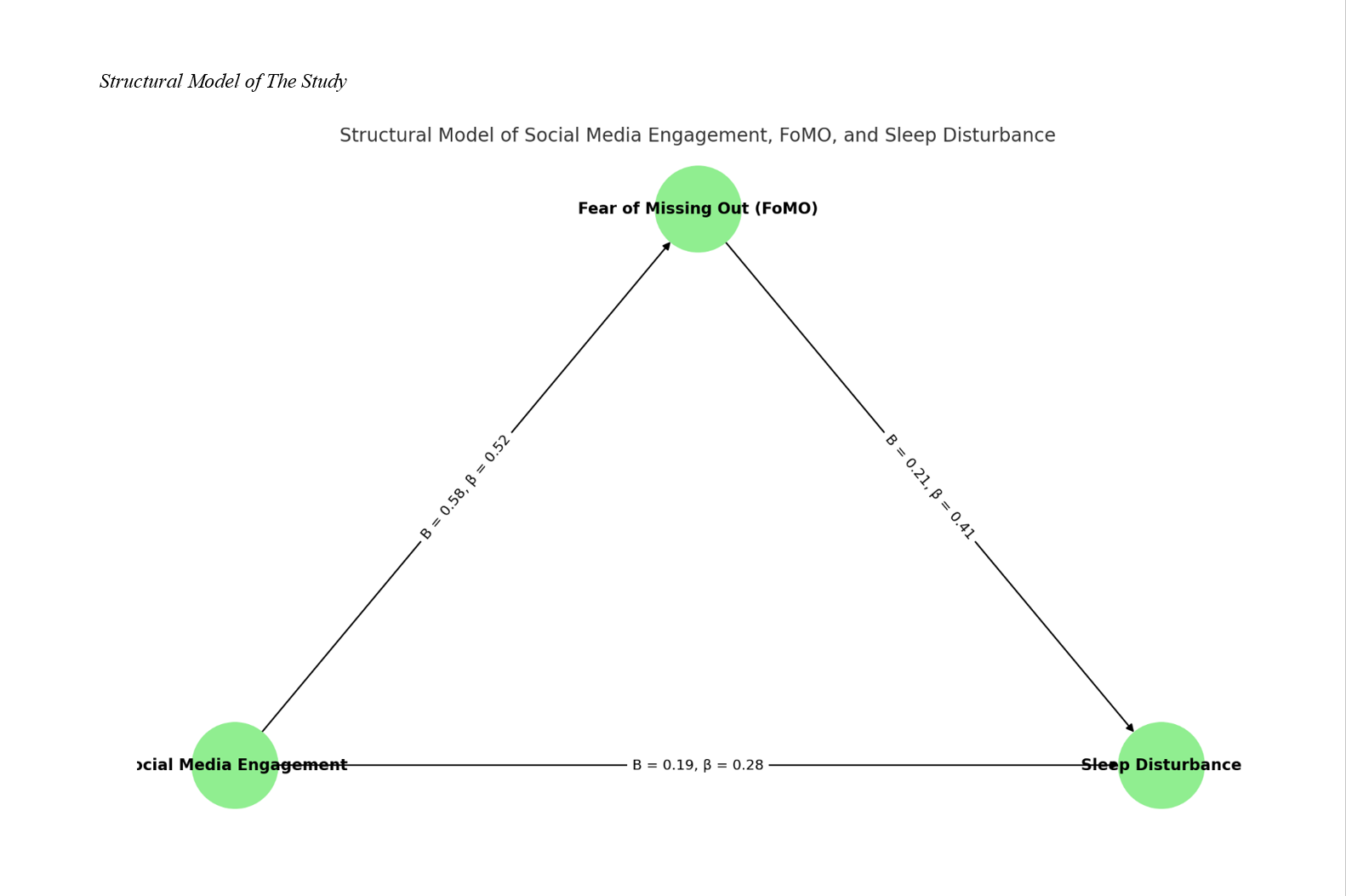
Findings: Results revealed that social media engagement was significantly and positively associated with FoMO (r = .52, p < .001) and sleep disturbance (r = .43, p < .001). Additionally, FoMO was strongly related to sleep disturbance (r = .49, p < .001). The SEM analysis confirmed that FoMO partially mediated the relationship between social media engagement and sleep disturbance. The structural model demonstrated good fit indices (χ²/df = 2.17, CFI = 0.97, RMSEA = 0.051). Direct, indirect, and total effects were all statistically significant, highlighting the psychological mechanism through which excessive social media use impacts adolescent sleep quality.
Conclusion: These findings underscore the need for interventions targeting digital habits and FoMO to promote healthier sleep among youth.
Downloads
References
Aldbyani, A. (2024). Mindfulness Associated With Less Fear of Missing Out: Social Media Addiction as a Mediator. https://doi.org/10.21203/rs.3.rs-3872015/v1
Anggrainy, N. E., Mansyur, Z., & Maddusa, S. S. (2024). Neuroticism, Fear of Missing Out, and Phubbing on Teenager Girls who Used Social Media. AL-MAIYYAH: Media Transformasi Gender dalam Paradigma Sosial Keagamaan, 16, 155-166. https://doi.org/10.35905/almaiyyah.v16i2.8709
Bayrami, R., Moghaddam tabrizi, F., Talebi, E., & Ebrahimi, S. (2019). A Survey On Relation Between Fear Of Missing Out And Social Media Use Among Students In Urmia University Of Medical Sciences. Nursing and Midwifery Journal, 17(5), 355-362. http://unmf.umsu.ac.ir/article-1-3796-fa.html
Bissell, K., & Chou, S. (2024). Living for the Likes: Social Media Use, Fear of Missing Out, and Body and Life Satisfaction in Women. Psychology of Popular Media, 13(3), 481-489. https://doi.org/10.1037/ppm0000507
Blackwell, D., Leaman, C., Tramposch, R., & Osborne, M. (2017). Extraversion, neuroticism, attachment style and fear of missing out as predictors of social media use and addiction. Personality and individual differences, 116, 69-72. https://doi.org/10.1016/j.paid.2017.04.039
Bright, L. F., & Logan, K. (2018). Is my fear of missing out (FOMO) causing fatigue? Advertising, social media fatigue, and the implications for consumers and brands. Internet Research, 28(5), 1213-1227. https://doi.org/10.1108/IntR-03-2017-0112
Chakrabarti, D. (2024). A Study on How Social Media FOMO (Fear of Missing Out) Impacts the Gen Z Audience. https://doi.org/10.54105/ijmcj.E1083.04010924
Chi, L. C., Tang, T. C., & Tang, E. (2022). The phubbing phenomenon: A cross-sectional study on the relationships among social media addiction, fear of missing out, personality traits, and phubbing behavior. Current Psychology, 41(2), 1112-1123. https://doi.org/10.1007/s12144-021-02468-y
ÇİFÇİ, S., & Kumcağız, H. (2023). The Relation Between Fear of Missing Out and Subjective Well-Being: The Mediating Role of Social Comparison and Loneliness. E-International Journal of Educational Research. https://doi.org/10.19160/e-ijer.1187412
Durak, H., & Seferoğlu, S. S. (2020). Antecedents of Social Media Usage Status: Examination of Predictiveness of Digital Literacy, Academic Performance, and Fear of Missing Out Variables. Social Science Quarterly, 101(3), 1056-1074. https://doi.org/10.1111/ssqu.12790
Elhai, J. D., Gallinari, E. F., Rozgonjuk, D., & Yang, H. (2020). Depression, anxiety and fear of missing out as correlates of social, non-social and problematic smartphone use. Addictive behaviors, 105, 106335. https://doi.org/10.1016/j.addbeh.2020.106335
Elhai, J. D., Levine, J. C., Dvorak, R. D., & Hall, B. J. (2016). Fear of missing out, need for touch, anxiety and depression are related to problematic smartphone use. Computers in human Behavior, 63, 509-516. https://doi.org/10.1016/j.chb.2016.05.079
Fabris, M. A., Marengo, D., Longobardi, C., & Settanni, M. (2020). Investigating the links between fear of missing out, social media addiction, and emotional symptoms in adolescence: The role of stress associated with neglect and negative reactions on social media. Addictive behaviors, 106, 106364. https://doi.org/10.1016/j.addbeh.2020.106364
Fioravanti, G., Casale, S., Benucci, S. B., Prostamo, A., Falone, A., Ricca, V., & Rotella, F. (2021). Fear of missing out and social networking sites use and abuse: A meta-analysis. Computers in human Behavior, 122, 106839. https://doi.org/10.1016/j.chb.2021.106839
Gao, B., Shen, Q., Luo, G., & Xu, Y. (2023). Why mobile social media-related fear of missing out promotes depressive symptoms? The roles of phubbing and social exclusion. BMC psychology, 11(1), 189. https://doi.org/10.1186/s40359-023-01231-1
Ibrahim, F. M. (2021). The Effect of Using Social Media on Job Satisfaction: Is There a Role for Job Engagement and Organization Engagement as a Mediator? Journal of Economics Finance and Management Studies, 04(07). https://doi.org/10.47191/jefms/v4-i7-26
Jia, Y., & Yan, H. (2023). The Mediating Effect of Self-Control Between College Students' Social Exclusion and Fear of Missing Out. 175-182. https://doi.org/10.2991/978-2-38476-158-6_24
Koç, H., Şimşir, Z., & Seki, T. (2023). The Relationships Between Self-Control and Distress Among Emerging Adults: A Serial Mediating Roles of Fear of Missing Out and Social Media Addiction. Emerging Adulthood, 11(3), 626-638. https://doi.org/10.1177/21676968231151776
Safdar Bajwa, R., Abdullah, H., Zaremohzzabieh, Z., Wan Jaafar, W. M., & Abu Samah, A. (2023). Smartphone addiction and phubbing behavior among university students: A moderated mediation model by fear of missing out, social comparison, and loneliness. Frontiers in psychology, 13, 1072551. https://doi.org/10.3389/fpsyg.2022.1072551
Shen, Y., Zhang, S., & Xin, T. (2020). Extrinsic Academic Motivation and Social Media Fatigue: Fear of Missing Out and Problematic Social Media Use as Mediators. Current Psychology, 41(10), 7125-7131. https://doi.org/10.1007/s12144-020-01219-9
Shi, J., Li, W., Han, C., Han, J., & Pan, F. (2022). Mediating Pathways of Neuroticism and Social Anxiety in the Relationship Between Childhood Trauma and the Fear of Missing Out Among Chinese College Students. Frontiers in Psychiatry, 13. https://doi.org/10.3389/fpsyt.2022.933281
Sommantico, M., Ramaglia, F., & Lacatena, M. (2023). Relationships Between Depression, Fear of Missing Out and Social Media Addiction: The Mediating Role of Self-Esteem. Healthcare, 11(12), 1667. https://doi.org/10.3390/healthcare11121667
Taj, S., Abbasi, P. N., & Khan, M. (2025). Impact of Phubbing Behavior on Loneliness: Mediated by Fear of Missing Out among Young Adults. ACADEMIA International Journal for Social Sciences, 4(1), 1119-1130. https://doi.org/10.63056/ACAD.004.01.0159
Türk, F., & Koçyiğit, B. (2025). The Relationship Between Fear of Missing Out and Loneliness Among Adolescents in the Digital Age: The Mediating Roles of Emotion Dysregulation and Social Media Addiction. Malaysian Online Journal of Educational Technology, 13(1), 19-36. https://doi.org/10.52380/mojet.2025.13.1.566
Villegas, H. D. T., Sayles, L. A. G., Fernan, C. A. C., Go, M. A., Pilayre-Contreras, L. M. Z., & Manaois, J. O. (2025). Navigating the Fear of Missing Out: A Narrative Analysis of Filipino Adolescents’ Experiences of Fear of Missing Out. Hum. Behav. Dev. Soc., 26(1), 91-102. https://doi.org/10.62370/hbds.v26i1.278202
Wolniewicz, C. A., Tiamiyu, M. F., Weeks, J. W., & Elhai, J. D. (2018). Problematic smartphone use and relations with negative affect, fear of missing out, and fear of negative and positive evaluation. Psychiatry research, 262, 618-623. https://doi.org/10.1016/j.psychres.2017.09.058
Yu, T., & Gen, Z. (2023). College Students' Social Media Addiction and Sleep Problems: Chain Mediating Effects of Fear of Missing Out and Nocturnal Social Media Use. Social Behavior and Personality an International Journal, 51(6), 1-9. https://doi.org/10.2224/sbp.12176
Downloads
Additional Files
Publication Timeline
- Submitted
- Revised
- Accepted
Issue
Section
License

This work is licensed under a Creative Commons Attribution-NonCommercial 4.0 International License.