Exploring the Impact of Spiritual Intelligence and Positive Affectivity on Academic Engagement in High School Students
DOI:
https://doi.org/10.61838/kman.jayps.6.6.8Keywords:
Academic engagement, Spiritual intelligence, Positive affectivity, High school students, Educational psychology.Abstract
Objective: This study aims to assess the predictive power of spiritual intelligence and positive affectivity on academic engagement among high school students. It explores how these psychological constructs influence students’ involvement and commitment to their learning experiences.
Methods and Materials: Employing a cross-sectional design, the study sampled 250 high school students from various grades and academic tracks. Participants completed standardized questionnaires measuring academic engagement (Utrecht Work Engagement Scale for Students), spiritual intelligence (King’s Interpersonal Spiritual Intelligence Scale), and positive affectivity (Positive and Negative Affect Schedule). Data were analyzed using SPSS version 27 to perform multiple linear regression analyses, adjusting for potential confounders such as age and gender.
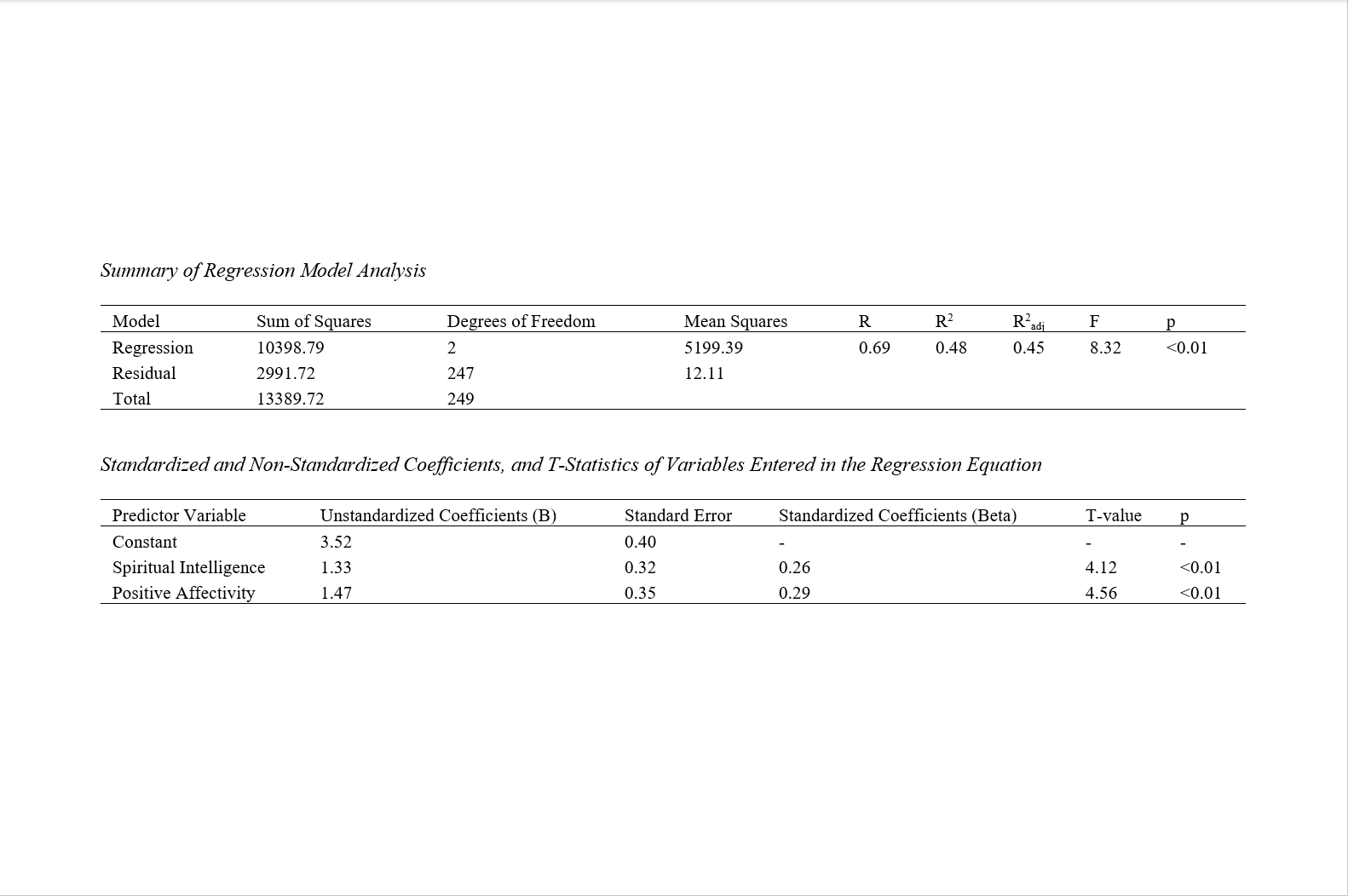
Findings: Results revealed that both spiritual intelligence (β = 0.26, p < 0.01) and positive affectivity (β = 0.29, p < 0.01) significantly predicted academic engagement, accounting for 48% of the variance (R² = 0.48, adjusted R² = 0.45). These findings indicate a substantial relationship between the psychological constructs of spiritual intelligence and positive affectivity and the level of academic engagement among high school students.
Conclusion: The study underscores the significance of spiritual intelligence and positive affectivity in enhancing academic engagement. It suggests that educational strategies aimed at nurturing these qualities may foster deeper involvement and commitment to learning among high school students. These findings contribute to the broader discourse on academic engagement, highlighting the need for a holistic approach that considers students' psychological well-being alongside academic achievement
Downloads
References
Adebayo, O. W., Salerno, J. P., Francillon, V., & Williams, J. R. (2018). A Systematic Review of Components of Community-Based Organisation Engagement. Health & Social Care in the Community. https://doi.org/10.1111/hsc.12533
Aliabadi, P. K., Zazoly, A. Z., Sohrab, M., Neyestani, F., Nazari, N., Mousavi, S., Fallah, A., Youneszadeh, M., Ghasemiyan, M., & Ferdowsi, M. (2021). The Role of Spiritual Intelligence in Predicting the Empathy Levels of Nurses With COVID-19 Patients. Archives of Psychiatric Nursing. https://doi.org/10.1016/j.apnu.2021.10.007
Anwar, S., & Rana, H. (2023). Spiritual Intelligence and Psychological Wellbeing of Pakistani University Students. Current Psychology. https://doi.org/10.1007/s12144-023-04717-8
Chen, H., & Zhang, M. H. (2022). The Relationship Between Basic Psychological Needs Satisfaction and University Students’ Academic Engagement: The Mediating Effect of Emotional Intelligence. Frontiers in psychology. https://doi.org/10.3389/fpsyg.2022.917578
Fredricks, J. A., Blumenfeld, P. C., & Paris, A. H. (2004). School Engagement: Potential of the Concept, State of the Evidence. Review of Educational Research. https://doi.org/10.3102/00346543074001059
Jenaabadi, H., & Noora, S. (2022). Relationship Between Spiritual Intelligence and Academic Engagement: Mediating Role of Academic Conscience. Iranian Evolutionary Educational Psychology Journal. https://doi.org/10.52547/ieepj.4.1.1
Nagy, R. P., Martin, A. J., & Collie, R. J. (2022). Disentangling Motivation and Engagement: Exploring the Role of Effort in Promoting Greater Conceptual and Methodological Clarity. Frontiers in psychology. https://doi.org/10.3389/fpsyg.2022.1045717
Pincus, J. D. (2022). Employee Engagement as Human Motivation: Implications for Theory, Methods, and Practice. Integrative Psychological and Behavioral Science. https://doi.org/10.1007/s12124-022-09737-w
Pintrich, P. R., & Groot, E. V. D. (1990). Motivational and Self-Regulated Learning Components of Classroom Academic Performance. Journal of Educational Psychology. https://doi.org/10.1037/0022-0663.82.1.33
Downloads
Additional Files
Publication Timeline
- Submitted
- Revised
- Accepted
Issue
Section
License
Copyright (c) 2025 Fereshteh Shafiee (Author); Seyed Ali Darbani (Corresponding Author); Alireza Yousefi, Mahdis Fatemi (Author)

This work is licensed under a Creative Commons Attribution-NonCommercial 4.0 International License.