Loss Experience and Emotional Maturity: The Mediating Role of Reflective Functioning
DOI:
https://doi.org/10.61838/kman.jayps.6.4.18Keywords:
Loss experience, Reflective functioning, Emotional maturity, AdolescentsAbstract
Objective: This study aimed to examine the mediating role of reflective functioning in the relationship between loss experience and emotional maturity among adolescents.
Methods and Materials: This descriptive correlational study was conducted with a sample of 390 high school students aged 15 to 18 from various regions of Greece, selected using multistage cluster sampling based on the Krejcie and Morgan sample size table. Participants completed the Core Bereavement Items (CBI) to measure loss experience, the Reflective Functioning Questionnaire (RFQ-8), and the Emotional Maturity Scale (EMS). Data analysis included Pearson correlation using SPSS version 27 and Structural Equation Modeling (SEM) using AMOS version 21. Model fit was evaluated using multiple indices including Chi-square, GFI, AGFI, CFI, RMSEA, and TLI.
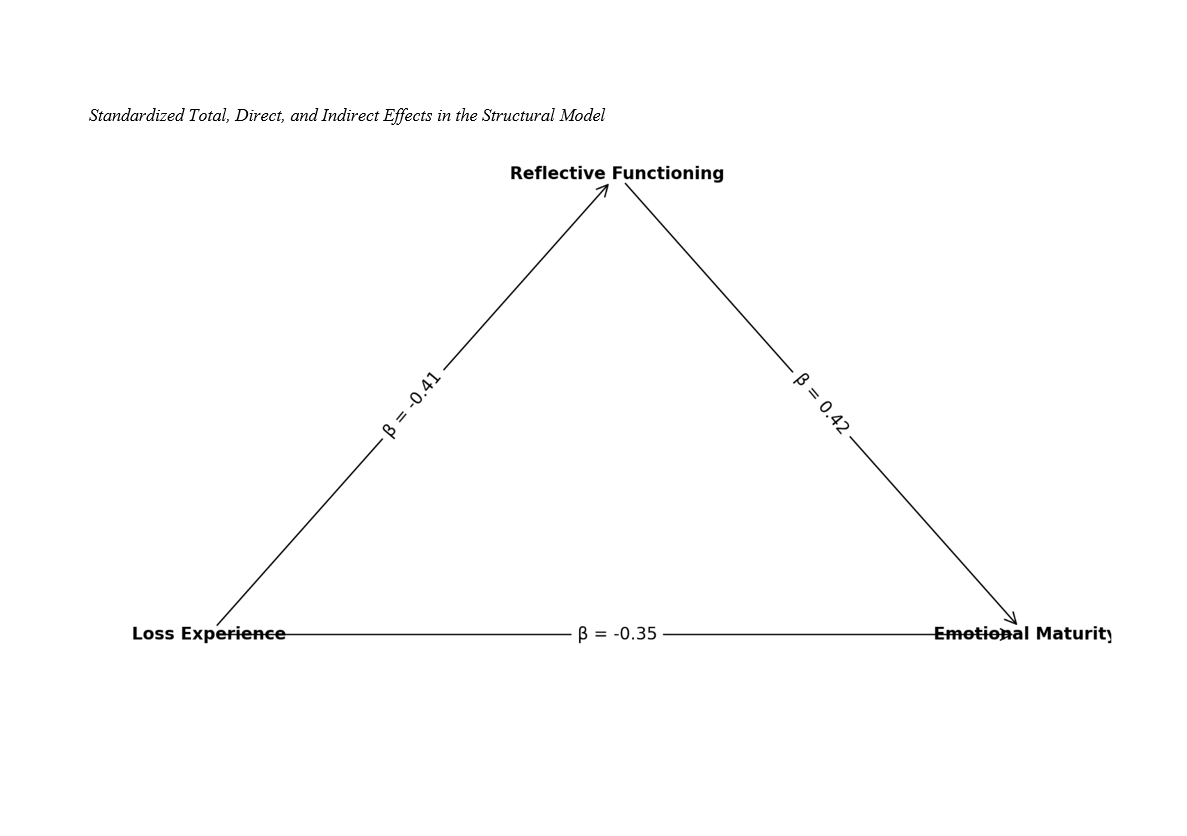
Findings: Results revealed significant negative correlations between loss experience and both reflective functioning (r = –.41, p < .001) and emotional maturity (r = –.47, p < .001). Reflective functioning was positively correlated with emotional maturity (r = .53, p < .001). SEM findings indicated that the structural model had acceptable fit (χ² = 124.65, df = 48, χ²/df = 2.60, GFI = 0.95, AGFI = 0.92, CFI = 0.96, RMSEA = 0.064, TLI = 0.95). Direct effects were significant from loss experience to reflective functioning (β = –0.41, p < .001) and to emotional maturity (β = –0.35, p < .001), and from reflective functioning to emotional maturity (β = 0.42, p < .001). Reflective functioning partially mediated the relationship between loss experience and emotional maturity (indirect β = –0.17, p < .001).
Conclusion: Reflective functioning plays a significant mediating role in how adolescents emotionally mature following experiences of loss, suggesting that enhancing reflective abilities may be a viable intervention strategy to foster resilience and emotional growth during adolescence.
Downloads
References
Arora, S., & Bhatia, S. (2023). Addressing Grief and Bereavement in Covid-19 Pandemic. Illness, Crisis & Loss, 10541373221145536. https://doi.org/10.1177/10541373221145536
Borelli, J. L., Stern, J., Marvin, M., Smiley, P. A., Pettit, C., & Samudio, M. (2021). Reflective Functioning and Empathy Among Mothers of School-Aged Children: Charting the Space Between. Emotion, 21(4), 783-800. https://doi.org/10.1037/emo0000747
Buckley, A., Dodd, A., & Guerin, S. (2024). Grief and bereavement in the time of COVID-19: a thematic analysis exploring psychotherapists’ observations of clients’ experiences. Counselling Psychology Quarterly, 37(1), 93-111. https://doi.org/10.1080/09515070.2023.2186834
Chen, X., McCormick, E. M., Ravindran, N., McElwain, N. L., & Telzer, E. H. (2020). Maternal Emotion Socialization in Early Childhood Predicts Adolescents’ Amygdala-vmPFC Functional Connectivity to Emotion Faces. Developmental Psychology, 56(3), 503-515. https://doi.org/10.1037/dev0000852
D’Aurizio, G., Tempesta, D., Saporito, G., Pistoia, F., Socci, V., Mandolesi, L., & Curcio, G. (2022). Can Stimulus Valence Modulate Task-Switching Ability? A Pilot Study on Primary School Children. International journal of environmental research and public health, 19(11), 6409. https://doi.org/10.3390/ijerph19116409
Davis, M. M., Miernicki, M. E., Telzer, E. H., & Rudolph, K. D. (2018). The Contribution of Childhood Negative Emotionality and Cognitive Control to Anxiety-Linked Neural Dysregulation of Emotion in Adolescence. Journal of abnormal child psychology, 47(3), 515-527. https://doi.org/10.1007/s10802-018-0456-0
Fetti, D. F., & Albulescu, I. (2024). Degree of Manifestation of Emotional Style Dimensions in Primary School Teachers. Educatia 21(27), 130-140. https://doi.org/10.24193/ed21.2024.27.13
Hidayat, M. Y., & Andaryuni, L. (2023). Emotional Maturity in Building Household Harmony From the Perspective of Maqashid Syariah. Jurnal Al-Qadau Peradilan Dan Hukum Keluarga Islam, 10(2), 190-203. https://doi.org/10.24252/al-qadau.v10i2.44348
Kabenova, O., Šiugždaitė, R., & Kustubayeva, A. (2024). Age-Related Features of Structural MRI of the Brain and Methods for Their Quantification. Bulletin of the L N Gumilyov Eurasian National University Bioscience Series, 146(1), 103-113. https://doi.org/10.32523/2616-7034-2024-146-1-103-113
Kakolian, S., Mashayekh, M., Davaei, M., & Khosravi Babadi, A. A. (2024). Modeling marital satisfaction based on marital expectations, emotional maturity, and aspects of love with the mediation of marital conflicts of married women. Shenakht Journal of Psychology and Psychiatry, 11(3), 1-5. https://doi.org/10.32598/shenakht.11.3.1
Karimi Farsani, A., & Bahramipour Isfahani, M. (2023). The Effectiveness of Mentalization based Treatment for Children (MBT-C) on Parental Reflective Functioning of Divorced Parents with Children Aged Five to Twelve. Journal of Pediatric Nursing, 9(4), 32-43. https://jpen.ir/browse.php?a_id=679&slc_lang=en&sid=1&printcase=1&hbnr=1&hmb=1
Kartol, A. (2023). Reflections of Emotions on Daily Life: Functionality of Positive Emotions. Psikiyatride Guncel Yaklasimlar - Current Approaches in Psychiatry, 15(3), 508-517. https://doi.org/10.18863/pgy.1172504
Khaimova, V. M. (2024). The Epistolary Dialogue Between M. Tsvetaeva and R.M. Rilke as a Mutual Emotional Impact and as a Creative Prehistory to M. Tsvetaeva’s Poem “Novogodnee”. Rsuh/Rggu Bulletin Literary Theory Linguistics Cultural Studies Series(12), 183-195. https://doi.org/10.28995/2686-7249-2024-12-183-195
Lazar, F. L. (2021). The Efforts to Develop Self-Control Skills to Become an Effective Person. Jurnal Pendidikan Dan Kebudayaan Missio, 13(2), 179-190. https://doi.org/10.36928/jpkm.v13i2.748
LosÎI, E. (2023). Maturizarea Emoțională a Preadolescenților Și Acceptarea Celorlalți. 123-131. https://doi.org/10.46727/c.01-02-12-2023.p123-131
Mansoori, J., Khodabakhshi-Koolaee, A., Falsafinejad, M. R., & Kashani Vahid, L. (2023). Bereavement for a Loved Person: A Look at the Opinions and Process of Coping With Grief in the COVID-19 Era. PCP, 11(3), 223-238. https://doi.org/10.32598/jpcp.11.3.746.4
Mohammadi, H., Naderi Nobandegani, Z., Asadi, S., & Sadeghiyeh, T. (2023). The mediating Role of Reflective Functioning Dimensions in the Relationship Between Parental Insecure Attachment Styles and Parenting Stress in Parents of Child with Attention Deficit-Hyperactivity Disorder. Psychology of Exceptional Individuals, 13(52), 1-30. https://jpe.atu.ac.ir/article_16936_en.html
Morningstar, M., Mattson, W. I., & Nelson, E. E. (2022). Longitudinal Change in Neural Response to Vocal Emotion in Adolescence. Social Cognitive and Affective Neuroscience, 17(10), 890-903. https://doi.org/10.1093/scan/nsac021
Musetti, A., Gagliardini, G., Lenzo, V., & Cella, S. (2023). From Childhood Emotional Maltreatment to Disordered Eating: A Path Analysis. Psychoanalytic Psychology, 40(2), 90-98. https://doi.org/10.1037/pap0000438
Nasution, I. K., Marini, L., & Dalimunthe, R. Y. (2018). Self-Compassion and Emotional Maturity of Street Children Assisted by KKSP Medan. https://doi.org/10.2991/icosop-17.2018.60
Nijssens, L., Vliegen, N., & Luyten, P. (2020). The Mediating Role of Parental Reflective Functioning in Child Social–emotional Development. Journal of Child and Family Studies, 29(8), 2342-2354. https://doi.org/10.1007/s10826-020-01767-5
Parsakia, K. (2023). The Impact of Emotional Maturity and Social Problem-Solving Abilities on Neurobehavioral Outcomes in Autistic Adolescents. Prien, 1(3), 35-41. https://doi.org/10.61838/kman.prien.1.3.6
Piven, М. (2019). Characteristics of Subjective Perception of Parental Attitudes by Persons With Different Levels of Emotional Maturity. Young Scientist, 10(74). https://doi.org/10.32839/2304-5809/2019-10-74-99
Setiawati, D., & Endrastuty, J. F. (2019). Emotional Maturity of Vocational School Students. https://doi.org/10.2991/icei-19.2019.83
Sharma, A., & Yadav, R. (2023). A Study of Transgenders in Relation to Perceived Stress, Loneliness, Quality of Life and Emotional Maturity. International Journal of Advanced Research, 11(12), 412-416. https://doi.org/10.21474/ijar01/18001
Siffredi, V., Liverani, M. C., Freitas, L. G. A., Tadros, D., Farouj, Y., Tolsa, C. B., Ville, D. V. D., Hüppi, P. S., & Leuchter, R. H. (2022a). Large-Scale Brain Network Dynamics in Very Preterm Children and Relationship With Socio-Emotional Outcomes: An Exploratory Study. Pediatric research, 93(7), 2072-2080. https://doi.org/10.1038/s41390-022-02342-y
Siffredi, V., Liverani, M. C., Freitas, L. G. A., Tadros, D., Farouj, Y., Tolsa, C. B., Ville, D. V. D., Hüppi, P. S., & Leuchter, R. H. (2022b). Large Scale Brain Network Dynamics in Very Preterm Children and Relationship With Socio-Emotional Outcomes. https://doi.org/10.1101/2022.03.18.22272505
Solobutina, M. (2022). Personal Development of Future Psychologists: Role of Reflection in Structure of Ego Identity. https://doi.org/10.3897/ap.5.e1611
Srivastava, N. S., & Goswami, S. (2025). A Study of Emotional Maturity and Professional Commitment of Teachers at Secondary Level. International Journal for Multidisciplinary Research, 7(1). https://doi.org/10.36948/ijfmr.2025.v07i01.37421
Tanzilli, A., Giuseppe, M. D., Giovanardi, G., Boldrini, T., Caviglia, G., Conversano, C., & Lingiardi, V. (2021). Mentalization, Attachment, and Defense Mechanisms: A Psychodynamic Diagnostic Manual-2-Oriented Empirical Investigation. Research in Psychotherapy Psychopathology Process and Outcome, 24(1). https://doi.org/10.4081/ripppo.2021.531
Testoni, I., Antonellini, M., Ronconi, L., Biancalani, G., & Neimeyer, R. A. (2022). Spirituality and Meaning-Making in Bereavement: The Role of Social Validation. Journal of Loss and Trauma, 27(4), 351-366. https://doi.org/10.1080/15325024.2021.1983304
Vilgis, V., Rhoads, S. A., Weissman, D. G., Gelardi, K. L., Forbes, E. E., Hipwell, A. E., Keenan, K., Hastings, P. D., & Guyer, A. E. (2019). Direct Replication of Task‐dependent Neural Activation Patterns During Sadness Introspection in Two Independent Adolescent Samples. Human Brain Mapping, 41(3), 739-754. https://doi.org/10.1002/hbm.24836
Wilhelm, I., Groch, S., Preiss, A., Walitza, S., & Huber, R. (2017). Widespread Reduction in Sleep Spindle Activity in Socially Anxious Children and Adolescents. Journal of psychiatric research, 88, 47-55. https://doi.org/10.1016/j.jpsychires.2016.12.018
Xie, S., Liu, J., Hu, Y., Liu, W., Ma, C., Jin, S., Zhang, L., Kang, Y., Ding, Y., Zhang, X., Hu, Z., Cheng, W., & Yang, Z. (2023). A Normative Model Of brain Responses to Social Scenarios Reflects the Maturity Of children And adolescents’ Social–emotional Abilities. Social Cognitive and Affective Neuroscience, 18(1). https://doi.org/10.1093/scan/nsad062
Zabrodina, O. V., & Ryazanova, M. I. (2024). Social Maturity and Thinking Flexibility as a Basis of Student Resilience. Vestnik Universiteta(4), 235-241. https://doi.org/10.26425/1816-4277-2024-4-235-241
Четверик-Бурчак, А. Г., & Матях, В. (2020). Features of Experiencing Guilt in People With Different Levels of Personal Maturity. Visnyk of v N Karazin Kharkiv National University a Series of Psychology(68). https://doi.org/10.26565/2225-7756-2020-68-03
Downloads
Additional Files
Publication Timeline
- Submitted
- Revised
- Accepted
Issue
Section
License

This work is licensed under a Creative Commons Attribution-NonCommercial 4.0 International License.