Parental Rejection and Emotional Reactivity: The Mediating Role of Self-Esteem
DOI:
https://doi.org/10.61838/kman.jayps.6.5.15Keywords:
Parental Rejection, Emotional Reactivity, Self-Esteem, AdolescentsAbstract
Objective: This study aimed to examine the relationship between perceived parental rejection and emotional reactivity among adolescents, with self-esteem as a potential mediating variable.
Methods and Materials: A descriptive correlational design was used, involving 600 adolescents aged 15 to 18 years from urban areas in China, selected through multi-stage cluster sampling based on the Morgan and Krejcie table. Standardized self-report instruments were employed: the Parental Acceptance-Rejection Questionnaire (PARQ), the Rosenberg Self-Esteem Scale (RSES), and the Emotional Reactivity Scale (ERS). Data analysis was conducted using SPSS-27 for descriptive and inferential statistics and AMOS-21 for Structural Equation Modeling (SEM). The assumptions of normality, linearity, multicollinearity, and homoscedasticity were tested and confirmed.
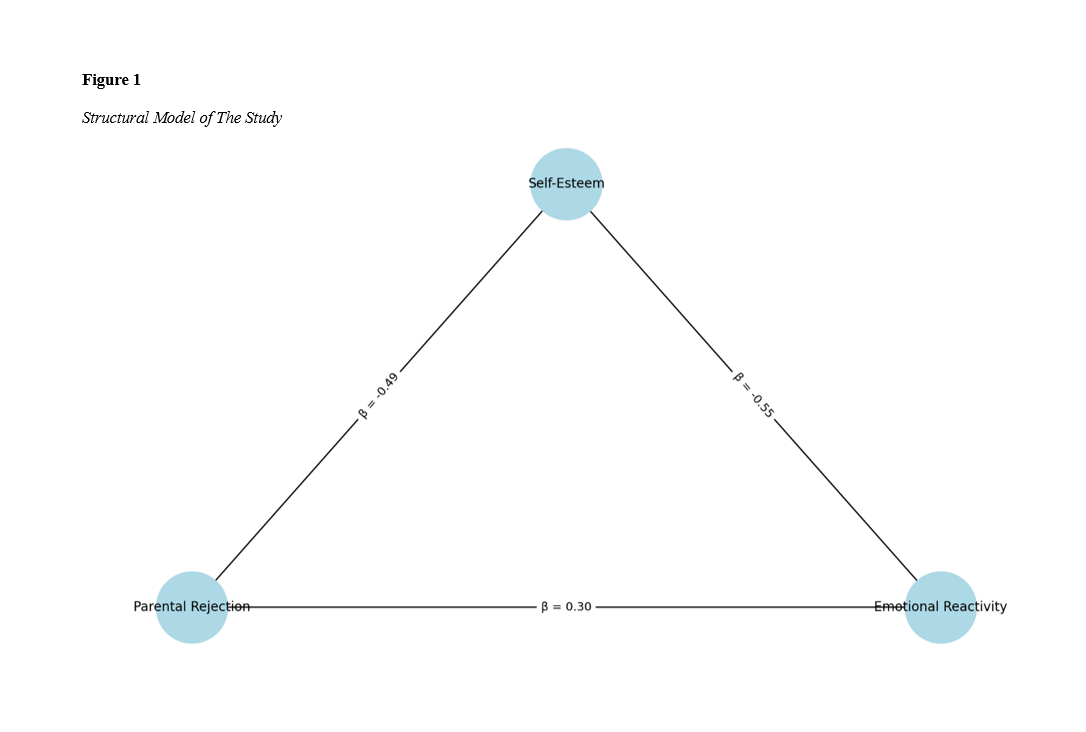
Findings: Pearson correlation analysis revealed significant relationships among the variables: parental rejection was positively correlated with emotional reactivity (r = .52, p < .001) and negatively with self-esteem (r = –.49, p < .001), while self-esteem was negatively correlated with emotional reactivity (r = –.55, p < .001). The SEM model showed acceptable fit indices (χ²/df = 2.53, GFI = 0.94, CFI = 0.96, RMSEA = 0.048). Path analysis indicated that parental rejection had a significant direct effect on self-esteem (β = –0.49, p < .001) and emotional reactivity (β = 0.30, p < .001). Self-esteem significantly predicted emotional reactivity (β = –0.55, p < .001), and a significant indirect effect of parental rejection on emotional reactivity through self-esteem was observed (β = 0.27, p < .001).
Conclusion: The findings support a partial mediation model, indicating that self-esteem serves as a significant mechanism through which parental rejection influences adolescents’ emotional reactivity. These results highlight the importance of promoting positive parental behaviors and enhancing adolescent self-esteem to reduce emotional vulnerability.
Downloads
References
Ali, S., Rohner, R. P., Britner, P. A., & Jahn, A. (2024). Longing for Belonging: Feeling Loved (Or Not) and Why It Matters. Family Relations, 73(4), 2639-2654. https://doi.org/10.1111/fare.13029
Bekaroğlu, E., & Yılmaz, T. (2023). How Perceptions of Parents’ Parenting Behaviors Pave the Way to Somatic Symptoms: The Mediating Role of Emotion Regulation Among Adults. Psychological Reports. https://doi.org/10.1177/00332941231191722
Gardner, A. A., & Zimmer‐Gembeck, M. J. (2018). Rejection Sensitivity and Responses to Rejection: Serial Mediators Linking Parenting to Adolescents and Young Adults’ Depression and Trait-Anxiety. Journal of Relationships Research, 9. https://doi.org/10.1017/jrr.2018.8
Gufeng, W., Sueb, R., Zulkifli, A. F., Hashim, H., & Changli, Y. (2024). The Influence of Parenting Styles on Mental Health Among Children in Henan Province, China. Malaysian Journal of Social Sciences and Humanities (MJSSH), 9(10), e003026. https://doi.org/10.47405/mjssh.v9i10.3026
Havewala, M., & Wang, C. (2021). Effects of Peer Victimization on Child Emotional and Behavioral Difficulties: The Moderating Role of Parenting. Journal of Child and Family Studies, 30(11), 2601-2615. https://doi.org/10.1007/s10826-021-02054-7
Jin, X. (2023). The Relationship Between Parenting Style of Parental Rejection and Cyberbullying in College Students: Two Moderating Models. BCP Education & Psychology, 10, 90-101. https://doi.org/10.54691/bcpep.v10i.5207
Kosson, D. S., Schraft, C. V., Brieman, C. L., McBride, C. K., & Knight, R. A. (2020). Parental Rejecting Behaviors: Validating a Behaviorally Based Youth-Report Measure of Parental Emotional Abuse. Assessment, 28(3), 899-917. https://doi.org/10.1177/1073191120918943
Mendo-Lázaro, S., Barco, B. L. d., María Isabel Polo del, R., Tosina, R. Y., & López-Ramos, V.-M. (2019). The Role of Parental Acceptance–Rejection in Emotional Instability During Adolescence. International journal of environmental research and public health, 16(7), 1194. https://doi.org/10.3390/ijerph16071194
Miller, A. B., Prinstein, M. J., Munier, E., Machlin, L., & Sheridan, M. A. (2019). Emotion Reactivity and Regulation in Adolescent Girls Following an Interpersonal Rejection. Journal of Cognitive Neuroscience, 31(2), 249-261. https://doi.org/10.1162/jocn_a_01351
Nurhafizah, Indriyani, T., & Zukhairina, Z. (2024). The Influence of Online Learning and Parental Involvement Towards Early Childhood Social Emotional Intelligence. Jurnal Dzurriyat Jurnal Pendidikan Islam Anak Usia Dini, 2(1), 38-48. https://doi.org/10.61104/jd.v2i1.35
Palmer, A. R., Foster, R., Distefano, R., & Masten, A. S. (2020). Emotional Reactivity and Parenting in Families Experiencing Homelessness. https://doi.org/10.31219/osf.io/3x29w
Palmer, A. R., Foster, R. A., Distefano, R., & Masten, A. S. (2022). Emotional Reactivity and Parenting in Families Experiencing Homelessness. Journal of Family Psychology, 36(4), 636-641. https://doi.org/10.1037/fam0000921
Phuttharo, P. (2025). Solution-Focused Therapy Program on Self-Esteem and Depression in Thai Older Adults With Major Depressive Disorder: A Quasi-Experimental Study. Prijnr, 29(2), 326-342. https://doi.org/10.60099/prijnr.2025.272331
Pourkhiyabi, M., Kafie, M., & Abolghasemi, A. (2024). The effectiveness of Internet-based cognitive-behavioral therapy on extreme responsibility and irritability of adolescent girls with symptoms of obsessive-compulsive disorder. Research in Clinical Psychology and Counseling, -. https://doi.org/10.22067/tpccp.2024.79513.1397
Razvaliaeva, A. Y., & Polskaya, N. A. (2023). The Relationship Between Interpersonal Sensitivity and Emotion Regulation in Youths. European Journal of Psychology Open, 82(4), 171-179. https://doi.org/10.1024/2673-8627/a000051
Reis, S., Huxley, E., Feng, B. E. Y., & Grenyer, B. F. S. (2021). Pathological Narcissism and Emotional Responses to Rejection: The Impact of Adult Attachment. Frontiers in psychology, 12. https://doi.org/10.3389/fpsyg.2021.679168
Sajid, B., & Shah, S. N. (2021). Perceived Parental Rejection and Psychological Maladjustment among Adolescents of Khyber Pakhtunkhwa, Pakistan. İlköğretim Online, 20(4). https://scholar.google.com/citations?user=ovkUZ94AAAAJ&hl=en
Shin, J., & Bae, S. M. (2023). Moderating Effects of Emotional Recognition Competency in Rejective Parenting and Adolescent Depression and Aggression. International journal of environmental research and public health, 20(18), 6775. https://doi.org/10.3390/ijerph20186775
Slagt, M., Dubas, J. S., Ellis, B. J., Marcel, A. G. v. A., & Deković, M. (2018). Linking Emotional Reactivity “For Better and for Worse” to Differential Susceptibility to Parenting Among Kindergartners. Development and Psychopathology, 31(02), 741-758. https://doi.org/10.1017/s0954579418000445
Tan, P. Z., Oppenheimer, C. W., Ladouceur, C. D., Butterfield, R. D., & Silk, J. S. (2020). A Review of Associations Between Parental Emotion Socialization Behaviors and the Neural Substrates of Emotional Reactivity and Regulation in Youth. Developmental Psychology, 56(3), 516-527. https://doi.org/10.1037/dev0000893
Ttofa, J., & Greenhouse, P. (2022). Emotional Reactivity and Emotional Flashbacks. 16-17. https://doi.org/10.4324/9781003121411-7
Vandewalle, J., Mabbe, E., Debeuf, T., Braet, C., & Moens, E. (2017). The Daily Relation Between Parental Rejection and Emotional Eating in Youngsters: A Diary Study. Frontiers in psychology, 8. https://doi.org/10.3389/fpsyg.2017.00691
Westermann, N., Busching, R., Klein, A. M., & Warschburger, P. (2023). The Longitudinal Interplay Between Adverse Peer Experiences and Self-Regulation Facets: A Prospective Analysis During Middle Childhood. Research on Child and Adolescent Psychopathology, 52(2), 293-308. https://doi.org/10.1007/s10802-023-01117-1
Wulandari, A. N. (2025). Self-Esteem as a Moderator of the Influence of Peer Pressure on Adolescent Aggression. Psychological-Educational Studies, 17(1), 53-63. https://doi.org/10.17759/psyedu.2025170104
Yuan, X. (2023). The Correlation Between Parenting Styles and Chinese College Students' Attitudes Toward Seeking Professional Psychological Help. Journal of Education Humanities and Social Sciences, 24, 177-182. https://doi.org/10.54097/8pqwm550
Zeng, Q., Yang, Z., Xiao, T., Luo, H., & Chen, P. (2025). Different Parental Rearing Behaviors and Depressive Symptoms of Adolescents: Roles of Psychological Insecurity and Core Self-Evaluations. School Psychology International, 46(2), 172-196. https://doi.org/10.1177/01430343241308554
Zheng, Y., Zhou, Y., & Zou, L. (2022). The Effect of Parenting Styles on Adolescent Students’ Learning Initiative. https://doi.org/10.2991/assehr.k.220704.208
Голубева, Е., & Истратова, О. Н. (2018). Emotional Rejection of the Child by Parents: Causes and Consequences. https://doi.org/10.12737/monography_5a86bca813bdb1.50609827
Downloads
Additional Files
Publication Timeline
- Submitted
- Revised
- Accepted
Issue
Section
License

This work is licensed under a Creative Commons Attribution-NonCommercial 4.0 International License.