Cultural Insecurity and Social Anxiety: The Mediating Role of Identity Uncertainty
DOI:
https://doi.org/10.61838/kman.jayps.6.2.17Keywords:
Cultural insecurity, Identity uncertainty, Social anxietyAbstract
Objective: This study aimed to examine the mediating role of identity uncertainty in the relationship between cultural insecurity and social anxiety among adults in the United States.
Methods and Materials: The study employed a descriptive correlational design and included 430 adult participants from the United States, selected based on the Morgan and Krejcie sample size table. Standardized tools were used to assess cultural insecurity, identity uncertainty, and social anxiety. Data were analyzed using Pearson correlation in SPSS-27 and structural equation modeling (SEM) in AMOS-21 to test both direct and indirect relationships between variables and evaluate the model fit.
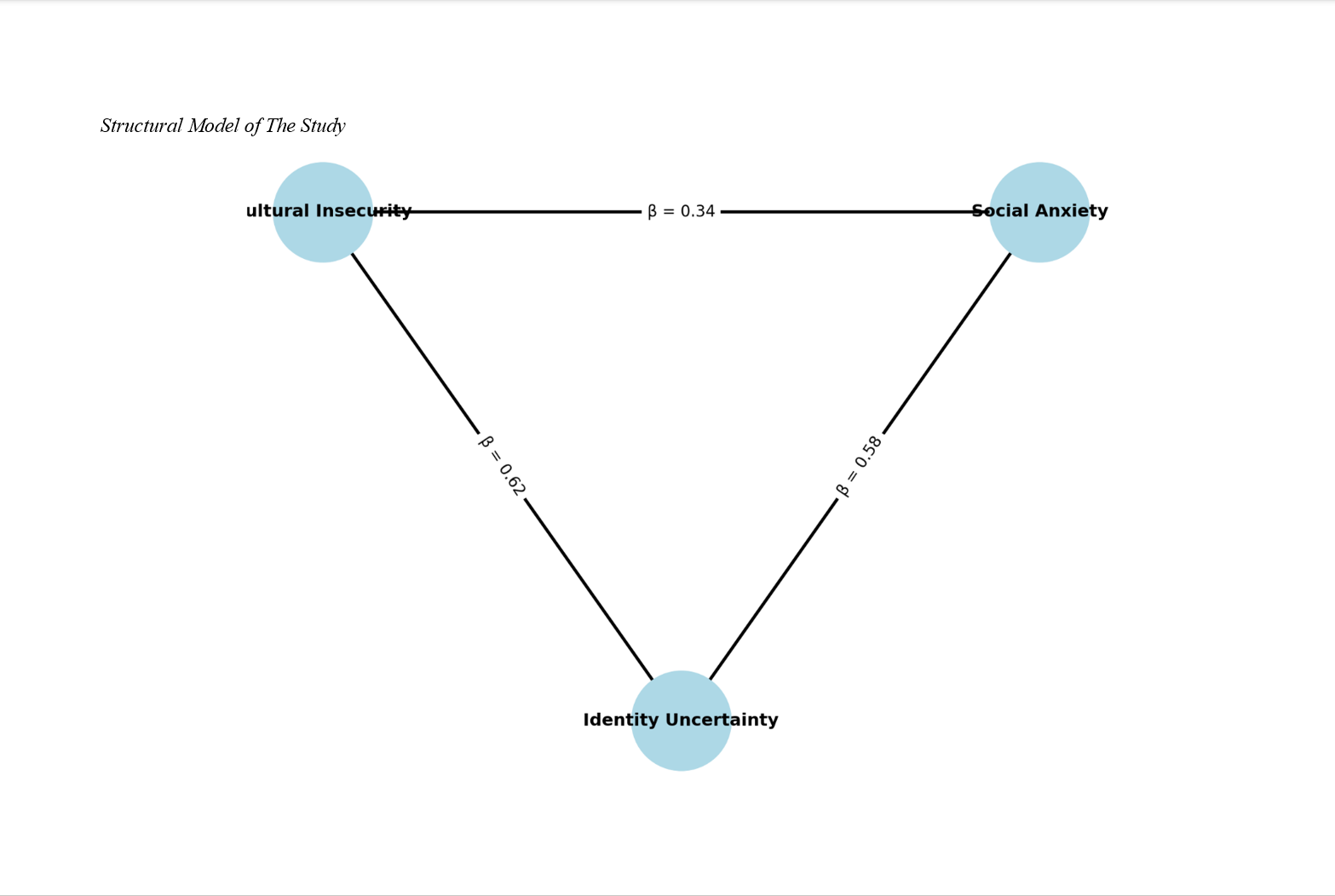
Findings: The results showed significant positive correlations among cultural insecurity, identity uncertainty, and social anxiety (r = .53 to .62, p < .001). Structural equation modeling confirmed that identity uncertainty significantly mediated the relationship between cultural insecurity and social anxiety. The model demonstrated good fit indices (χ² = 134.28, df = 74, χ²/df = 1.81, RMSEA = 0.043, CFI = 0.97, TLI = 0.95). The total effect of cultural insecurity on social anxiety was strong and significant (β = .70, p < .001), with both direct (β = .34, p < .001) and indirect effects via identity uncertainty (β = .36, p < .001) contributing to this relationship.
Conclusion: The findings highlight the psychological pathway through which cultural insecurity leads to social anxiety by increasing individuals' identity uncertainty. This underscores the importance of addressing identity-related stress in interventions aimed at reducing social anxiety, especially in culturally diverse and shifting environments. Efforts to promote cultural inclusion and strengthen identity coherence may serve as protective factors against social withdrawal and emotional distress.
Downloads
References
Azizah, S., Supeno, S., & Muharlisiani, L. T. (2022). The Impacts of E-Learning Psychologically Towards Teachers (A Literature Review). International Journal of Multidisciplinary Research and Literature, 1(3), 253-258. https://doi.org/10.53067/ijomral.v1i3.26
Belavadi, S., Gardikiotis, A., & Hogg, M. A. (2023). Social Identity Uncertainty During the Greek Financial Crisis: The Role of Media Narratives. Psychology of Language and Communication. https://doi.org/10.58734/plc-2023-0005
Burke, P. J. (2020). Identity Dispersion: Flexibility, Uncertainty, or Inconsistency? , 89-117. https://doi.org/10.1007/978-3-030-41231-9_4
Duell, D. (2022). Shared Social Identity and Strategic Uncertainty. https://doi.org/10.17605/osf.io/pkzhr
Dyar, C., Feinstein, B. A., Schick, V., & Davila, J. (2017). Minority Stress, Sexual Identity Uncertainty, and Partner Gender Decision Making Among Nonmonosexual Individuals. Psychology of Sexual Orientation and Gender Diversity, 4(1), 87-104. https://doi.org/10.1037/sgd0000213
Frost, J. (2019). Certainty, Uncertainty, or Indifference? Examining Variation in the Identity Narratives of Nonreligious Americans. American Sociological Review, 84(5), 828-850. https://doi.org/10.1177/0003122419871957
Hogg, M. A. (2022). Self-Uncertainty and Social Identity Processes in Organizations. https://doi.org/10.1093/oxfordhb/9780197501061.013.8
Hogg, M. A. (2023). Walls Between Groups: Self‐uncertainty, Social Identity, and Intergroup Leadership. Journal of Social Issues, 79(2), 825-840. https://doi.org/10.1111/josi.12584
Jung, J., Hogg, M. A., Livingstone, A., & Choi, H. S. (2019). From Uncertain Boundaries to Uncertain Identity: Effects of Entitativity Threat on Identity–uncertainty and Emigration. Journal of Applied Social Psychology, 49(10), 623-633. https://doi.org/10.1111/jasp.12622
Karolinsky, L. (2019). Social Anxiety in Children: Exploring Insecure Attachment and Parental Behaviors in the Constellation of Societal and Cultural Moderators. Social Research Reports, 11(2), 49-60. https://doi.org/10.33788/srr11.2.4
Krismanti, N. (2021). Students’ Academic Identities in Time of Uncertainties. https://doi.org/10.2991/assehr.k.211021.019
Leifer, M. (2023). Uncertainty From the Aharonov–Vaidman Identity. Quantum Studies Mathematics and Foundations, 10(3), 373-397. https://doi.org/10.1007/s40509-023-00301-8
Marcrum, J. (2024). Exploring Cultural Identity through Education and Acculturation. Academic Press. https://www.frontiersin.org/journals/education/articles/10.3389/feduc.2024.1338671/full
Milesi, P. (2022). Identity Leadership, Procedural Justice, and Group Identification in Uncertain Organizational Contexts. Journal of Applied Social Psychology, 52(9), 886-911. https://doi.org/10.1111/jasp.12897
Nawaz, Z. J., & Bhutta, D. M. H. (2024). Usage of Social Media and Cultural Identity in Chitral: An Exploration Through Mix-Method Approach. CRSSS, 2(2), 51-65. https://doi.org/10.59075/wsyr1071
Qi, X., Pei, Y., Li, G., Liu, Y., Tang, W., Hall, B. J., & Wu, B. (2024). The Mitigating Role of Social Capital on the Association Between Food Insecurity and Psychological Distress Among Chinese Adults. International Journal of Social Psychiatry, 70(8), 1542-1551. https://doi.org/10.1177/00207640241277152
Rahmayanty, D., Lubis, M. A., Mahardika, R., Pitria, P., Mulyani, M. R., Lizia, A., & Sadewa, R. D. (2024). Factors That Cause Insecurity in College Students When Viewing Tiktok Content. International Research-Based Education Journal, 6(2), 161. https://doi.org/10.17977/um043v6i2p161-170
Rozina, I. V., Маланюк, Н., Kalyniuk, A., Потапюк, Л., & Tsumarieva, N. (2024). Tolerance to Uncertainty as a Factor in the Development of Higher Education Students’ Professional Identity. Sapienza International Journal of Interdisciplinary Studies, 5(4), e24080. https://doi.org/10.51798/sijis.v5i4.881
Samuolis, J., & Griffin, K. W. (2014). Identity Distress and Negative Affect in College Students. Identity, 14(4), 246-254. https://doi.org/10.1080/15283488.2014.944694
Sriwenda, D. (2025). Impact of Parent’s Communication on Adolescent Social Anxiety. Ijorer International Journal of Recent Educational Research, 6(2), 398-409. https://doi.org/10.46245/ijorer.v6i2.788
Thelma, C. C., & Madoda, D. (2024). Exploring the relationship between cultural identity and educational equity: A Zambian analysis. https://ijrpr.com/uploads/V5ISSUE5/IJRPR28751.pdf
Wagoner, J. A., Antonini, M., Hogg, M. A., Barbieri, B., & Talamo, A. (2018). Identity‐centrality, Dimensions of Uncertainty, and Pursuit of Subgroup Autonomy: The Case of Sardinia Within Italy. Journal of Applied Social Psychology, 48(10), 582-589. https://doi.org/10.1111/jasp.12549
Wagoner, J. A., & Chur, M. (2024). Domains of Uncertainty, Identification Processes, and Exit Intentions. Group Processes & Intergroup Relations, 27(7), 1541-1568. https://doi.org/10.1177/13684302231215043
Wagoner, J. A., & Hogg, M. A. (2016). Normative Dissensus, Identity-Uncertainty, and Subgroup Autonomy. Group Dynamics Theory Research and Practice, 20(4), 310-322. https://doi.org/10.1037/gdn0000057
Wang, M., Wu, X., & Wang, J. (2019). Paternal and Maternal Harsh Parenting and Chinese Adolescents’ Social Anxiety: The Different Mediating Roles of Attachment Insecurity With Fathers and Mothers. Journal of interpersonal violence, 36(21-22), 9904-9923. https://doi.org/10.1177/0886260519881531
Yoon, D. B., & Theiss, J. A. (2021). The Role of Identity Uncertainty in Predicting Relational Turbulence and Perceived Partner Communication for Women Coping With Infertility. Journal of Social and Personal Relationships, 39(3), 670-691. https://doi.org/10.1177/02654075211044493
Zhang, H. (2025). The Relationship Between Childhood Trauma and Social Anxiety in College Students: The Mediating Role of Evaluation Fear. BMC psychiatry, 25(1). https://doi.org/10.1186/s12888-025-06668-9
Downloads
Additional Files
Publication Timeline
- Submitted
- Revised
- Accepted
Issue
Section
License

This work is licensed under a Creative Commons Attribution-NonCommercial 4.0 International License.