Cognitive Avoidance and Somatic Complaints in Adolescents: The Mediating Role of Interoceptive Awareness
DOI:
https://doi.org/10.61838/kman.jayps.6.1.17Keywords:
Cognitive avoidance, interoceptive awareness, somatic complaints, adolescentsAbstract
Objective: This study aimed to investigate the relationship between cognitive avoidance and somatic complaints in adolescents, with a specific focus on the mediating role of interoceptive awareness.
Methods and Materials: The research utilized a descriptive correlational design with a sample of 400 adolescents aged 13 to 18 years, selected from high schools in Peru based on the Morgan and Krejcie sample size table. Participants completed the Cognitive Avoidance Questionnaire (CAQ), the Children’s Somatization Inventory (CSI-24), and the Multidimensional Assessment of Interoceptive Awareness – Youth Version (MAIA-Y). Data analysis was conducted using SPSS-27 for descriptive and Pearson correlation analyses, and AMOS-21 was employed for structural equation modeling (SEM) to evaluate the mediating effect of interoceptive awareness on the relationship between cognitive avoidance and somatic complaints.
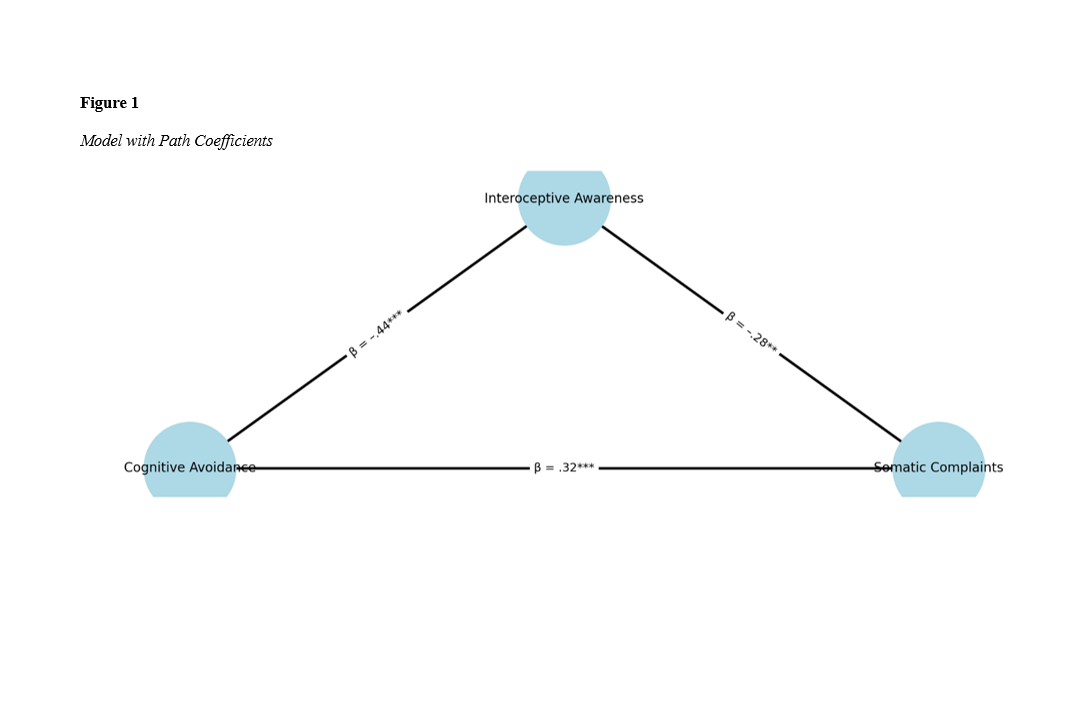
Findings: Pearson correlation results indicated that cognitive avoidance was positively correlated with somatic complaints (r = .42, p < .001), while interoceptive awareness was negatively correlated with both cognitive avoidance (r = –.44, p < .001) and somatic complaints (r = –.39, p < .001). The structural model showed excellent fit indices (χ²/df = 1.68, CFI = .97, RMSEA = .041). SEM results confirmed that cognitive avoidance had a significant direct effect on somatic complaints (β = .32, p < .001) and a significant indirect effect through interoceptive awareness (β = –.12, p = .004), supporting the mediating role of interoception.
Conclusion: Enhancing interoceptive awareness may serve as an effective intervention target for reducing psychosomatic distress in youth who rely on maladaptive cognitive coping strategies.
Downloads
References
Balconi, M., Angioletti, L., & Crivelli, D. (2023). Neurofeedback as Neuroempowerment Technique for Affective Regulation and Interoceptive Awareness in Adolescence: Preliminary Considerations Applied to a Psychogenic Pseudosyncope Case. Frontiers in Rehabilitation Sciences, 4. https://doi.org/10.3389/fresc.2023.1056972
Barmpagiannis, P., & Baldimtsi, E. (2025). Interoception and Emotional Regulation in Autistic Children Through an Occupational Therapy Perspective: A Literature Review. Brazilian Journal of Science, 4(2), 1-14. https://doi.org/10.14295/bjs.v4i2.699
Bijsterbosch, J. M., Hasenack, B., Rooijen, B. v., Sternheim, L., Boelen, P. A., Dijkerman, H. C., & Keizer, A. (2023). Intolerable Feelings of Uncertainty Within the Body: Associations Between Interoceptive Awareness, Intolerance of Uncertainty, and Body Dissatisfaction. Journal of adolescence, 95(8), 1678-1688. https://doi.org/10.1002/jad.12237
Braet, J., & Braet, C. (2024). I Can Feel My Heartbeat: The Relationship Between Interoceptive Abilities and Emotional States During Stress and Recovery in Healthy Adolescents. Psychophysiology, 61(12). https://doi.org/10.1111/psyp.14679
Braet, J., Giletta, M., Desmedt, O., Wante, L., Rapp, L., Pollatos, O., & Braet, C. (2024). Should Adolescents Listen to Their Hearts? A Closer Look at the Associations Between Interoception, Emotional Awareness and Emotion Regulation in Adolescents. Psychological Reports. https://doi.org/10.1177/00332941241286435
Brown, C., & Dunn, W. (2022). Development of a Participation Focused Measure of Interoception for Adults. Otjr Occupational Therapy Journal of Research, 43(2), 264-270. https://doi.org/10.1177/15394492221112651
Colaianne, B. A., Lavelle, B. D., Small, M. L., & Roeser, R. W. (2022). Cultivating Compassion for Self and Others: A School‐Based Pilot Study for Peer‐Nominated Caring Adolescents. Journal of Research on Adolescence, 33(1), 169-187. https://doi.org/10.1111/jora.12795
Datta, N., & Lock, J. (2023). Exploration of Interoceptive Capabilities in Avoidant/Restrictive Food Intake Disorder and Anorexia Nervosa. Journal of eating disorders, 11(1). https://doi.org/10.1186/s40337-023-00914-9
Donadeo, A., Politi, P., Silva, A., Civardi, S. C., Farinella, E., Brondino, N., Olivola, M., Sommi, F., & Damiani, S. (2021). Correlation Profiles Between Interoception and Exteroception in Psychotic Patients Versus Healthy Controls. European Psychiatry, 64(S1), S536-S536. https://doi.org/10.1192/j.eurpsy.2021.1430
Engel, M. P., & Schmidt, M. (2025). All Extern? Exploring the Impact of Social Media and Physical Activity on Adolescents’ Body Image and Interoception. Current Issues in Sport Science (Ciss), 10(2), 061. https://doi.org/10.36950/2025.2ciss061
Ho, T. C., Walker, J. C., Teresi, G. I., Kulla, A., Kirshenbaum, J. S., Gifuni, A. J., Singh, M. K., & Gotlib, I. H. (2020). Default Mode and Salience Network Alterations in Suicidal and Non-Suicidal Self-Injurious Thoughts and Behaviors in Adolescents With Depression. https://doi.org/10.1101/2020.09.20.304204
Hooshmandi, R., Aljaberi, M. A., Hammadi, F., & Ma, J. (2024). The Impact of Interoceptive Awareness on Pain Catastrophizing and Illness Perception. Journal of Personality and Psychosomatic Research (JPPR), 2(2), 4-10. https://doi.org/10.61838/kman.jppr.2.2.2
Itoi, C., Ujiie, Y., Matsushima, K., Takahashi, K., & Ide, M. (2022). Validation of the Japanese Version of the Interoception Sensory Questionnaire for Individuals With Autism Spectrum Disorder. Scientific reports, 12(1). https://doi.org/10.1038/s41598-022-25883-y
Jones, A., Silas, J., Todd, J., Stewart, A. L., Acree, M., Coulson, M., & Mehling, W. (2020). Exploring the Multidimensional Assessment of Interoceptive Awareness in Youth Aged 7–17 Years. Journal of Clinical Psychology, 77(3), 661-682. https://doi.org/10.1002/jclp.23067
Kiera, A. (2025). Experiences of Interoception and Anxiety in Autistic Adolescents: A Reflexive Thematic Analysis. Autism. https://doi.org/10.1177/13623613251314595
Laczkovics, C., Czernin, K., Carlitscheck, J., Zeiler, M. D., Schlund, P., Wunram, H. L., Lehmkuhl, G., & Krischer, M. (2022). Personality Disorder in Adolescent Patients With Anorexia Nervosa. Psychopathology, 56(4), 268-275. https://doi.org/10.1159/000527555
Lin, H. (2025). A Review of Research on the Effects of Mindful Exercises on Emotion Regulation and Mental Health Among Adolescents. Studies in Sports Science and Physical Education, 3(1), 24-35. https://doi.org/10.56397/ssspe.2025.03.03
Liné, C., Lachal, J., & Andrieu, B. (2022). Obesity and Interoceptive Awareness: A Preliminary Qualitative Study of Hospitalized Adolescent Girls With Obesity. L Évolution Psychiatrique, 87(1), e1-e18. https://doi.org/10.1016/j.evopsy.2021.12.001
Meneguzzo, P., Pascoli, L. D., Bindolo, M. C., Collantoni, E., Meregalli, V., Zanetti, T., Veronese, A., Tenconi, E., & Favaro, A. (2023). The Psychological and Medical Landscape of Anorexia Nervosa Over a Decade: A Retrospective Study of Possible Physical and Psychological Shifts. Journal of clinical medicine, 12(23), 7294. https://doi.org/10.3390/jcm12237294
Palser, E. R., Galvez-Pol, A., Palmer, C. E., Hannah, R., Fotopoulou, A., Pellicano, E., & Kilner, J. M. (2021). Reduced Differentiation of Emotion-Associated Bodily Sensations in Autism. Autism, 25(5), 1321-1334. https://doi.org/10.1177/1362361320987950
Riboli, G. (2022). Multidimensional Interoceptive Awareness, Psychosomatic Symptoms, and Risk for Eating Disorders in a Female at Birth Adolescent Sample. Curr Res Psychol Behav Sc, 3(2), 1-4. https://doi.org/10.54026/crpbs/1040
Sakaj, E. (2025). Wim Hof’s Breathing Method: Influence on the Autonomic Nervous System and Somatosensory Perception. https://doi.org/10.31234/osf.io/n2d34
Scotta, A. V., Cortez, M. V., & Miranda, A. R. (2022). Insomnia is associated with worry, cognitive avoidance and low academic engagement in Argentinian university students during the COVID-19 social isolation. Psychology, Health & Medicine, 27(1), 199-214. https://doi.org/10.1080/13548506.2020.1869796
Seiffge‐Krenke, I., & Sattel, H. (2024). How Personality Factors, Coping With Identity-Stress, and Parental Rearing Styles Contribute to the Expression of Somatic Complaints in Emerging Adults in Seven Countries. Frontiers in Psychiatry, 15. https://doi.org/10.3389/fpsyt.2024.1257403
Tahoon, R. (2023). Differences in Cognitive Avoidance, Anger Rumination, and the General Anxiety in Light of the Gender and Emotional Regulation Disturbance Among Undergraduate Students. Sage Open, 13(4). https://doi.org/10.1177/21582440231187281
Tymofiyeva, O., Sipes, B. S., Luks, T., Hamlat, E. J., Samson, T. E., Hoffmann, T. J., Glidden, D. V., Jakary, A., Li, Y., Ngan, T., Henje, E., & Yang, T. (2024). Interoceptive Brain Network Mechanisms of Mindfulness-Based Training in Healthy Adolescents. Frontiers in psychology, 15. https://doi.org/10.3389/fpsyg.2024.1410319
Wazir, M. N. K. (2023). Psychiatric Illnesses, Somatic Complaints, and Treatments in a Tertiary Care Hospital in Khyber Pakhtunkhwa, Pakistan: A Cross-Sectional Study. Cureus. https://doi.org/10.7759/cureus.43151
Yu, X., Cohen, Z. P., Tsuchiyagaito, A., Cochran, G., Aupperle, R. L., Stewart, J. L., Singh, M. K., Misaki, M., Bodurka, J., Paulus, M. P., & Kirlić, N. (2022). Neurofeedback-Augmented Mindfulness Training Elicits Distinct Responses in the Subregions of the Insular Cortex in Healthy Adolescents. Brain Sciences, 12(3), 363. https://doi.org/10.3390/brainsci12030363
Downloads
Additional Files
Publication Timeline
- Submitted
- Revised
- Accepted
Issue
Section
License

This work is licensed under a Creative Commons Attribution-NonCommercial 4.0 International License.