Career Pathways and Employment Outcomes of BSBA Graduates Class (2011-2019): A Tracer Study from NEMSU
DOI:
https://doi.org/10.61838/kman.jayps.2011Keywords:
Tracer Study, Financial Management, Human Resource Development Management, Sustainable Development GoalsAbstract
Objective: This study intended to examine the total population of college graduates from the BSBA Financial Management (FM) and the Human Resource Development Management (HRM) programs who firmly committed to develop North Eastern Mindanao State University (NEMSU) also known previously as Surigao del Sur State University (SDSSU) to be their main path for access to higher education in a combined, 2030 -point, and international “glocal” setting. Specifically. The objective of the study is to analyze the career development pathways of the BSBA batch of 2011–2019.
Methods and Materials: The descriptive research approach was used in this study to precisely describe the graduates of BSBA 2011-2019 of North Eastern Mindanao State University (NEMSU), Tagbina campus. Another example of sample survey implementation is managing the scope of the study to the manageable fraction of the bigger population and able to find few key insights. Additionally, a part of the study is also dedicated to the opinion survey, as most variables relates around what respondents have seen and perceived. The type of descriptive research approach was relevant in this study, because the question is determined by determining the graduate status needed by description related to the condition of the current graduates. The tracer study was heavily descriptive, used to understand broadly the career trajectories, job satisfaction, and professional achievement of graduates (Kresnawati et al, 2021). The education institution applied this approach in order to get a more realistic perception regarding the career path of its graduates from the graduation period to make rational decisions related to updating the curricula or designing appropriate career services for the students (Stroj et al., 2023). These studies incorporate descriptive analysis even hinting towards trends and patterns that are not only useful for benchmarking but also for measuring the efficacy of programs (Liu et al., 2023).
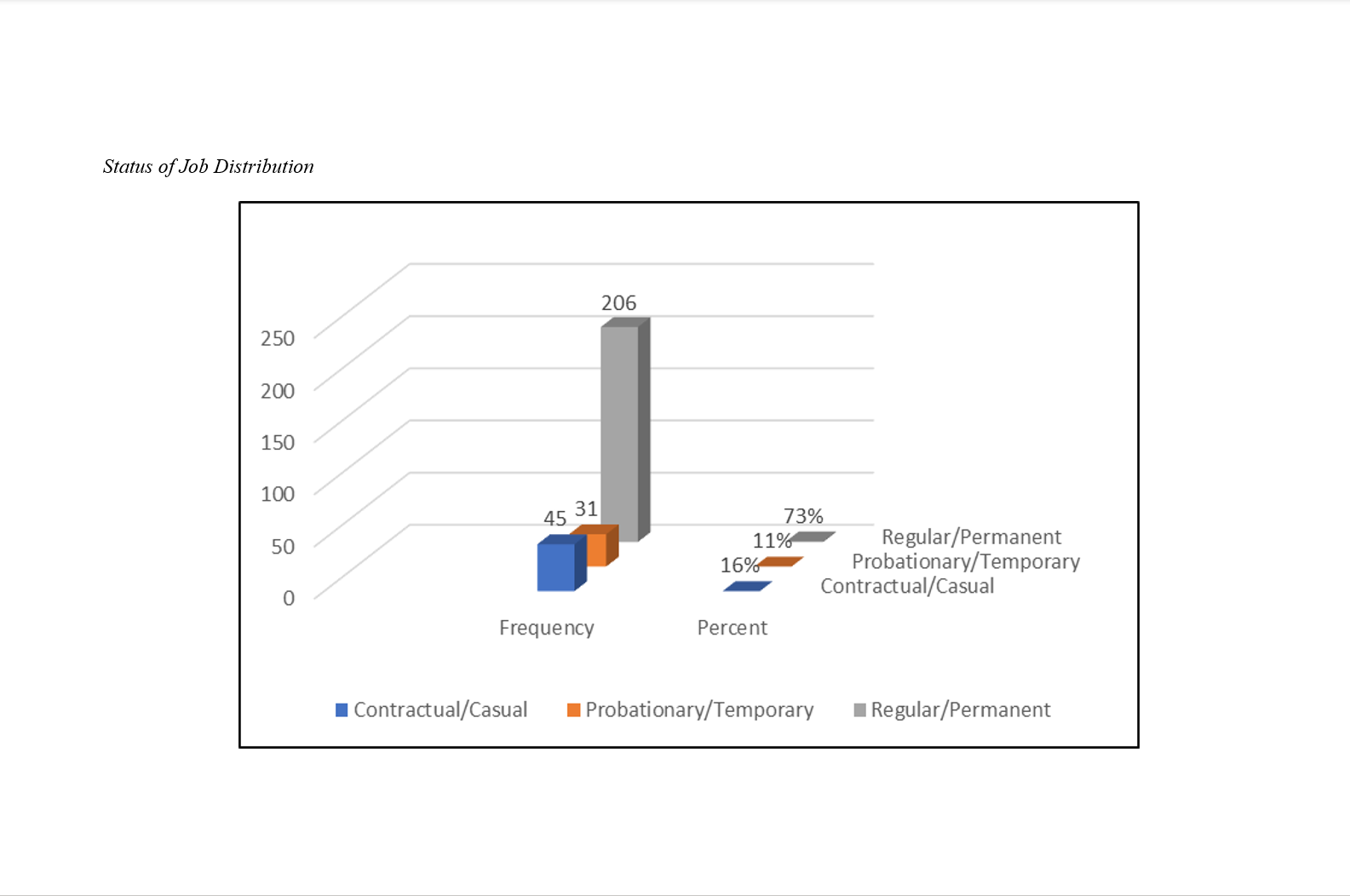
Findings: The employment data indicates that 73% of the respondents who remain in the country are in some form of regular or permanent employment. Between 1 and 2 months was the average time it took the graduates to get their first job, and it was reported that they spent less than 6 months in their first positions
Conclusion: The study also reveals the prevalence of clerical support staff in both groups and stresses that there is greater need for more industry relevant curricula so as to enable graduates secure jobs as well as progress in their careers. These factors prove that tracer studies serve a great purpose in the modernization of learning structures.
Downloads
References
Acosta, A. S., Narisma, J. E. B., Belarmino, C. G. A., P.Maragana, T. M., & U. Carino, R. M. A. U. D. T. M. K. (2020). Doing things right: The lived experience of overseas filipino workers having brain drain. International Journal of New Technology and Research, 6(1), 16-22. https://doi.org/10.31871/ijntr.6.1.8
Acut, D. P., Curaraton, E. P., Latonio, G. C., & Latonio, R. A. C. (2021). Work immersion performance appraisal and evaluation of grade 12 STEM students in science and technology-based industries.
Albina, A. C., & Sumagaysay, L. P. (2020). Employability tracer study of information technology education graduates from a state university in the Philippines. Social Sciences & Humanities Open, 2(1), 100055. https://doi.org/10.1016/j.ssaho.2020.100055
Austero, J., Armenia, P., & Seriño, M. N. (2012). Employment outcomes of graduates in selected higher educational institutions in eastern Visayas, Philippines. Annals of Tropical Research, 34(1), 147-162. https://doi.org/10.32945/atr3419.2012
Bachita, E. B., & Bayoneta, M. J. A. R. (2021). Implementation of public employment services in a Philippine local government unit. Philippine Social Science Journal, 4(3), 133-144. https://doi.org/10.52006/main.v4i3.412
Bustos, R. (2024). Bridging the gap: Aligning higher education priorities with the shifting job landscape in the Philippines. Recoletos Multidisciplinary Research Journal, 12(1), 9-24. https://doi.org/10.32871/rmrj2412.01.02
Igarashi, T., & Acosta, P. (2022). Who benefits from dual training systems? Evidence from the Philippines. Philippine Review of Economics, 59(1), 26-45. https://doi.org/10.37907/2ERP2202J
Kalaw, M. T. B. (2019). Tracer study of Bachelor of Science in Mathematics. International Journal of Evaluation and Research in Education (IJERE), 8(3), 537-548. https://doi.org/10.11591/ijere.v8i3.17434
Khan, M. A. I., & Mojkury, M. A. H. (2021). Curricula and employability: An empirical study on tertiary level students of Bangladesh. Asian Journal of Education and Social Studies, 17(2), 1-10. https://doi.org/10.9734/ajess/2021/v17i230415
Kresnawati, E. S., Irmeilyana, I., Amran, A., & Saputra, D. M. (2021). Independence test and plots in correspondence analysis to explore tracer study data. International Journal of Applied Sciences and Smart Technologies, 3(2), 241-256. https://doi.org/10.24071/ijasst.v3i2.3891
Mendoza, X. L. D., Pichay, S. B., & Tadeo, J. B. (2023). Utilization of modified SERVQUAL model in crafting strategies among courier services. International Journal of Multidisciplinary: Applied Business and Education Research, 4(3), 701-712. https://doi.org/10.11594/ijmaber.04.03.03
Mseleku, Z. (2021). Youth high unemployment/unemployability in South Africa: The unemployed graduates' perspectives. Higher education, skills and work-based learning, 12(4), 775-790. https://doi.org/10.1108/heswbl-06-2021-0114
Pentang, J. T., Perez, D. R., Cuanan, K. H., Recla, M. B., Dacanay, R. T., Bober, R. M., Dela Cruz, C. E., Egger, S. P., Herrera, R. L., Illescas, C. M., Salmo, J. M., Bucad, J. M. L., Agasa, J. V., & Abaca, N. A. P. Tracer study of teacher education graduates of Western philippines university-Puerto Princesa campus: Basis for curriculum review and revision. International Journal of Multidisciplinary: Applied Business and Education Research, 3(3), 419-432. https://doi.org/10.11594/ijmaber.03.03.12
Posadas, K. F., Osabel, A. C., Cruz, M. T. A. D., Villaflor, M. R. D., Suarez, N. C., Flores, J. T., Maňas, J. L., Yago, C. S., & Adrales, D. D. M. (2021). Employability of teacher education graduates of Nueva Ecija university of science and technology, San Isidro campus. International Journal Of Applied Research, 7(6), 15-164. https://doi.org/10.22271/allresearch.2021.v7.i6c.8650
Roman, A. G., & Villanueva, R. U. (2023). Graduate employment rate of one state university of the Calabarzon region in Philippines: A retrospection. International Journal of Evaluation and Research in Education (IJERE), 12(2), 667-674. https://doi.org/10.11591/ijere.v12i2.24795
Sayson, C. J. O., Asilum, W. G., Pintacasi, J. E., Pepania, A. D., & Sumicad Jr, E. H. (2024). Tracer study of bachelor of science in accountancy graduates. International Journal of Multidisciplinary, 5(2), 383-397. https://doi.org/10.11594/ijmaber.05.02.02
Toquero, C. M. D., & Ulanday, D. M. P. (2021). University graduates’ assessment of the relevance of the curriculum to the labor market in the philippines. International Research in Education, 9(1), 19-37. https://doi.org/10.5296/ire.v9i1.17421
Valdez, M. L., Paulo, J. B., Vizcarra, E. M., Torres, A. G., & Chloe, P. (2023). Tracer study of bachelor of science in mathematics graduates: Unveiling career trajectories. International Journal of Research Publication and Reviews, 4(11), 2724-2730. https://doi.org/10.55248/gengpi.4.1123.113142
Victoriano, H. T., Posadas, F. C., Migallos, S. F., Reyes, C. S., Campugan, C. E., & Salas, L. F. (2022). Graduate tracer study for the 12 academic programs in the graduate school of San Pedro college, Davao City, Philippines. Asian Journal of Education and Social Studies, 35(1), 44-61. https://doi.org/10.9734/ajess/2022/v35i1747
Downloads
Additional Files
Publication Timeline
- Submitted
- Revised
- Accepted
Issue
Section
License
Copyright (c) 2025 Romel C. Nemiño (Corresponding Author); Fe G. Villamor, Sharon May R. Gibertas (Author)

This work is licensed under a Creative Commons Attribution-NonCommercial 4.0 International License.