Effectiveness of Acceptance and Commitment Therapy (ACT) on Anxiety and Emotion Regulation in Girls
DOI:
https://doi.org/10.61838/kman.jayps.6.4.8Keywords:
Acceptance and Commitment Therapy, anxiety, emotion regulation, adolescent girls, psychological flexibility, randomized controlled trialAbstract
Objective: This study aimed to investigate the effectiveness of Acceptance and Commitment Therapy (ACT) in reducing anxiety and improving emotion regulation in adolescent girls.
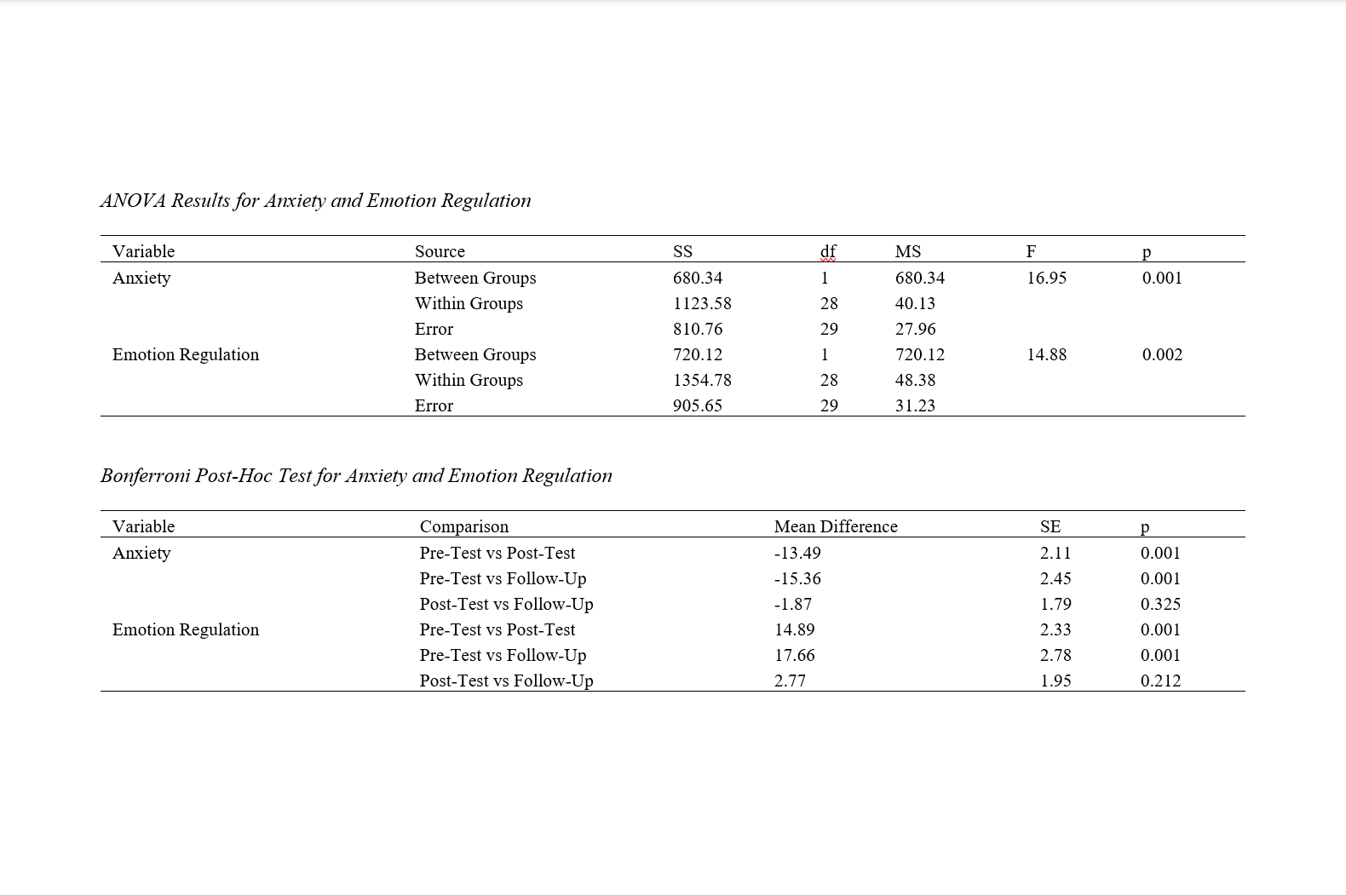
Methods and Materials: This study employed a randomized controlled trial (RCT) design with 30 adolescent girls from Tehran, randomly assigned to either the ACT intervention group (n = 15) or a control group (n = 15). The ACT group participated in eight 90-minute therapy sessions, while the control group received no intervention. Standardized measures, including the Beck Anxiety Inventory (BAI) and the Difficulties in Emotion Regulation Scale (DERS), were administered at pre-test, post-test, and five-month follow-up. Data were analyzed using analysis of variance with repeated measurements (ANOVA-RM) and the Bonferroni post-hoc test in SPSS-27 to examine within-group and between-group differences.
Findings: The results showed a significant reduction in anxiety scores in the ACT intervention group from 35.24 (SD = 5.12) at pre-test to 21.75 (SD = 4.85) at post-test and 19.88 (SD = 4.77) at follow-up, while the control group’s anxiety scores remained stable (p = 0.001). Similarly, emotion regulation significantly improved in the intervention group, with scores increasing from 45.32 (SD = 6.23) at pre-test to 60.21 (SD = 5.90) at post-test and 62.98 (SD = 5.78) at follow-up, whereas the control group showed no significant changes (p = 0.002). Bonferroni post-hoc analysis confirmed that these improvements were statistically significant and sustained over time.
Conclusion: The findings suggest that ACT is an effective intervention for reducing anxiety and enhancing emotion regulation in adolescent girls, with long-term therapeutic benefits. Given these results, ACT could be integrated into adolescent mental health programs to improve emotional well-being and coping strategies.
Downloads
References
Asgari, A., Asadi, J., & Hosseinae, A. (2023). The Effectiveness of Acceptance and Commitment Therapy on Cognitive Emotion Regulation and Marital Forgiveness of Women Affected by Marital Infidelity. Rooyesh-e-Ravanshenasi Journal (RRJ), 12(3), 165-174. https://frooyesh.ir/article-1-3995-en.html
Caletti, E., Massimo, C., Magliocca, S., Moltrasio, C., Brambilla, P., & Delvecchio, G. (2022). The role of the acceptance and commitment therapy in the treatment of social anxiety: An updated scoping review. Journal of affective disorders, 310, 174-182. https://doi.org/10.1016/j.jad.2022.05.008
Cojocaru, C. M., Popa, C. O., Schenk, A., Suciu, B. A., & Szasz, S. (2024). Cognitive-behavioral therapy and acceptance and commitment therapy for anxiety and depression in patients with fibromyalgia: a systematic review and meta-analysis. Medicine and Pharmacy Reports, 97(1), 26. https://doi.org/10.15386/mpr-2661
Ebrahimi, S., Moheb, N., & Alivani Vafa, M. (2024). Comparison of the Effectiveness of Cognitive-behavioral Therapy and Acceptance and Commitment Therapy on Cognitive Distortions and Rumination in Adolescents with Social Anxiety Disorder. Practice Clinical Psychology, 12(1). https://doi.org/10.32598/jpcp.12.1.922.1
Enayati Shabkolai, M., Enayati Shabkalai, M., & Bagheri Dadokolai, M. (2023). The Effectiveness of Treatment based on Acceptance and Commitment on Social Adaptation, Academic Self-Regulation and Cognitive Flexibility of Students with Specific Learning Disorders. International Journal of Education and Cognitive Sciences, 4(1), 33-41. https://doi.org/10.61838/kman.ijecs.4.1.5
Esfahani, A., & Zainali, K. (2020). The Effectiveness of Group Therapy Based on Acceptance and Commitment on Pain-Related Anxiety and Cognitive Emotion Regulation in Breast Cancer Patients: A Clinical Trial. Journal of Arak University of Medical Sciences, 23(2), 138-149. https://doi.org/10.32598/JAMS.23.2.3364.2
Fahlekar, A., Faal, M., Zahedzadeh, F., Amani, O., & Askari, M. (2020). The effect of acceptance and commitment therapy on emotional regulation and coping strategies in patients with generalized anxiety disorder. Quarterly Journal of Child Mental Health, 6(4), 253-265. https://doi.org/10.29252/jcmh.6.4.23
Fattahi, A., Mazini, F., Jaberghaderi, N., Rajabi, F., Derakhshani, M., & Laki, M. (2023). Effectiveness of acceptance and commitment therapy upon distress, emotion regulation, and self-compassion in patients with cardiovascular disease: a randomized clinical trial. Trends in Psychiatry and Psychotherapy, AheadOfPrint, 0-0. https://doi.org/10.47626/2237-6089-2023-0685
Fernández-Rodríguez, C., Coto-Lesmes, R., Martínez-Loredo, V., González-Fernández, S., & Cuesta, M. (2023). Is Activation the Active Ingredient of Transdiagnostic Therapies? A Randomized Clinical Trial of Behavioral Activation, Acceptance and Commitment Therapy, and Transdiagnostic Cognitive-Behavioral Therapy for Emotional Disorders. Behavior Modification, 47(1), 3-45. https://doi.org/10.1177/01454455221083309
Iri, H., Makvandi, B., Bakhtiarpour, S., & Hafezi, F. (2019). Comparison of the effectiveness of Acceptance and Commitment Therapy and Dialectical Behavioral Therapy on health anxiety, psychosocial adjustment and cognitive emotion regulation of divorced women. medical journal of mashhad university of medical sciences, 61(supplment1), 79-88. https://doi.org/10.22038/mjms.2019.13786
Karbasdehi, R., Ebrahim, Abolghasemi, A., Hosein, K., & Rahbar, K. (2021). Effectiveness of Acceptance and Commitment Therapy on Cognitive Emotion Regulation and Existential Anxiety in Patients with Multiple Sclerosis. Clinical Psychology and Personality, 18(2), 1-9. https://cpap.shahed.ac.ir/article_3220_en.html
Kazemeini, S. E., Ranjbaripour, T., NezhadMohammad Nameghi, A., Sodagar, S., & Peyvandi, P. (2022). Comparison the effectiveness of Acceptance and Commitment therapy with Mindfulness-Based Cognitive therapy on Cognitive Emotion Regulation in Heart Failure Patients. Journal of Assessment and Research in Applied Counseling, 4(3), 11-18. https://doi.org/10.52547/jarac.4.3.30
Khodadadi Jokar, F., Panahi Far, S., & Yazdanbakhsh, K. (2023). Comparison of the Impact of Couples Therapy Using the Imago Model Versus Acceptance and Commitment Therapy on Emotion Regulation Strategies in Divorce-Seeking Couples. Counseling and Family Psychotherapy, 12(2), 177-206. https://fcp.uok.ac.ir/article_62737.html
Peymannia, B. (2021). The Effectiveness of ACT Matrix with compassion on cognitive emotion regulation strategy in Students with Test Anxiety Disorders. The Journal of New Thoughts on Education, 16(4), 217-236. https://doi.org/10.22051/jontoe.2020.24026.2494
Roohi, R., Soltani, A. A., Zinedine Meimand, Z., & Razavi Nematollahi, V. (2019). The Effect of Acceptance and Commitment Therapy (ACT) on Increasing the Self-Compassion, Distress Tolerance, and Emotion Regulation in Students with Social Anxiety Disorder [Research]. Quarterly Journal of Child Mental Health, 6(3), 173-187. https://doi.org/10.29252/jcmh.6.3.16
Rouhi, M., Manzari Tavakoli, A., & Tajrobehkar, M. (2023). Comparison of the effectiveness of acceptance and commitment therapy with dialectical behavior therapy on integrative self-knowledge, emotion regulation, and quality of life in hemodialysis patients. Journal of Cognitive Psychology and Psychiatry, 10(2), 131-146. https://doi.org/10.32598/shenakht.10.2.131
Sarabadani, A., Hasanzadeh, R., & Ghanadzadegan, H. (2023). The effectiveness of acceptance and commitment therapy on distress tolerance and cognitive emotion regulation in women with generalized anxiety disorder. Applied Family Therapy Journal (AFTJ), 4(2), 96-114. https://doi.org/10.61838/kman.aftj.4.2.6
Shahsavari Googhari, Z., Hafezi, F., Asgari, P., & Heidari, A. (2022). The effectiveness of mindfulness-based cognitive therapy and acceptance and commitment therapy on medical science students’ subjective well-being, psychological distress, and emotion regulation. J Shahrekord Univ Med Sci, 24(1), 35-41. https://doi.org/10.34172/jsums.2022.07
Taghvaeinia, A., Karami, M., & Azizi, A. (2024). Comparison of the effect of dialectical behavior therapy, acceptance and commitment therapy mindfulness-based Stress reduction on irritable bowel syndrome symptoms, quality of life, anxiety and depression: A pilot randomized controlled trial. The Psychiatric Quarterly, 95(1), 53-68. https://doi.org/10.1007/s11126-023-10058-3
Tardast, K., Amanelahi, A., Rajabi, G., Aslani, K., & Shiralinia, K. (2023). The Effectiveness of Acceptance and Commitment-based Treatment on Children's Anxiety and the Parenting Stress of Mothers. Journal of Woman and Study of Family, 16(59), 117-142. https://www.magiran.com/paper/2618899
Downloads
Additional Files
Publication Timeline
- Submitted
- Revised
- Accepted
Issue
Section
License
Copyright (c) 2025 Zahra Dinarvand (Corresponding Author)

This work is licensed under a Creative Commons Attribution-NonCommercial 4.0 International License.