Effectiveness of Psychodrama on Exam Anxiety in Students with Different Coping Styles
DOI:
https://doi.org/10.61838/kman.jayps.6.4.7Keywords:
Psychodrama, test anxiety, coping styles, high school students, emotion-focused coping, problem-focused coping, avoidance copingAbstract
Objective: This study aimed to examine the effectiveness of psychodrama in reducing test anxiety among high school students with different coping styles, including problem-focused, emotion-focused, and avoidance coping.
Methods and Materials: The study employed a quasi-experimental pre-test and post-test design with a control group. The sample consisted of 32 female high school students in Ahvaz, selected through multistage cluster random sampling and randomly assigned to experimental (n = 16) and control (n = 16) groups. The experimental group participated in 12 psychodrama sessions, while the control group received no intervention. The Sarason Test Anxiety Scale (1985) was used to measure test anxiety levels, and the Lazarus Coping Strategies Questionnaire (1985) assessed coping styles. Data were analyzed using multivariate and univariate analysis of covariance (MANCOVA and ANCOVA), controlling for pre-test scores.
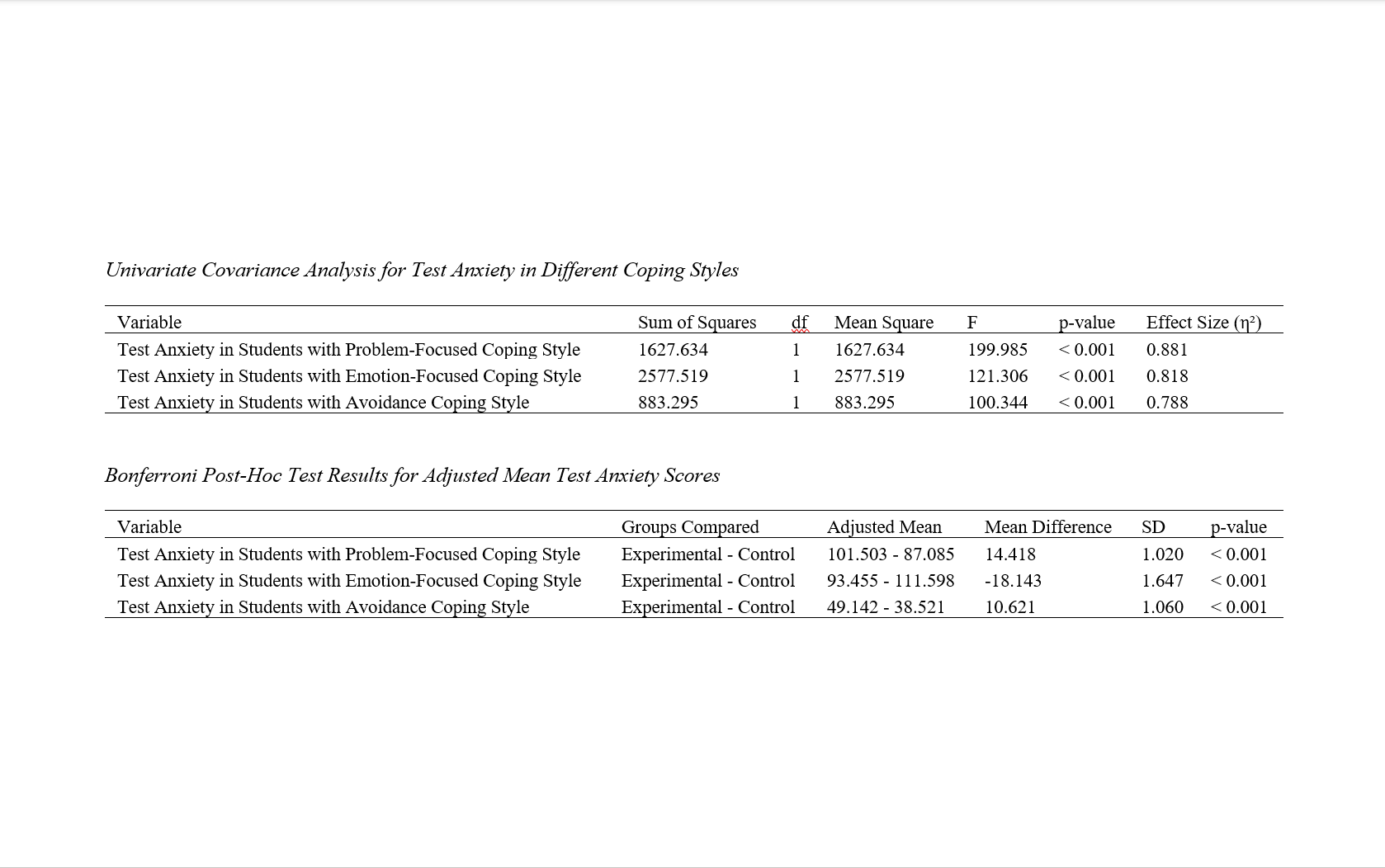
Findings: The results indicated a significant effect of psychodrama on test anxiety across different coping styles. Students with an emotion-focused coping style in the experimental group exhibited a significant reduction in test anxiety (adjusted post-test mean = 93.45) compared to the control group (adjusted post-test mean = 111.59) (p < 0.001). However, students with problem-focused and avoidance coping styles in the experimental group experienced an increase in test anxiety, with adjusted post-test means of 101.50 and 49.14, respectively, compared to 87.08 and 38.52 in the control group (p < 0.001). These results suggest that psychodrama is particularly effective for students with emotion-focused coping styles but may initially increase anxiety in those with problem-focused and avoidance coping styles.
Conclusion: Psychodrama is an effective intervention for reducing test anxiety, particularly among students with emotion-focused coping styles. However, its impact on students with problem-focused and avoidance coping styles suggests that therapeutic approaches should be tailored based on coping mechanisms.
Downloads
References
Afandi, M., Arif, T., Pertami, S. B., & Yuswanto, T. J. A. (2024). Workload and Coping Strategies Correlated With Burnout Syndrome in Operating Room Nurses. Jurnal Ners Dan Kebidanan (Journal of Ners and Midwifery), 11(1), 105-112. https://doi.org/10.26699/jnk.v11i1.art.p105-112
Bahreini Moghim Jiroft, N., Golparvar, M., & Aghaei, A. (2023). Comparison of the Effectiveness of Educational Perfectionism Schema Based Strategies Training with Cognitive Behavior Training on Test Anxiety and Academic Burnout among Female Students with Educational Perfectionism. Journal of Educational Psychology Studies, 20(49), 20-21. https://doi.org/10.22111/jeps.2023.42744.5095
Barutçu Yıldırım, F., & Demir, A. (2019). Self-Handicapping Among University Students: The Role of Procrastination, Test Anxiety, Self-Esteem, and Self-Compassion. Psychological Reports, 123(3), 825-843. https://doi.org/10.1177/0033294118825099
Erbay, L. G., Reyhani, İ., Ünal, S., Özcan, C., Özgöçer, T., Uçar, C., & Yıldız, S. (2018). Does Psychodrama Affect Perceived Stress, Anxiety-Depression Scores and Saliva Cortisol in Patients With Depression? Psychiatry Investigation, 15(10), 970-975. https://doi.org/10.30773/pi.2018.08.11.2
Kabusi, M. (2023). Assessing the Effects of Acceptance-Commitment and Psychodrama Therapies in Nurses With Social Anxiety Disorder. Iranian Rehabilitation Journal, 21(2), 223-230. https://doi.org/10.32598/irj.21.1.763.3
Kaya, F., & Deniz, H. (2020). The Effects of Using Psychodrama on the Psychological Wellbeing of University Students. Perspectives in psychiatric care, 56(4), 905-912. https://doi.org/10.1111/ppc.12510
Munte, R. F., & Arsini, Y. (2024). Psychodrama Technique Group Guidance to Develop Positive Self-Concept for Students. JMKSP (Jurnal Manajemen Kepemimpinan Dan Supervisi Pendidikan), 9(2), 1381-1395. https://doi.org/10.31851/jmksp.v9i2.16699
Ofem, U. J., Ovat, S., Hycenth, N., & Udeh, M. I. (2024). Item Sequencing and Academic Performance in Physics: A Quasi -Experimental Approach with Gender and Test Anxiety as Control Variables. International Journal of Education and Cognitive Sciences, 5(2), 38-50. https://doi.org/10.61838/kman.ijeas.5.2.6
Örnek, B. Y. (2023). The Effects of Group Psychodrama on the Ruminative Thinking Style, Dysfunctional Attitudes, Anxiety and Depressive Symptoms: A Quasi-Experimental Study. Archives of Psychiatry and Psychotherapy, 25(3), 84-93. https://doi.org/10.12740/app/166563
Parlak, S., & Oksuz Gul, F. (2021). Psychodrama oriented group therapy for forgiveness in university students. The Arts in Psychotherapy, 73, 101761. https://doi.org/10.1016/j.aip.2021.101761
Permana, H., & Suwarjo, S. (2022). Psychodrama Techniques to Improve Academic Self-Efficacy in Madrasah Aliyah Students. Al-Ishlah Jurnal Pendidikan, 14(4), 6773-6782. https://doi.org/10.35445/alishlah.v14i4.2288
Polat, S. (2023). Impact of Psychodrama on Emotional Awareness and Psychological Well-Being in University Students. Kırıkkale Üniversitesi Tıp Fakültesi Dergisi, 25(3), 463-471. https://doi.org/10.24938/kutfd.1356005
Saifulah, D., Rellyta, N., & Saputro, H. (2024). Effectiveness of Psychodrama Model Group Activity Therapy on Anxiety Levels in the Elderly. Open Access Health Scientific Journal, 5(2), 29-37. https://doi.org/10.55700/oahsj.v5i2.54
Shirani Bidabadi, M., Abedi, A., Mehryar, A., & Saberi, H. (2022). Investigation of the effectiveness of psychodrama on improving obsessive-compulsive symptoms and anger in patients with obsessive-compulsive disorder. Journal-of-Psychological-Science, 21(111), 575-592. https://doi.org/10.52547/JPS.21.111.575
Wan, Y. (2023). Is Psychodrama an Effective Method to Intervene High School Students Social Anxiety? Lecture Notes in Education Psychology and Public Media, 6(1), 38-46. https://doi.org/10.54254/2753-7048/6/20220138
Wang, Q., Ding, F., Chen, D., Zhang, X., Shen, K., Fan, Y., & Li, L. (2020). Intervention effect of psychodrama on depression and anxiety: A meta-analysis based on Chinese samples. The Arts in Psychotherapy, 69, 101661. https://doi.org/10.1016/j.aip.2020.101661
Wieser, M. A. (2023). Impact of Teaching Palliative Psychology With Psychodrama and Arts Therapies on Psychology Students in Klagenfurt. Behavioral Sciences, 13(11), 931. https://doi.org/10.3390/bs13110931
Yanli, C., Wang, H., Li, J., & Yi, S. (2023). The Application of Psychodrama in Students’ Mental Health Education. 1804-1810. https://doi.org/10.2991/978-2-38476-092-3_231
Yu, R., Tan, H., Wang, E., Huang, J., Wang, P., Li, X., Zheng, H.-H., Lv, F., & Hu, H. (2022). Antidepressants Combined With Psychodrama Improve the Coping Style and Cognitive Control Network in Patients With Childhood Trauma-Associated Major Depressive Disorder. World journal of psychiatry, 12(8), 1016-1030. https://doi.org/10.5498/wjp.v12.i8.1016
Zayman, E., & Simsek, B. (2023). The Effect of Psychodrama on Anxiety Levels and Stress Coping Styles in Academicians. Medicine Science | International Medical Journal, 12(1), 253. https://doi.org/10.5455/medscience.2022.12.261
Downloads
Additional Files
Publication Timeline
- Submitted
- Revised
- Accepted
Issue
Section
License
Copyright (c) 2025 Samira Memari (Author); Mahsa Jorjorzadeh Shoushtari (Corresponding Author)

This work is licensed under a Creative Commons Attribution-NonCommercial 4.0 International License.