Psychometric assessment of the Persian translation of the higher education version of the Social Emotional Health Survey (SEHS-HE) with students
Keywords:
Social and Emotional Health Survey, Psychometric assessment, validation, youths, studentsAbstract
Objective: The primary objective of this research is to establish the cross-cultural validity of the SEHS-HE in Iran, thereby providing a validated instrument for measuring the core dimensions of positive mental health (belief in self, belief in others, emotional competence, and engaged living) among Iranian youth in higher education.
Method and Materials: This study was purposed to initially translate it into Persian and then assess its psychometric properties among a sample of 308 female students ranging 20-25 years old. The face, content, construct and concurrent validity were investigated in order to check the validity of the scale. Also, the Cronbach's alpha and composite reliability were applied to evaluate the reliability.
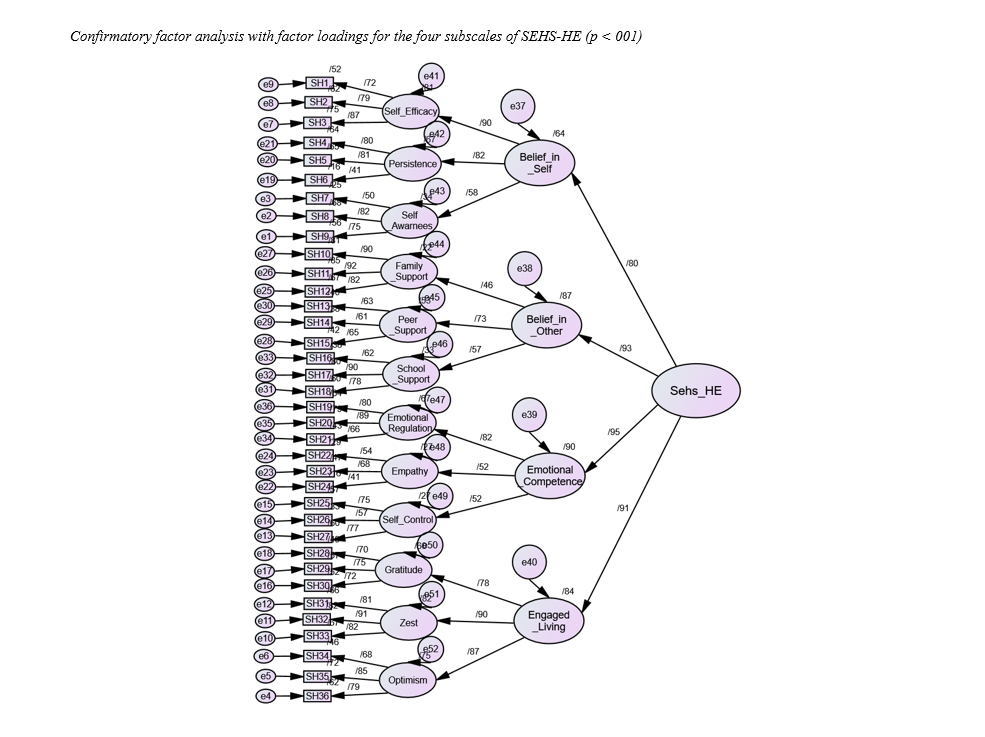
Findings: The findings confirmed the SEHS-HE possesses an appropriate validity and reliability, the obtained AVE and CR values of this article were 0.54 and 0.96 and the Cronbach’s alpha was 0.92 .The Model fits of the SEHS-HE were at the appropriate range and the confirmatory factor analysis also affirmed the appropriateness of the items and four dimension of the survey.
Conclusion: In general, the information obtained from this research indicates that the psychometric properties of this instrument are suitable for evaluating the mental health of Iranian youths and it would be applicable in future studies.
Downloads
References
Arslan, G., Allen, K. A., Telef, B. B., & Craig, H. (2020). Social-emotional health in higher education: a psychometric evaluation with Turkish students. British Journal of Guidance & Counselling, 1-14. https://doi.org/10.1080/03069885.2020.1789554
Auerbach, R. P., Mortier, P., Bruffaerts, R., Alonso, J., Benjet, C., Cuijpers, P., Demyttenaere, K., Ebert, D. D., Green, J. G., Hasking, P., Murray, E., Nock, M. K., Pinder-Amaker, S., Sampson, N. A., Stein, D. J., Vilagut, G., Zaslavsky, A. M., & Kessler, R. C. (2018). WHO world mental health surveys international college student project: Prevalence and distribution of mental disorders. Journal of Abnormal Psychology, 127(7), 623-638. https://doi.org/10.1037/abn0000362
Azizli, N., Atkinson, B. E., Baughman, H. M., & Giammarco, E. A. (2015). Relationships between general self-efficacy, planning for the future, and life satisfaction. Personality and Individual Differences, 82, 58-60. https://doi.org/10.1016/j.paid.2015.03.006
Bagherian-Sararoudi, R., Hajian, A., Bahrami Ehsan, H., Sarafraz, M. R., & Zimet, G. D. (2013). Psychometric Properties of the Persian Version of the Multidimensional Scale of Perceived Social Support in Iran. International Journal of Preventive Medicine, 4(11), 1277. https://pmc.ncbi.nlm.nih.gov/articles/PMC3883252/
Bao, X., Pan, W., Shi, M., & Ji, M. (2013). Life Satisfaction and Mental Health in Chinese Adults. Social Behavior and Personality, 41(10), 1597-1604. https://doi.org/10.2224/sbp.2013.41.10.1597
Beck, A. T., Epstein, N., Brown, G., & Steer, R. A. (1988). An Inventory for Measuring Clinical Anxiety: Psychometric Properties. Journal of Consulting and Clinical Psychology, 56(6), 893-897. https://doi.org/10.1037/0022-006X.56.6.893
Bieda, A., Hirschfeld, G., Schönfeld, P., Brailovskaia, J., Lin, M., & Margraf, J. (2019). Happiness, life satisfaction and positive mental health: Investigating reciprocal effects over four years in a Chinese student sample. Journal of Research in Personality, 78, 198-209. https://doi.org/10.1016/j.jrp.2018.11.012
Brislin, R. W., Lonner, W. J., & Berry, J. W. (1986). Field methods in cross-cultural research. SAGE.
Byrne, B. M. (2013). Structural Equation Modeling with Mplus. Routledge. https://doi.org/10.4324/9780203807644
Castelli, L., & Marcionetti, J. (2024). Life satisfaction and school experience in adolescence: the impact of school supportiveness, peer belonging and the role of academic self-efficacy and victimization. Cogent Education, 11(1), 2338016. https://doi.org/10.1080/2331186X.2024.2338016
Chauhan, A. S., Mathur, G., Gulati, C., & Sharma, A. (2025). The relationship between gratitude and life satisfaction: The mediating effect of mental well-being. Social Sciences & Humanities Open, 11, 101224. https://doi.org/10.1016/j.ssaho.2024.101224
Cohen, S. (1994). Perceived Stress Scale. http://www.mindgarden.com/products/pss.htm
Denovan, A., & Macaskill, A. (2017). Stress and Subjective Well-Being Among First Year UK Undergraduate Students. Journal of Happiness Studies, 18(2), 505-525. https://doi.org/10.1007/s10902-016-9736-y
Diener, E., Emmons, R. A., Larsem, R. J., & Griffin, S. (2010). The Satisfaction With Life Scale. Journal of Personality Assessment, 49(1), 71-75. https://doi.org/10.1207/s15327752jpa4901_13
Ekinci, N., & Koç, H. (2023). Grit, general self-efficacy, and life satisfaction: The mediating role of hope. Journal of Community Psychology, 51(3), 1288-1299. https://doi.org/10.1002/jcop.22962
Fergusson, D. M., McLeod, G. F. H., Horwood, L. J., Swain, N. R., Chapple, S., & Poulton, R. (2015). Life satisfaction and mental health problems (18 to 35 years). Psychological Medicine, 45(11), 2427-2436. https://doi.org/10.1017/S0033291715000422
Foroughi, A. A., Parvizifard, A., Sadeghi, K., & Moghadam, A. P. (2021). Psychometric properties of the Persian version of the Emotion Regulation Questionnaire. Trends in Psychiatry and Psychotherapy, 43(2), 101-107. https://doi.org/10.47626/2237-6089-2018-0106
Furlong, M. J., Nylund-Gibson, K., Dowdy, E., Wagle, R., Hinton, T., & Carter, D. (2020). Modification and Standardization of Social Emotional Health Survey-Secondary--2020 Edition. https://eric.ed.gov/?id=ED600109
Furlong, M. J., You, S., Renshaw, T. L., Smith, D. C., & O'Malley, M. D. (2014). Preliminary development and validation of the social and emotional health survey for secondary school students. Social Indicators Research, 117(3), 1011-1032. https://doi.org/10.1007/s11205-013-0373-0
Furlong, M. J., You, S., Shishim, M., & Dowdy, E. (2017). Development and Validation of the Social Emotional Health Survey-Higher Education Version. Applied Research in Quality of Life, 12(2), 343-367. https://doi.org/10.1007/s11482-016-9464-9
Harrer, M., Adam, S. H., Baumeister, H., Cuijpers, P., Karyotaki, E., Auerbach, R. P., Kessler, R. C., Bruffaerts, R., Berking, M., & Ebert, D. D. (2019). Internet interventions for mental health in university students: A systematic review and meta-analysis. International Journal of Methods in Psychiatric Research, 28(2), e1759. https://doi.org/10.1002/mpr.1759
Hayes, N., & Joseph, S. (2003). Big 5 correlates of three measures of subjective well-being. Personality and Individual Differences, 34(4), 723-727. https://doi.org/10.1016/S0191-8869(02)00057-0
Hernández-Torrano, D., Ibrayeva, L., Sparks, J., Lim, N., Clementi, A., Almukhambetova, A., Nurtayev, Y., & Muratkyzy, A. (2020). Mental Health and Well-Being of University Students: A Bibliometric Mapping of the Literature. Frontiers in Psychology, 11, 1226. https://doi.org/10.3389/fpsyg.2020.01226
Hills, P., & Argyle, M. (2002). The Oxford Happiness Questionnaire: a compact scale for the measurement of psychological well-being. Personality and Individual Differences, 33(7), 1073-1082. https://doi.org/10.1016/S0191-8869(01)00213-6
Jia, L., & Wang, X. (2024). Self-Efficacy and life satisfaction mediate the relationship between perceived social support and career exploration among college students: A cross-sectional study. The Journal of Psychology, 158(5), 368-382. https://doi.org/10.1080/00223980.2024.2312870
Jiang, Y., Lu, C., Chen, J., Miao, Y., Li, Y., & Deng, Q. (2022). Happiness in University Students: Personal, Familial, and Social Factors: A Cross-Sectional Questionnaire Survey. International Journal of Environmental Research and Public Health, 19(8), 4713. https://doi.org/10.3390/ijerph19084713
Johnson, M. (1996). Statistical Methods for Health Care Research. Gastroenterology Nursing, 19(4), 153. https://doi.org/10.1097/00001610-199607000-00010
Jones, C. N., You, S., & Furlong, M. J. (2013). A Preliminary Examination of Covitality as Integrated Well-Being in College Students. Social Indicators Research, 111(2), 511-526. https://doi.org/10.1007/s11205-012-0017-9
Kakemam, E., Navvabi, E., Albelbeisi, A. H., Saeedikia, F., Rouhi, A., & Majidi, S. (2022). Psychometric properties of the Persian version of Depression Anxiety Stress Scale-21 Items (DASS-21) in a sample of health professionals: a cross-sectional study. BMC Health Services Research, 22(1), 1-9. https://doi.org/10.1186/s12913-022-07514-4
Kalınkara, Y., & Talan, T. (2025). Psychological balances in the digital world: Dynamic relationships among social media addiction, depression, anxiety, academic self-efficacy, general belongingness, and life satisfaction. The Journal of Genetic Psychology, 186(2), 85-113. https://doi.org/10.1080/00221325.2024.2400342
Kardas, F., Cam, Z., Eskisu, M., & Gelibolu, S. (2019). Gratitude, hope, optimism and life satisfaction as predictors of psychological well-being. Eurasian Journal of Educational Research, 2019(82), 81-100. https://doi.org/10.14689/ejer.2019.82.5
Kaur, K. (2025). Understanding the Relationship between Gratitude, Anxiety, and Life Satisfaction. International Journal of Interdisciplinary Approaches in Psychology, 3(5) 1-13. http://psychopediajournals.com/index.php/ijiap/article/view/765
Keyes, C. L. (2007). Promoting and protecting mental health as flourishing: a complementary strategy for improving national mental health. American Psychologist, 62(2), 95. https://doi.org/10.1037/0003-066X.62.2.95
Lambert, N. M., Fincham, F. D., Stillman, T. F., & Dean, L. R. (2009). More gratitude, less materialism: The mediating role of life satisfaction. The Journal of Positive Psychology, 4(1), 32-42. https://doi.org/10.1080/17439760802216311
LeBlanc, S., Uzun, B., & Aydemir, A. (2021). Structural relationship among mindfulness, reappraisal and life satisfaction: The mediating role of positive affect. Current Psychology, 40(9), 4406-4415. https://doi.org/10.1007/s12144-019-00383-x
Lee, S. y., You, S., & Furlong, M. J. (2016). Validation of the Social Emotional Health Survey-Secondary for Korean Students. Child Indicators Research, 9(1), 73-92. https://doi.org/10.1007/s12187-014-9294-y
Lent, R. W., Singley, H. D., Sheu, U. B., Gainor, K. A., Brenner, B. R., Treistman, D., & Ades, L. (2005). Social cognitive predictors of domain and life satisfaction: Exploring the theoretical precursors of subjective well-being. Journal of Counseling Psychology, 52(3), 429-442. https://doi.org/10.1037/0022-0167.52.3.429
Lin, C. C. (2015). The relationships among gratitude, self-esteem, depression, and suicidal ideation among undergraduate students. Scandinavian Journal of Psychology, 56(6), 700-707. https://doi.org/10.1111/sjop.12252
Lovibond, P. F., & Lovibond, S. H. (1995). The structure of negative emotional states: Comparison of the Depression Anxiety Stress Scales (DASS) with the Beck Depression and Anxiety Inventories. Behaviour Research and Therapy, 33(3), 335-343. https://doi.org/10.1016/0005-7967(94)00075-U
Maroufizadeh, S., Ghaheri, A., Samani, R. O., & Ezabadi, Z. (2016). Psychometric properties of the satisfaction with life scale (SWLS) in Iranian infertile women. International Journal of Reproductive Biomedicine, 14(1), 57. https://doi.org/10.29252/ijrm.14.1.57
McGreal, R., & Joseph, S. (1993). The Depression-Happiness Scale. Psychological Reports, 73(3), 1279-1282. https://doi.org/10.2466/pr0.1993.73.3f.1279
Morgan, B., & Simmons, L. (2021). A 'PERMA' Response to the Pandemic: An Online Positive Education Programme to Promote Wellbeing in University Students. Frontiers in Education, 6, 642632. https://doi.org/10.3389/feduc.2021.642632
Paz, J. L., Arch, D. N., & Kazee, T. (2022). Centering Resiliency and Capturing Covitality: Patterns of Well-Being among Former Youth in Foster Care.
Petrocchi, N., & Couyoumdjian, A. (2015). The impact of gratitude on depression and anxiety: the mediating role of criticizing, attacking, and reassuring the self. Self and Identity, 15(2), 191-205. https://doi.org/10.1080/15298868.2015.1095794
Porru, F., Schuring, M., Bültmann, U., Portoghese, I., Burdorf, A., & Robroek, S. J. W. (2022). Associations of university student life challenges with mental health and self-rated health: A longitudinal study with 6 months follow-up. Journal of Affective Disorders, 296, 250-257. https://doi.org/10.1016/j.jad.2021.09.057
Renshaw, T. L., & Bolognino, S. J. (2016). The College Student Subjective Wellbeing Questionnaire: A Brief, Multidimensional Measure of Undergraduate's Covitality. Journal of Happiness Studies, 17(2), 463-484. https://doi.org/10.1007/s10902-014-9606-4
Sarkar, A., Jasmine, E., Thomas, S. L., & Andrade, C. (2022). Markers of Social and Emotional Health in College Students During the COVID-19 Pandemic. The Primary Care Companion for CNS Disorders, 24(3), 40876. https://doi.org/10.4088/PCC.22m03247
Sharma, P. K., & Kumra, R. (2022). Relationship between mindfulness, depression, anxiety and stress: Mediating role of self-efficacy. Personality and Individual Differences, 186, 111363. https://doi.org/10.1016/j.paid.2021.111363
Tabachnick, B. G., & Fidell, L. S. (2012). Using multivariate statistics: International edition. Pearson. https://www.pearsonhighered.com/assets/preface/0/1/3/4/0134790545.pdf
Taheri, A., Pourshahriari, M., Abdollahi, A., Hosseinian, S., & Allen, K. A. (2020). Psychometric assessment of the Persian translation of the Social and Emotional Health Survey-Secondary (SEHS-S) with female adolescents. International Journal of School & Educational Psychology, 50(1), 16-32. https://doi.org/10.1080/00207411.2020.1843965
Telef, B. B., & Furlong, M. J. (2016). Adaptation and validation of the Social and Emotional Health Survey-Secondary into Turkish culture. International Journal of School & Educational Psychology, 5(4), 255-265. https://doi.org/10.1080/21683603.2016.1234988
Wood, A. M., Maltby, J., Gillett, R., Linley, P. A., & Joseph, S. (2008). The role of gratitude in the development of social support, stress, and depression: Two longitudinal studies. Journal of Research in Personality, 42(4), 854-871. https://doi.org/10.1016/j.jrp.2007.11.003
Yildirim, M., & Alanazi, Z. (2018). Gratitude and Life Satisfaction: Mediating Role of Perceived Stress. International Journal of Psychological Studies, 10(3), 21. https://doi.org/10.5539/ijps.v10n3p21
You, S., Furlong, M., Felix, E., & O'Malley, M. (2015). Validation of the Social and Emotional Health Survey for five sociocultural groups: Multigroup invariance and latent mean analyses. Psychology in the Schools, 52(4), 349-362. https://doi.org/10.1002/pits.21828
You, S., Furlong, M. J., Dowdy, E., Renshaw, T. L., Smith, D. C., & O'Malley, M. D. (2014). Further Validation of the Social and Emotional Health Survey for High School Students. Applied Research in Quality of Life, 9(4), 997-1015. https://doi.org/10.1007/s11482-013-9282-2
Downloads
Additional Files
Publication Timeline
- Submitted
- Revised
- Accepted