The Structural Model for Predicting Addiction Potential in Adolescent Boys Based on Sensation Seeking with the Mediation of Resilience
DOI:
https://doi.org/10.61838/kman.jayps.6.1.10Keywords:
Addiction potential, resilience, adolescent boys, sensation seekingAbstract
Objective: The objective of the present study was to predict addiction potential in adolescent boys based on sensation seeking, with the mediation of resilience.
Methods and Materials: The research method was descriptive and correlational. The statistical population included all 12-year-old male students from public schools in Tehran during the first and second semesters of the 2018-2019 academic year. A total of 300 students were selected through multi-stage random sampling. The research tools included the Sensation Seeking Scale, the Connor-Davidson Resilience Scale, and the Adolescent Addiction Potential Scale. The data were analyzed using structural equation modeling and AMOS software.
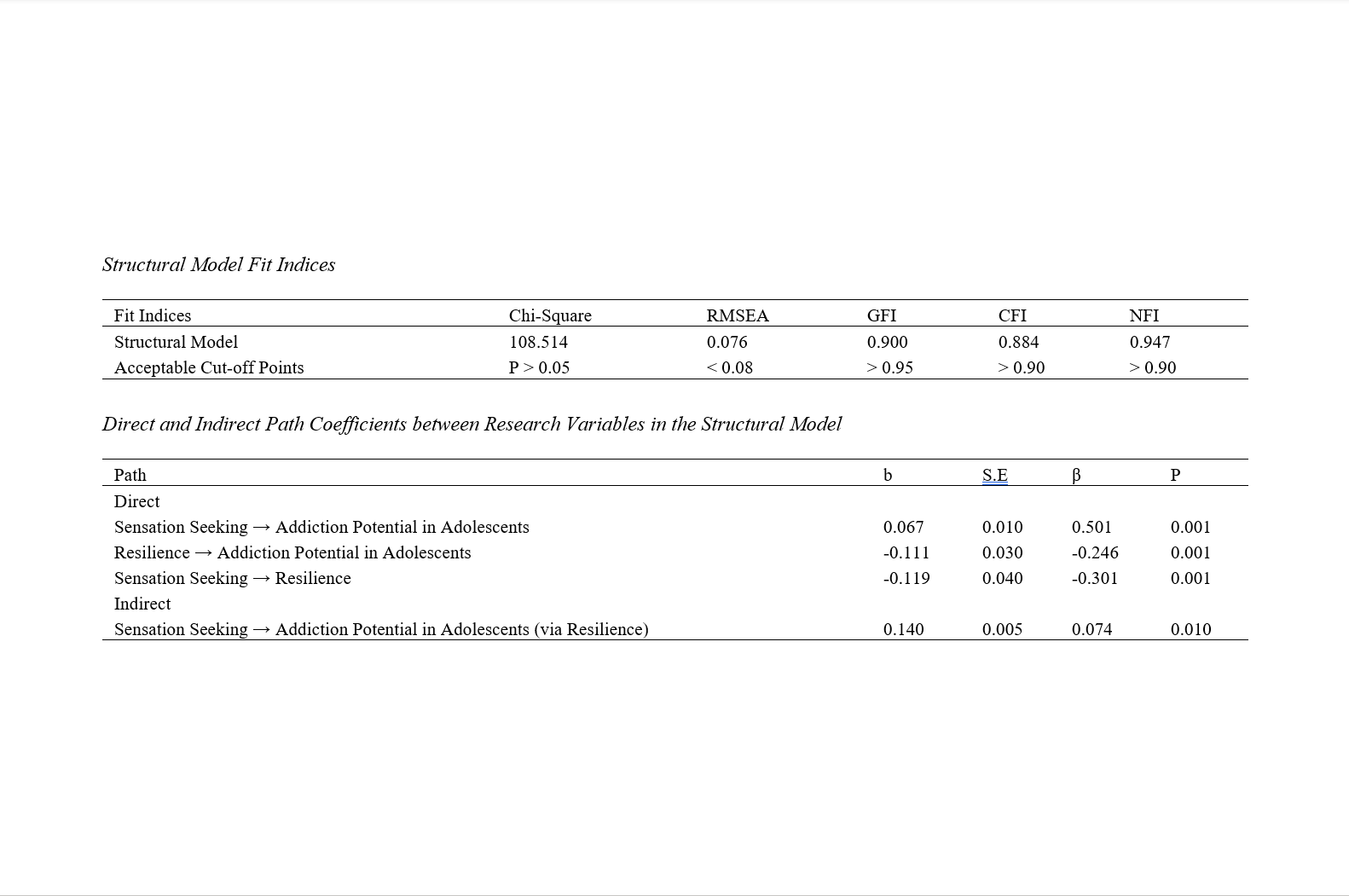
Findings: The results showed that sensation seeking (β = 0.501, P = 0.001) positively and significantly predicted addiction potential in adolescents, while resilience (β = -0.246, P = 0.001) negatively and significantly predicted addiction potential in adolescents. Sensation seeking, through the mediation of resilience, predicted addiction potential in adolescents (β = 0.074, P = 0.010).
Conclusion: Sensation seeking, through the mediation of resilience, predicted addiction potential in adolescent boys. It is recommended that specialists implement educational and therapeutic programs aimed at enhancing resilience for sensation-seeking adolescents and youth in educational and university settings.
Downloads
Downloads
Additional Files
Publication Timeline
- Submitted
- Revised
- Accepted
Issue
Section
License
Copyright (c) 2024 Azar Akbari (Author); Nastern Sharifi (Corresponding Author); Hassan Pasha Sharifi, Malek Mirhashmi (Author)

This work is licensed under a Creative Commons Attribution-NonCommercial 4.0 International License.