The Mediating Role of Early Maladaptive Schemas in the Relationship between Individual and Contextual Risk-Protective Factors and Attitudes towards Substance Use in Adolescents
DOI:
https://doi.org/10.61838/kman.jayps.5.11.12Keywords:
Early maladaptive schemas, risk-protective factors, attitudes towards substance useAbstract
Objective: This study aimed to examine the mediating role of early maladaptive schemas in the relationship between individual and contextual risk-protective factors and attitudes towards substance use in adolescents.
Methods and Materials: The statistical population of this research included all high school students in Gorgan city. A sample of 400 individuals was selected through multi-stage cluster sampling. The research instruments included the Young Schema Questionnaire-Short Form (Young, 1998), the Risk and Protective Factors Scale (Mohammad Khani, 2007), and the Substance Use Attitude Questionnaire (Delavar et al., 2004). Data analysis was conducted using structural equation modeling in the PLS software.
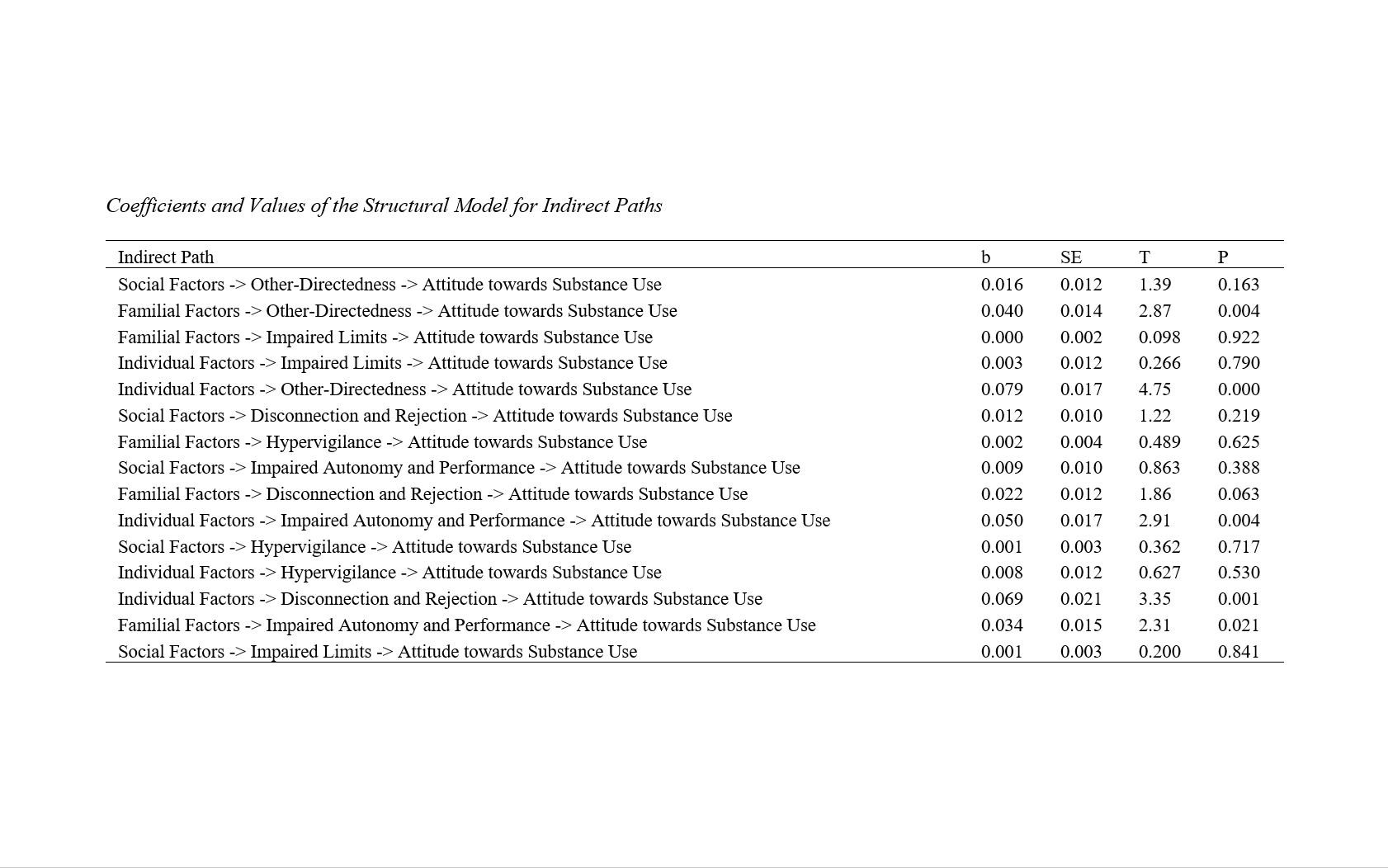
Findings: The findings indicated that the model, which included individual and contextual risk/protective factors as predictors of substance use, significantly explained the variance in scores attributed to the mediating variables of impaired autonomy and performance, impaired limits, other-directedness, and hypervigilance. Additionally, the model, which included individual and contextual risk/protective factors as predictors of substance use, significantly explained the variance in scores attributed to the criterion variable of attitudes towards substance use.
Conclusion: Based on the results, it can be concluded that maladaptive schemas can explain part of the shared variance between the two factors, risk/protective factors, and attitudes towards substance use in adolescents. In fact, maladaptive schemas play a mediating role in the relationship between risk/protective factors and attitudes towards substance use.
Downloads
Downloads
Additional Files
Publication Timeline
- Submitted
- Revised
- Accepted
Issue
Section
License
Copyright (c) 2024 Farima Bakhtiari Saeed (Author); Saeed Imani (Corresponding Author); Omid Shokri (Author)

This work is licensed under a Creative Commons Attribution-NonCommercial 4.0 International License.