Cyberbullying Exposure and Rejection Sensitivity as Predictors of Social Withdrawal
DOI:
https://doi.org/10.61838/kman.jarac.7.2.23Keywords:
Cyberbullying, Rejection Sensitivity, Social Withdrawal, AdolescentsAbstract
Objective: This study aimed to examine the predictive roles of cyberbullying exposure and rejection sensitivity in explaining social withdrawal among Malaysian adolescents.
Methods and Materials: A correlational descriptive design was employed with a sample of 424 secondary school students in Malaysia, selected based on the Krejcie and Morgan sample size table. Participants completed standardized questionnaires assessing cyberbullying exposure (European Cyberbullying Intervention Project Questionnaire), rejection sensitivity (Rejection Sensitivity Questionnaire), and social withdrawal (Child Behavior Checklist subscale). Data were analyzed using SPSS version 27, with Pearson’s correlation tests used to examine the relationships among variables and standard multiple linear regression employed to identify the predictive power of the independent variables on social withdrawal. All assumptions of linearity, normality, homoscedasticity, and multicollinearity were verified prior to regression analysis.
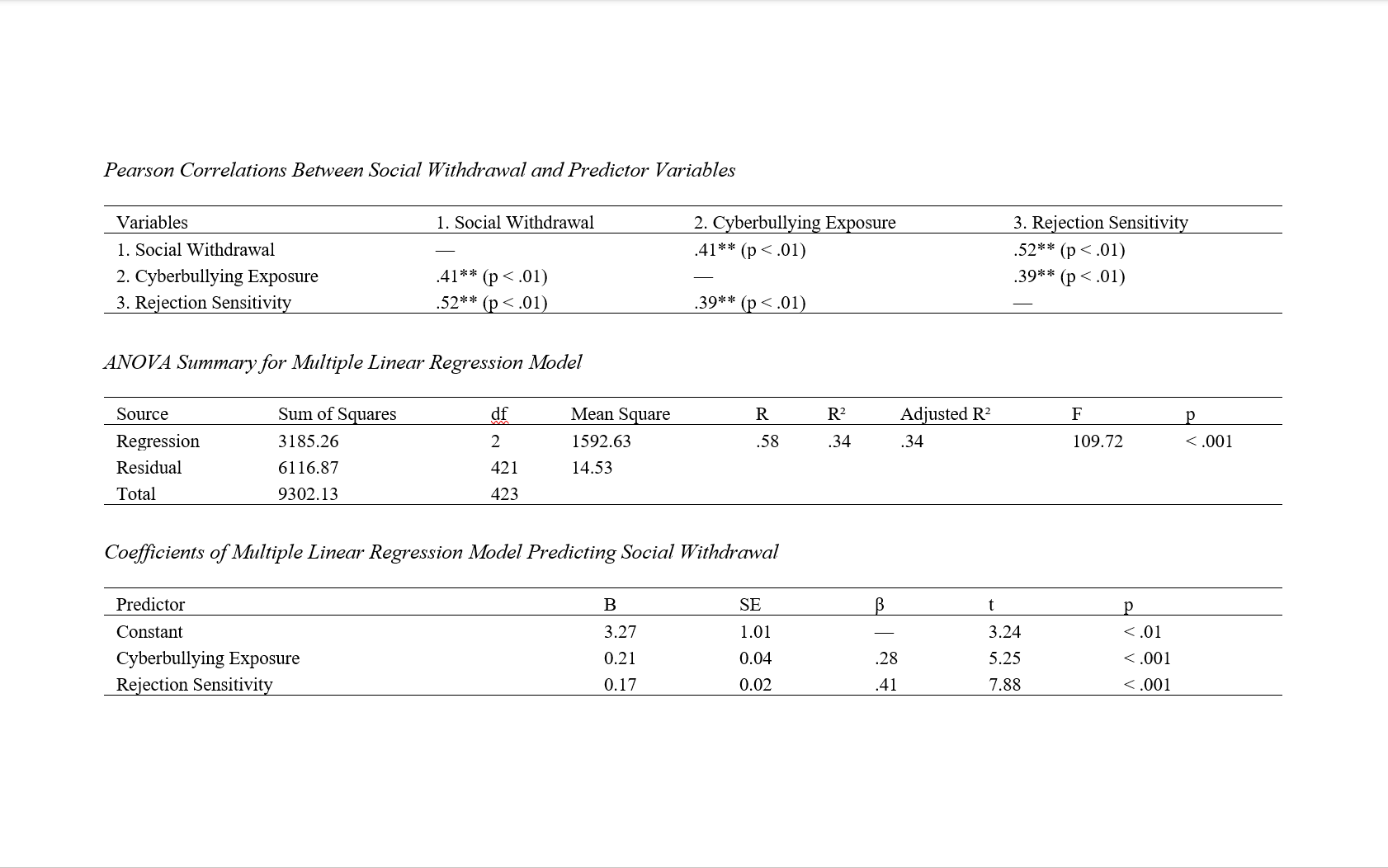
Findings: Pearson correlation results showed that social withdrawal was significantly and positively correlated with both cyberbullying exposure (r = .41, p < .01) and rejection sensitivity (r = .52, p < .01). The regression model was statistically significant, F(2, 421) = 109.72, p < .001, with an R² of .34, indicating that the model explained 34% of the variance in social withdrawal. Both predictors made significant contributions: cyberbullying exposure (B = 0.21, β = .28, t = 5.25, p < .001) and rejection sensitivity (B = 0.17, β = .41, t = 7.88, p < .001).
Conclusion: These findings highlight the significant influence of both cyberbullying exposure and rejection sensitivity on adolescent social withdrawal. Rejection sensitivity emerged as a stronger predictor, suggesting that internal psychological dispositions may amplify the behavioral consequences of external stressors. Intervention programs targeting both online victimization and emotional-cognitive vulnerabilities are essential for mitigating social withdrawal in adolescents.
Downloads
References
Ali, S., & Rohner, R. P. (2025). Parental Rejection in Childhood Leads to Interpersonal Rejection Sensitivity in Adulthood. 153-162. https://doi.org/10.4324/9781003441243-10
Andrews, J. L., Khin, A. C., Crayn, T., Humphreys, K., & Schweizer, S. (2022). Measuring Online and Offline Social Rejection Sensitivity in the Digital Age. Psychological assessment, 34(8), 742-751. https://doi.org/10.1037/pas0001136
Balaya, M., & Sündermann, O. (2024). The Roles of Appearance-Based Rejection Sensitivity and Race-Based Rejection Sensitivity in Body Dysmorphic Symptoms. Asia Pacific Journal of Counselling and Psychotherapy, 15(1), 16-31. https://doi.org/10.1080/21507686.2024.2363784
Bondü, R., Bilgin, A., & Warschburger, P. (2020). Justice Sensitivity and Rejection Sensitivity as Predictors and Outcomes of Eating Disorder Pathology: A 5‐year Longitudinal Study. International Journal of Eating Disorders, 53(6), 926-936. https://doi.org/10.1002/eat.23273
Charoensukmongkol, P. (2023). The Interaction of Organizational Politics and Political Skill On employees' Exposure To workplace Cyberbullying: The conservation of Resources Theory Perspective. Asia-Pacific Journal of Business Administration, 16(4), 940-957. https://doi.org/10.1108/apjba-08-2022-0364
Denehey, A. M. (2023). Behavioural Reactions to Rejection: The Respective Influence of Attachment and Rejection Sensitivity. https://doi.org/10.26181/21852645.v1
Dorfman, A. (2022). Rejection Sensitivity and Wise Reasoning. https://doi.org/10.17605/osf.io/ftzjx
Dorfman, A., Oakes, H., & Grossmann, I. (2020). Rejection Sensitivity Hurts Your Open Mind: Rejection Sensitivity and Wisdom in Workplace Conflicts. Academy of Management Proceedings, 2020(1), 20479. https://doi.org/10.5465/ambpp.2020.20479abstract
Gong, P., Li, X., Yang, Y., Yang, Y., Xue, M., & Zhang, M. (2024). The Influence of Testosterone on Rejection Sensitivity: Insights From Salivary Testosterone Levels and Genetic Polymorphisms. Journal of Pacific Rim Psychology, 18. https://doi.org/10.1177/18344909241254499
Hafner, N., Pepping, C. A., & Wertheim, E. H. (2019). Dispositional Mindfulness, Rejection Sensitivity, and Behavioural Responses to Rejection: The Role of Emotion Regulation. Australian Journal of Psychology, 71(2), 163-170. https://doi.org/10.1111/ajpy.12224
Jiang, Y., Ren, Y., Liu, T., & You, J. (2020). Rejection Sensitivity and Adolescent Non‐suicidal Self‐injury: Mediation Through Depressive Symptoms and Moderation by Fear of Self‐compassion. Psychology and Psychotherapy Theory Research and Practice, 94(S2), 481-496. https://doi.org/10.1111/papt.12293
Kraines, M. A., Kelberer, L. J., & Wells, T. T. (2018). Rejection Sensitivity, Interpersonal Rejection, and Attention for Emotional Facial Expressions. Journal of Behavior Therapy and Experimental Psychiatry, 59, 31-39. https://doi.org/10.1016/j.jbtep.2017.11.004
Kuai, S. (2024). The Effect of Violent Online Games Exposure on Chinese Teenagers’ Cyberbullying: The Mediation Role of Cognitive Empathy and Affective Empathy. International Journal of Academic Research in Progressive Education and Development, 13(2). https://doi.org/10.6007/ijarped/v13-i2/21095
Li, A., & Junyan, Z. (2022). A Review on Rejection Sensitivity. Psychology of China, 4(1), 82-91. https://doi.org/10.35534/pc.0401011
Mishra, M., Reis, S., & Allen, M. S. (2024). Predicting Relationship Outcomes From Rejection Sensitivity in Romantic Couples: Testing Actor and Partner Effects. Current Psychology, 43(36), 29095-29107. https://doi.org/10.1007/s12144-024-06431-5
Murphy, R. (2019). Adverse Personality Traits as Predictors of Rejection Sensitivity to Romantic Rejection. https://doi.org/10.13140/rg.2.2.26631.55206
Richter, M., & Schoebi, D. (2021). Rejection Sensitivity in Intimate Relationships. Zeitschrift Für Psychologie, 229(3), 165-170. https://doi.org/10.1027/2151-2604/a000448
Shin, J., Han, K. S., & Shin, H. J. (2024). Rejection Sensitivity: A Concept Analysis. Journal of Korean Academy of Psychiatric and Mental Health Nursing, 33(3), 253-261. https://doi.org/10.12934/jkpmhn.2024.33.3.253
Sigler, S. (2024). Rejection Sensitivity Dysphoria. 374-374. https://doi.org/10.4324/9781003464891-68
Vatansever, Z. A., Astar, M., Cömert, I. T., Ibrahim, I., & Başer, İ. G. (2023). Cyberbullying Perpetration in Adolescence in Terms of Exposure to Cyberbullying Levels. https://doi.org/10.36315/2023inpact019
Zhang, Y. (2024). The Influence of Media Violence Exposure on Cyberbullying Among Adolescents: The Mediating Role of Parental Monitoring. Hc, 1(10). https://doi.org/10.61173/69a8wm57
Downloads
Additional Files
Publication Timeline
- Submitted
- Revised
- Accepted
Issue
Section
License

This work is licensed under a Creative Commons Attribution-NonCommercial 4.0 International License.