Maladaptive Beliefs as a Mediator Between Trauma and Anxiety in Adult Survivors
DOI:
https://doi.org/10.61838/kman.jarac.3925Keywords:
Trauma, Maladaptive Beliefs, AnxietyAbstract
Objective: This study aimed to examine the mediating role of maladaptive beliefs in the relationship between trauma exposure and anxiety symptoms in adult survivors.
Methods and Materials: A descriptive correlational design was employed with a sample of 430 adult participants from Taiwan, selected based on Krejcie and Morgan’s sample size table. Participants completed the Life Events Checklist for DSM-5 (LEC-5) to assess trauma exposure, the Posttraumatic Cognitions Inventory (PTCI) to measure maladaptive beliefs, and the Beck Anxiety Inventory (BAI) to evaluate anxiety symptoms. Descriptive statistics and Pearson correlation analyses were performed using SPSS-27 to examine bivariate relationships, while Structural Equation Modeling (SEM) was conducted in AMOS-21 to assess the direct, indirect, and total effects among the study variables and to test the model’s fit.
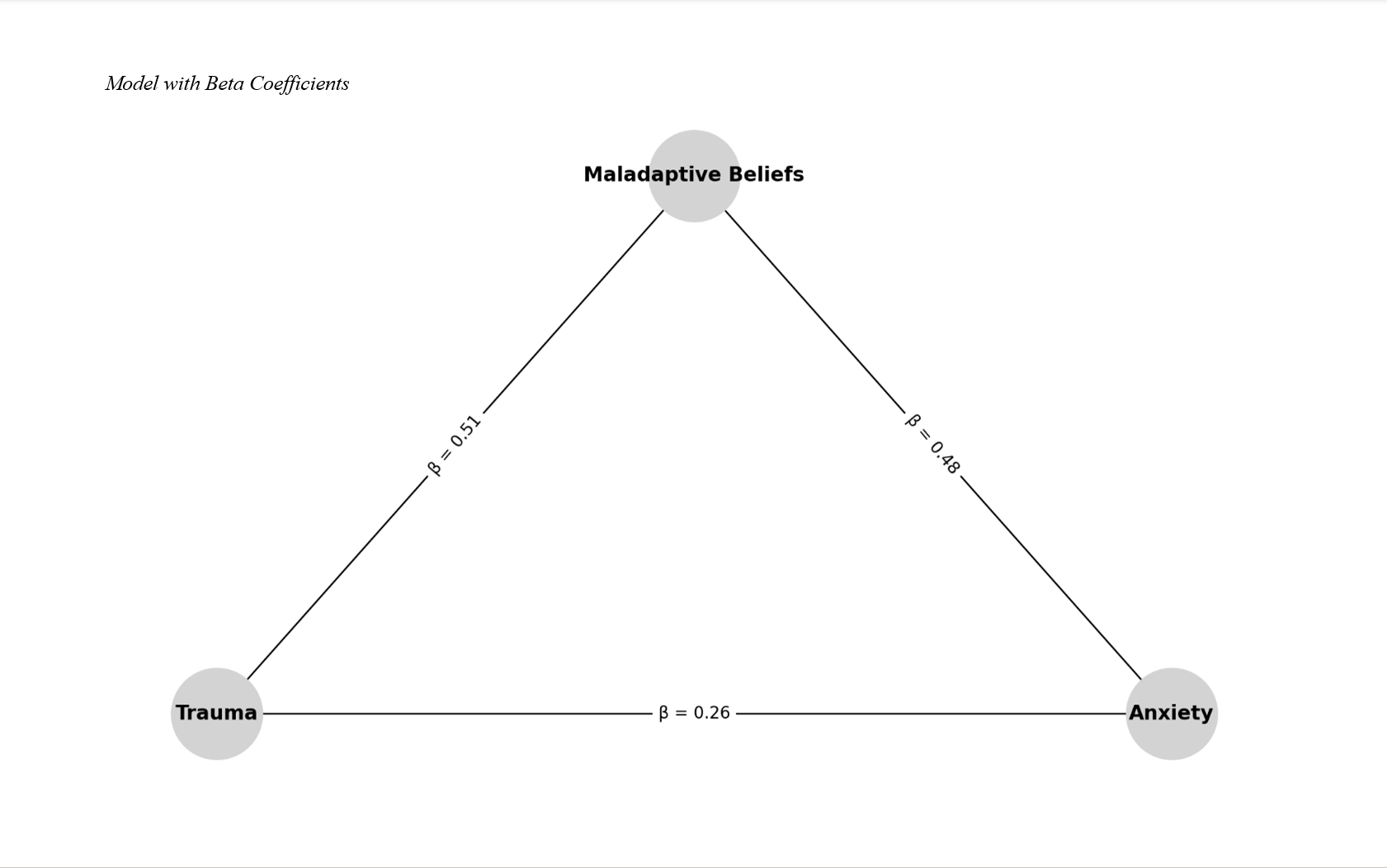
Findings: The results showed significant positive correlations between trauma and maladaptive beliefs (r = .51, p < .001), trauma and anxiety (r = .46, p < .001), and maladaptive beliefs and anxiety (r = .62, p < .001). SEM analysis indicated that maladaptive beliefs significantly mediated the relationship between trauma and anxiety. The direct path from trauma to anxiety (β = .26, p < .001), the path from trauma to maladaptive beliefs (β = .51, p < .001), and the path from maladaptive beliefs to anxiety (β = .48, p < .001) were all statistically significant. The indirect effect of trauma on anxiety through maladaptive beliefs (β = .25, p < .001) confirmed partial mediation. Model fit indices indicated a good fit (χ²/df = 2.41, CFI = 0.98, RMSEA = 0.057).
Conclusion: Addressing these dysfunctional cognitions may be essential for reducing anxiety symptoms and improving trauma recovery outcomes.
Downloads
References
Artime, T. M., & Peterson, Z. D. (2015). Feelings of Wantedness and Consent During Nonconsensual Sex: Implications for Posttraumatic Cognitions. Psychological Trauma Theory Research Practice and Policy, 7(6), 570-577. https://doi.org/10.1037/tra0000047
Beck, J. G., Reich, C. M., Woodward, M. J., Olsen, S. A., Jones, J. M., & Patton, S. C. (2015). How Do Negative Emotions Relate to Dysfunctional Posttrauma Cognitions? An Examination of Interpersonal Trauma Survivors. Psychological Trauma Theory Research Practice and Policy, 7(1), 3-10. https://doi.org/10.1037/a0032716
Boska, R. L., & Capron, D. W. (2021). Exploring the Maladaptive Cognitions of Moral Injury Within a Primarily Combat-Trauma Military Sample. Psychological Trauma Theory Research Practice and Policy, 13(8), 861-868. https://doi.org/10.1037/tra0001071
Contractor, A. A., Caldas, S. V., Banducci, A. N., & Armour, C. (2022). A Pilot Study Examining Roles of Cognitions and Affect Between Positive Memory Processing and Posttraumatic Stress Disorder Symptom Severity. Psychological Trauma Theory Research Practice and Policy, 14(4), 661-668. https://doi.org/10.1037/tra0000625
Davis, R. S., Halligan, S. L., Meiser‐Stedman, R., Elliott, E., Ward, G., & Hiller, R. M. (2022). A Longitudinal Investigation of the Relationship Between Trauma-Related Cognitive Processes and Internalising and Externalising Psychopathology in Young People in Out-of-Home Care. Research on Child and Adolescent Psychopathology, 51(4), 485-496. https://doi.org/10.1007/s10802-022-01005-0
Fenerci, R. L. B., & DePrince, A. P. (2018). Shame and Alienation Related to Child Maltreatment: Links to Symptoms Across Generations. Psychological Trauma Theory Research Practice and Policy, 10(4), 419-426. https://doi.org/10.1037/tra0000332
Georgina Gómez de La, C., Schweizer, S., Diehle, J., Young, J., & Meiser‐Stedman, R. (2019). The Relationship Between Maladaptive Appraisals and Posttraumatic Stress Disorder: A Meta-Analysis. European Journal of Psychotraumatology, 10(1). https://doi.org/10.1080/20008198.2019.1620084
Glad, K. A., Aakvaag, H. F., Wentzel‐Larsen, T., Dyb, G., & Thoresen, S. (2024). What Will Others Think of Me? The Longitudinal Association Between Trauma-Related Shame and Guilt and Psychopathology After a Terror Attack. BJPsych Open, 10(1). https://doi.org/10.1192/bjo.2023.624
Hansford, M., & Jobson, L. (2021). Associations Between Relationship Quality, Social Network Resources, Appraisals, Coping, and Posttraumatic Stress Disorder Symptoms. Psychological Trauma Theory Research Practice and Policy, 13(5), 575-585. https://doi.org/10.1037/tra0001015
Hiller, R. M., Halligan, S. L., Ariyanayagam, R., Dalgleish, T., Smith, P., Yule, W., Glucksman, E., Watson, P., & Meiser‐Stedman, R. (2015). Predictors of Posttraumatic Stress Symptom Trajectories in Parents of Children Exposed to Motor Vehicle Collisions. Journal of Pediatric Psychology, 41(1), 108-116. https://doi.org/10.1093/jpepsy/jsv068
Ito, D., Watanabe, A., & Osawa, K. (2021). Mindful Attention Awareness and Cognitive Defusion Are Indirectly Associated With Less PTSD-like Symptoms via Reduced Maladaptive Posttraumatic Cognitions and Avoidance Coping. Current Psychology, 42(2), 1182-1192. https://doi.org/10.1007/s12144-021-01521-0
Jaffe, A. E., DiLillo, D., Gratz, K. L., & Messman‐Moore, T. L. (2019). Risk for Revictimization Following Interpersonal and Noninterpersonal Trauma: Clarifying the Role of Posttraumatic Stress Symptoms and Trauma‐Related Cognitions. Journal of Traumatic Stress, 32(1), 42-55. https://doi.org/10.1002/jts.22372
Jensen, T. K., Holt, T., Ormhaug, S. M., Fjermestad, K. W., & Wentzel‐Larsen, T. (2018). Change in Post-Traumatic Cognitions Mediates Treatment Effects for Traumatized Youth—A Randomized Controlled Trial. Journal of counseling psychology, 65(2), 166-177. https://doi.org/10.1037/cou0000258
Karatzias, T., Jowett, S., Begley, A., & Deas, S. (2016). Early Maladaptive Schemas in Adult Survivors of Interpersonal Trauma: Foundations for a Cognitive Theory of Psychopathology. European Journal of Psychotraumatology, 7(1). https://doi.org/10.3402/ejpt.v7.30713
Katrinli, S., Stevens, J., Wani, A. H., Lori, A., Kilaru, V., van Rooij, S. J. H., Hinrichs, R., Powers, A., Gillespie, C. F., Michopoulos, V., Gautam, A., Jett, M., Hammamieh, R., Yang, R., Wildman, D., Qu, A., Koenen, K., Aiello, A. E., Jovanovic, T., . . . Smith, A. K. (2020). Evaluating the impact of trauma and PTSD on epigenetic prediction of lifespan and neural integrity. Neuropsychopharmacology, 45(10), 1609-1616. https://doi.org/10.1038/s41386-020-0700-5
Kong, R. (2024). Childhood Trauma and Adolescent Anxiety Disorders: A Comprehensive Study From Root Causes to Intervention. Lecture Notes in Education Psychology and Public Media, 43(1), 67-74. https://doi.org/10.54254/2753-7048/43/20240655
Kracker Imthon, A., Antônio Caldart, C., do Rosário, M. C., Fontenelle, L. F., Constantino Miguel, E., & Arzeno Ferrão, Y. (2020). Stressful Life Events and the Clinical Expression of Obsessive–Compulsive Disorder (OCD): An Exploratory Study. Journal of clinical medicine, 9(10).
Maeda, S., Shimada, H., Sato, T., Tashiro, K., & Tanaka, Y. (2017). Translation and Initial Validation of the Japanese Version of the Self-Beliefs Related to Social Anxiety Scale. Psychological Reports, 120(2), 305-318. https://doi.org/10.1177/0033294116686037
Magwai, T., & Xulu, K. R. (2022). Physiological Genomics Plays a Crucial Role in Response to Stressful Life Events, the Development of Aggressive Behaviours, and Post-Traumatic Stress Disorder (PTSD). Genes, 13(2), 300. https://doi.org/10.3390/genes13020300
McIlveen, R., Mitchell, R., Curran, D., Dyer, K. F. W., Corry, M., DePrince, A. P., Dorahy, M. J., & Hanna, D. (2022). Exploring the Relationship Between Alienation Appraisals, Trauma, Posttraumatic Stress, and Depression. Psychological Trauma Theory Research Practice and Policy, 14(6), 998-1006. https://doi.org/10.1037/tra0000523
McLean, C. P., Zang, Y., Gallagher, T., Suzuki, N., Yarvis, J. S., Litz, B. T., Mintz, J., Young-McCaughan, S., Peterson, A. L., & Foa, E. B. (2019). Trauma-Related Cognitions and Cognitive Emotion Regulation as Mediators of PTSD Change Among Treatment-Seeking Active-Duty Military Personnel With PTSD. Behavior therapy, 50(6), 1053-1062. https://doi.org/10.1016/j.beth.2019.03.006
Mitchell, R., Hanna, D., Brennan, K., Curran, D., McDermott, B., Ryan, M., Craig, K. S. W., McCullough, E., Wallace, P., & Dyer, K. F. W. (2018). Alienation Appraisals Mediate the Relationships Between Childhood Trauma and Multiple Markers of Posttraumatic Stress. Journal of Child & Adolescent Trauma, 13(1), 11-19. https://doi.org/10.1007/s40653-018-0220-1
Moradi, A., Piltan, M., Choobin, M. H., Azadfallah, P., Watson, P., Dalgleish, T., & Hitchcock, C. (2021). Proof of Concept for the Autobiographical Memory Flexibility (MemFlex) Intervention for Posttraumatic Stress Disorder. Clinical Psychological Science, 9(4), 686-698. https://doi.org/10.1177/2167702620982576
Pan, M. R., Zhang, S.-Y., Chen, C.-L., Qiu, S., Liu, L., Li, H., Zhao, M., Dong, M., Si, F., Wang, Y., & Qian, Q. (2023). Bidirectional Associations Between Maladaptive Cognitions and Emotional Symptoms, and Their Mediating Role on the Quality of Life in Adults With ADHD: A Mediation Model. Frontiers in Psychiatry, 14. https://doi.org/10.3389/fpsyt.2023.1200522
Read, D. L., Clark, G. I., Rock, A. J., & Coventry, W. L. (2018). Adult Attachment and Social Anxiety: The Mediating Role of Emotion Regulation Strategies. PLoS One, 13(12), e0207514. https://doi.org/10.1371/journal.pone.0207514
Scher, C. D., Suvak, M. K., & Resick, P. A. (2017). Trauma Cognitions Are Related to Symptoms Up to 10 Years After Cognitive Behavioral Treatment for Posttraumatic Stress Disorder. Psychological Trauma Theory Research Practice and Policy, 9(6), 750-757. https://doi.org/10.1037/tra0000258
Shabahang, R., Aruguete, M. S., Rezaei, S., & McCutcheon, L. E. (2021). Psychological Determinants and Consequences of COVID-19 Anxiety: A Web-Based Study in Iran. Health Psychology Research, 9(1). https://doi.org/10.52965/001c.24841
Srinivas, T., DePrince, A. P., & Chu, A. T. (2015). Links Between Posttrauma Appraisals and Trauma-Related Distress in Adolescent Females From the Child Welfare System. Child abuse & neglect, 47, 14-23. https://doi.org/10.1016/j.chiabu.2015.05.011
Stein, J., El‐Haj‐Mohamad, R., Stammel, N., Vöhringer, M., Wagner, B., Nesterko, Y., Böttche, M., & Knaevelsrud, C. (2024). Changes in Trauma Appraisal During Brief Internet-Based Exposure and Cognitive Restructuring Treatment for Arabic-Speaking People With PTSD. European Journal of Psychotraumatology, 15(1). https://doi.org/10.1080/20008066.2024.2324631
Stensvehagen, M. T., Bronken, B. A., Lien, L., & Larsson, G. (2020). Interrelationship of Posttraumatic Stress, Hassles, Uplifts, and Coping in Women With a History of Severe Sexual Abuse: A Cross-Sectional Study. Journal of interpersonal violence, 37(5-6), 2289-2309. https://doi.org/10.1177/0886260520935479
Stensvehagen, M. T., Bronken, B. A., Lien, L., & Larsson, G. (2022). Association of Daily Hassles, Daily Uplifts, Coping Styles and Stress‐related Symptoms Among Women Exposed to Sexual Abuse—A Cross‐sectional Study. Scandinavian Journal of Caring Sciences, 37(1), 117-130. https://doi.org/10.1111/scs.13107
Ullman, S. E., Peter‐Hagene, L. C., & Relyea, M. (2014). Coping, Emotion Regulation, and Self-Blame as Mediators of Sexual Abuse and Psychological Symptoms in Adult Sexual Assault. Journal of Child Sexual Abuse, 23(1), 74-93. https://doi.org/10.1080/10538712.2014.864747
Zhang, H. (2025). The Relationship Between Childhood Trauma and Social Anxiety in College Students: The Mediating Role of Evaluation Fear. BMC psychiatry, 25(1). https://doi.org/10.1186/s12888-025-06668-9
Downloads
Additional Files
Publication Timeline
- Submitted
- Revised
- Accepted
Issue
Section
License

This work is licensed under a Creative Commons Attribution-NonCommercial 4.0 International License.