Examining the Relationship between Ethical Climate and Organizational Commitment with the Mediating Role of Organizational–Professional Conflict in Educational Settings of Physical Education and Sport Sciences
DOI:
https://doi.org/10.61838/kman.ijimob.4617Keywords:
Ethical Climate, Organizational Commitment, Organizational–Professional Conflict, Educational Settings, Impression management, Sport SciencesAbstract
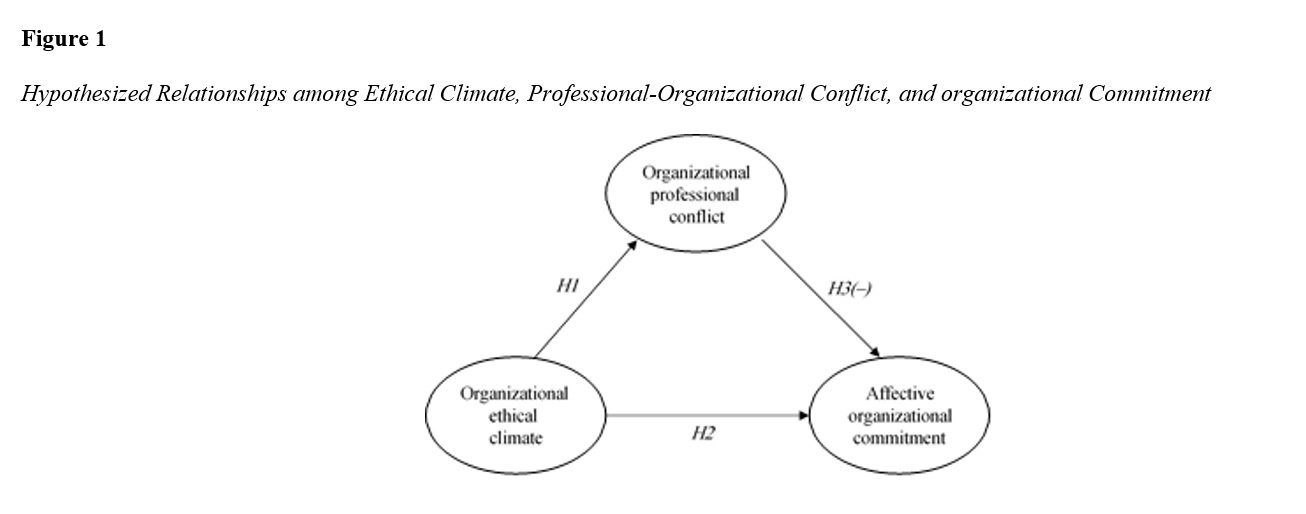
Objective: This study aimed to examine the relationship between ethical climate and organizational commitment among physical education teachers in Iran, focusing on the mediating role of organizational–professional conflict.
Methods and Materials: A correlational–descriptive design was used. The statistical population consisted of all physical education teachers in Iran (N ≈ 27,000). Based on Cochran and Sharp’s formula, 476 participants were selected through random sampling. Data were collected using four standardized instruments: the Ethical Climate Questionnaire (Cullen et al., 1993), the Organizational–Professional Conflict Questionnaire (Shafer et al., 2002), the Affective Commitment Scale (Meyer & Allen, 1984), and the Impression Management Scale (Paulhus, 1991). Cronbach’s alpha coefficients ranged from 0.76 to 0.89, confirming acceptable reliability. Data were analyzed using Pearson correlation and hierarchical regression analysis via AMOS software, with significance set at p < 0.05.
Findings: Results revealed that ethical climate dimensions significantly influenced both organizational–professional conflict and affective commitment. Egoistic/individual, egoistic/cosmopolitan, and benevolent/local climates negatively predicted organizational–professional conflict, whereas principled/individual and principled/cosmopolitan climates showed positive effects. Ethical climate variables accounted for 47% of the variance in organizational–professional conflict and 37% in affective commitment. Organizational–professional conflict exhibited a significant negative correlation with affective commitment but did not mediate the relationship between ethical climate and commitment. Impression management significantly influenced reported perceptions of ethical climate and commitment, indicating potential social desirability bias.
Conclusion: The ethical climate in educational organizations plays a pivotal role in shaping teachers’ commitment and managing professional conflicts. Benevolent and principled ethical climates foster stronger affective commitment, whereas egoistic climates undermine it. However, organizational–professional conflict does not function as a mediator in this relationship. Enhancing ethical awareness, fairness, and supportive communication among educational managers can improve teachers’ affective commitment and organizational harmony.
Downloads
References
Adniyah, H., Masluchah, A. L., Alfiah, A. N., Lameriya, D., & Mardiyah, M. (2024). Implementation of Career Planning and Employee Conflict Resolution Techniques. JISIP, 8(4), 2606. https://doi.org/10.58258/jisip.v8i4.7530
Ammari, N., & Gantare, A. (2024). Ethical climate and turnover intention among nurses: A scoping review. Nursing Ethics. https://doi.org/10.1177/09697330241296875
Aranya, N., & Ferris, K. R. (1984). A Reexamination of Accountants' Organizational-Professional Conflict. The Accounting Review, 59(1), 1-15. https://aapc.khu.ac.ir/browse.php?a_id=494&sid=1&slc_lang=en
Augustine, P., & Bora, R. (2024). A study of any association between organizational climate on communication, decision-making and conflict handling aspects. JASRAE, 21(7), 175-183. https://doi.org/10.29070/ye25fj61
Bates, J., Beus, J. M., & Parkinson, S. (2025). Contextualizing Ethical Climate: Examining Contextual Moderators of the Connection Between Ethical Climate Perceptions and Ethical Behavior. Journal of Business Ethics, 196(1), 129-148. https://doi.org/10.1007/s10551-024-05698-9
Bohuslavska, S., Kravchenko, O., & Rusalovsky, A. (2024). EFFECTIVE CONFLICT MANAGEMENT IN THE PUBLIC ADMINISTRATION SYSTEM AS A FACTOR IN PROMOTING THE DEVELOPMENT OF THE BUSINESS ENVIRONMENT. Es(193), 144-148. https://doi.org/10.30838/EP.193.144-148
Bravo, G., Fuentes-Garcia, A., Arriagada, M., & Castellucci, H. (2024). Methodological considerations in the study of perceived discrimination at work and its association with workers' health and occupational outcomes: A scoping review. Medwave, 24(04), e2910. https://doi.org/10.5867/medwave.2024.04.2910
Caso, T. J., Li, K. M., & Suzuki, L. A. (2023). Ethical issues and professional standards in psychotherapy. Encyclopedia of mental health. https://doi.org/10.1016/B978-0-323-91497-0.00221-6
Cullen, J. B., Victor, B., & Bronson, J. W. (1993). The Ethical Climate Questionnaire: An Assessment of its Development and Validity. Psychological Reports, 73(2), 667-674. https://doi.org/10.2466/pr0.1993.73.2.667
Fantahun, B., Dellie, E., Worku, N., & Debie, A. (2023). Organizational commitment and associated factors among health professionals working in public hospitals of southwestern Oromia, Ethiopia. BMC Health Services Research, 23(1), 180. https://doi.org/10.1186/s12913-023-09167-3
Ferreira, R. D. S., Marcon, G. B., Rodrigues Júnior, R. A., & Antunes Neto, J. M. F. (2024). Conflict management in the hospital environment and the nursing sector: a literature review. Brazilian Journal of Health Review, 7(5), e73093. https://doi.org/10.34119/bjhrv7n5-258
Ginting, S., Amar, I., Palupiningtyas, D., Khaerunnisa, F., & Rakkang, Y. (2024). Analysis of Conflict Management and Internal Communication on Employee Satisfaction in Creative Industries in Indonesia. WSSHS, 2(07), 1212-1220. https://doi.org/10.58812/wsshs.v2i07.1081
Goodarzi, S., Imanzadeh, M., Javid, M., & Amirhosseini, S. E. (2023). Investigating the Relationship Between Professional Ethics of Physical Education Teachers and Their Work Engagement with the Mediator Role of Self-Efficacy and Psychological Empowerment. Journal of School Psychology, 11(4), 92-105. https://jsp.uma.ac.ir/article_2046.html
Hyatt, J., & Gruenglas, J. (2023). Ethical Considerations in Organizational Conflict. Conflict Management - Organizational Happiness, Mindfulness, and Coping Strategies. https://doi.org/10.5772/intechopen.1002645
İncekara, İ., Karamanlıoğlu, A. U., & Sığrı, Ü. (2024). Ethical Leadership Behaviors and Employee Perceptions of Organizational Justice: A Qualitative Research. JLSDGR, 5(2), e03122. https://doi.org/10.47172/2965-730X.SDGsReview.v5.n02.pe03122
Io, O. V. (2023). Work ethics climate and organizational commitment in Nigeria: The moderating role of retention factors. International Journal of Research in Management, 5(2), 14-23. https://doi.org/10.33545/26648792.2023.v5.i2a.87
Juniarti, J. (2024). Study of Work Motivation, Work Discipline, and Communication on Employee Organizational Commitment. Ijems, 1(2), 181-187. https://doi.org/10.61132/ijems.v1i2.65
Karaca Güzel, F., & Göksoy, S. (2023). THE RELATIONSHIP BETWEEN ORGANIZATIONAL SILENCE EDUCATION EXPERIENCED IN SECONDARY EDUCATION INSTITUTIONS AND SCHOOL CULTURE. International Journal on Lifelong Education and Leadership, 9(2), 46-59. https://doi.org/10.25233/ijlel.1235484
Kobiyh, M., El Amri, A., Sahib Eddine, A., & Oulfarsi, S. (2024). Literature Review and Theoretical Generalizations of the Ethics Role in Business and Management: Family Business as a Case Study. BEL, 8(1), 93-106. https://doi.org/10.61093/bel.8(1).93-106.2024
Konrad Lorenz, E., Contreras García, F., González Alvarado, T. E., & Cabanelas Lorenzo, P. (2025). Retos en la gestión del talento humano: el papel del marketing interno en tiempos desfavorables. SUMNEG, 16(34), 1-9. https://doi.org/10.14349/sumneg/2025.V16.N34.A1
Kumar, M. S., & Kanta, P. T. (2024). Quality of Work Life of Employees working in MSME registered Plastic Industries at Odisha. Ijfmr, 6(4), 24048. https://doi.org/10.36948/ijfmr.2024.v06i04.24048
Lin, H., & Villanueva, L. E. (2024). Conflict management styles and organizational citizenship behavior towards a proactive conflict resolution program. JEER, 9(1), 432-442. https://doi.org/10.54097/6d9q2930
Maryani, M., & Gazali, A. U. (2024). The Effect of Work Conflict on Job Stress and Employee Performance. GRHRM, 4(2), 158-171. https://doi.org/10.52970/grhrm.v4i2.494
Meyer, J. P., & Allen, N. J. (1984). Testing the "side-bet theory" of organizational commitment: Some methodological considerations. Journal of Applied Psychology, 69(3), 372-378. https://doi.org/10.1037//0021-9010.69.3.372
Mosquera, P., Tigre, F. B., & Alegre, M. (2024). Overcoming organizational politics and unlocking meaningful work through ethical leadership. IJOES. https://www.emerald.com/insight/content/doi/10.1108/IJOES-04-2024-0108/full/html
Motsamai, P. F. T., & Onyenankeya, K. (2025). Employee perceptions of internal communication in culturally diverse workplaces in South Africa: A systematic literature review. Social Sciences & Humanities Open, 11, 101589. https://doi.org/10.1016/j.ssaho.2025.101589
Mou, F., & Dai, Y. (2024). Towards a Unified Framework of Work Commitment and Identification: Integrating Multiple Foci and Dimensions in Employee-Organization Relationships. FBEM, 17(1), 28-35. https://doi.org/10.54097/s0fyxt29
Muthuswamy, V. V., & Varshika, G. (2023). Factors Affecting Workplace Crime: Role of Organizational Commitment, Job Satisfaction, Self-efficacy, Ethical Climate and Deviant Behavior. International Journal of Criminal Justice Sciences, 18(2), 12-26. https://ijcjs.com/menu-script/index.php/ijcjs/article/view/673
Nirwana, I., Sriyanti, E., & Nurdyanti, A. (2025). Analysis of Employee Work Effectiveness from Communication and Work Environment. EF, 7(1), 46-57. https://doi.org/10.32877/ef.v7i1.1724
Nur, A. L., Sulistyaningsih, E., & Nilawati, L. (2024). Ethical work climate and whistleblowing intention. JMM, 23(2), 123-138. https://doi.org/10.28932/jmm.v23i2.7817
Odhiambo, O. K., Samwel, N. N., Ogenga, F. O., & Otieno, M. (2023). An Investigation of the Causes of Conflicts between Teaching Staff and Principals in Public Secondary Schools in Rachuonyo South Sub-County, Kenya. East African Journal of Educational Studies, 6(2), 264-276. https://doi.org/10.37284/eajes.6.2.1319
Olivia Putri, A., Sefia, D., Indah Fitria, S., & April, L. (2024). Peran Human Relation dalam Menciptakan Lingkungan Kerja yang Harmonis dan Produktif. Konsensus, 1(6), 140-148. https://doi.org/10.62383/konsensus.v1i6.476
Ostermeier, K., Anzollitto, P., Cooper, D., & Hancock, J. (2023). When identities collide: organizational and professional identity conflict and employee outcomes. Management Decision, 61(9), 2493-2511. https://doi.org/10.1108/MD-07-2022-0971
Parboteeah, K. P., Weiss, M., & Hoegl, M. (2024). Ethical Climates Across National Contexts: A Meta-Analytical Investigation. Journal of Business Ethics, 189(3), 573-590. https://doi.org/10.1007/s10551-023-05387-z
Paulhus, D. L. (1991). Measurement and Control of Response Bias In Measures of Personality and Social Psychological Attitudes. Elsevier. https://doi.org/10.1016/B978-0-12-590241-0.50006-X
Pike Lacy, A. M., Bowman, T. G., & Singe, S. M. (2024). Secondary School Athletic Trainers' Experiences Managing Workplace Organizational-Professional Conflict. Journal of Athletic Training, 59(10), 1042-1049. https://doi.org/10.4085/1062-6050-0627.23
Saberi, K., Sarraf, F., Banimahd, B., & Hamidian, M. (2024). The role of political ideology and auditors' professionalism on organizational professional conflict. Journal of Management Accounting and Auditing Knowledge, 14(53), 305-322. https://www.jmaak.ir/article_23506.html
Shafer, W. E., Park, L. J., & Liao, W. M. (2002). Professionalism, organizational–professional conflict and work outcomes: A study of certified management accountants. Accounting, Auditing & Accountability Journal, 15(1), 46-68. https://doi.org/10.1108/09513570210418888
Shukla, J., Stein, C., Bush, J. T., & Janardhanan, N. S. (2024). Should I do this? Incongruence in the face of conflicting moral and role expectations. Human Resource Management Review, 34(2), 101010. https://doi.org/10.1016/j.hrmr.2023.101010
Wu, W., & Merialses, R. D. (2024). Assessing the Impact of Leadership Styles on Organizational Effectiveness in Chinese Vocational Schools. JEER, 10(3), 121-126. https://doi.org/10.54097/qp1dq624
Yaseen, U., Idrees, R. N., Shakil, M. H., Haider, S. Z., & Khalil, J. (2025). Influence of academic leadership on organizational commitment of faculty members in private sector universities: mediating role of work engagement. QAE, 33(1), 17-30. https://doi.org/10.1108/QAE-04-2024-0072
Downloads
Additional Files
Publication Timeline
- Submitted
- Revised
- Accepted