Presenting the Organizational Legitimacy Model in Iraqi Public Universities
DOI:
https://doi.org/10.61838/kman.ijimob.4340Abstract
Objective: This study aimed to develop and validate a comprehensive model of organizational legitimacy in Iraqi public universities.
Methodology: The research employed a quantitative–descriptive design. The statistical population consisted of 6,000 employees from Iraqi public universities, from which a sample of 361 participants was selected through stratified random sampling using Cochran’s formula. Data were collected using a researcher-developed questionnaire containing 80 items across 14 dimensions, including independence, innovation, organizational culture, participation, commitment, adaptability, leadership style, organizational support, reward systems, result orientation, mission clarity, organizational behavior, identity, and organizational structure. Validity was established through content and construct validity procedures, while reliability was confirmed with a Cronbach’s alpha coefficient of 0.86. Data analysis was performed using structural equation modeling (SEM) with LISREL software, and model fit was assessed using multiple fit indices.
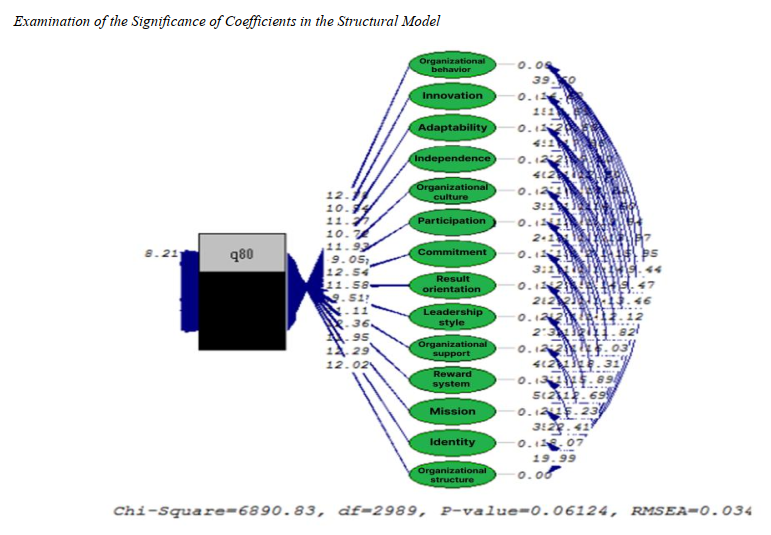
Findings: All dimensions demonstrated statistically significant path coefficients, generally exceeding 0.5, with many approaching or surpassing 0.8, indicating strong contributions to organizational legitimacy. The highest factor loadings were observed for independence, innovation, and organizational culture. All t-values exceeded 1.96, confirming statistical significance. Model fit indices indicated strong alignment with the observed data.
Conclusion: The validated model confirms that organizational legitimacy in Iraqi public universities is a multidimensional construct influenced by both internal capabilities and external stakeholder perceptions. Strengthening independence, fostering innovation, cultivating organizational culture, promoting participation, and ensuring transparent governance are key strategies for enhancing legitimacy. The model offers a practical framework for policymakers and university leaders to guide institutional development and strategic planning in higher education.
Downloads
References
Adams, N. P. (2022). The concept of legitimacy. Canadian Journal of Philosophy, 52(4), 381-395. https://doi.org/10.1017/can.2022.35
Bitektine, A., Hill, K., Song, F., & Vandenberghe, C. (2020). Organizational legitimacy, reputation, and status: Insights from micro-level measurement. Academy of Management Discoveries, 6(1), 107-136. https://doi.org/10.5465/amd.2017.0007
Díez-Martín, F., Blanco-González, A., & Diez-de-Castro, E. (2021). Measuring a scientifically multifaceted concept. The jungle of organizational legitimacy. European Research on Management and Business Economics, 27(1), 100131. https://doi.org/10.1016/j.iedeen.2020.10.001
Fu, J. S., & Wang, R. (2024). Multiple Pathways to Organizational Legitimacy: Information Visibility, Organizational Listening, and Cross-Sector Partnerships. Public Relations Review, 50(4), 1-28. https://doi.org/10.1016/j.pubrev.2024.102484
Gnes, D., & Vermeulen, F. (2018). Legitimacy as the basis for organizational development of voluntary organizations. In Handbook of community movements and local organizations in the 21st century (pp. 189-209). https://doi.org/10.1007/978-3-319-77416-9_12
Haddad, F. (2018). Understanding Iraq's Hashd al-Sha'bi: State and Power in Post-2014 Iraq. The Century Foundation. https://www.academia.edu/
Haghi Shima, S., Ardakani, S., & Sakhtro, M. (2021). Proposing a Model for the Legitimacy of Human Resource Management: A Case Study of the National Iranian Oil Company. Strategic Studies in Oil and Energy, 12(48), 252-267. https://ipom.journals.pnu.ac.ir/
Hampel, C. E., & Tracey, P. (2017). How organizations move from stigma to legitimacy: The case of Cook's travel agency in Victorian Britain. Academy of Management journal, 60(6), 2175-2207. https://doi.org/10.5465/amj.2015.0365
Herrera, E. W. (2016). Governance and development: the importance of legitimacy and institutional change Local governance, economic development and institutions. Palgrave Macmillan UK. https://doi.org/10.1057/9781137557599_2
Kazemi, N., & Heydari, M. (2021). The Relationship Between Ethical Leadership, Organizational Legitimacy, Organizational Hypocrisy, and Teacher Job Outcomes. Journal of Educational Leadership and Management, 15(2). http://edu.journals.iau-garmsar.ac.ir/article_682356.html?lang=fa
Khandan Del, V., Hosanzadeh, S., & Akbarpour, T. (2022). Examining the Importance of Organizational Legitimacy in Organizations. Proceedings of the Fourth International Conference on Innovative Approaches in Management, Psychology, and Human Sciences in the 21st Century, Tehran.
Massey, J. E. (2001). Managing organizational legitimacy: Communication strategies for organizations in crisis. The Journal of Business Communication (1973), 38(2), 153-182. https://doi.org/10.1177/002194360103800202
Mazidi Sharafbadi, M. (2025). The Impact of Green Human Resource Management on Sustainable Development Performance with the Role of Organizational Legitimacy, Organizational Competition, and Responsible Leadership Payame Noor University, Yazd Center].
Nazampour, S. (2025). Examining the Impact of Human Dignity on Job Loyalty with the Mediating Role of Organizational Legitimacy in the Judiciary of Ardabil Province Ardabil University].
Rahdarpour, J., Kikhai, M. R., Siasar, A., Atashfaraz, M., Ismaili, N., Vahidi, S. A., & Kha, O. (2023). The Impact of Human Resource Management and Social Responsibility on Organizational Legitimacy. Dynamic Management and Business Analysis, 2(3), 13-26. https://doi.org/10.61838/dmbaj.2.3.2
Rahnavard, F., Masoumi, S., & Hajipour, B. (2023). The Effects of Organizational Communications on Organizational Legitimacy with the Mediating Role of Social Responsibility. JMDP, 36(1), 59-90. https://doi.org/10.61186/jmdp.36.1.59
Razagh Moradi, H. (2022). Effective Institutional Independence of Public Universities in Iran: The Necessity of Dynamism in a Globalized Space. Journal Of Research and Planning In Higher Education, 20(4), 1-28. https://journal.irphe.ac.ir/article_702854.html
Razmkhah, Y., & Sajadi Khah, G. (2024). Examining the Indicators of Human Resource Management and Social Responsibility on Organizational Legitimacy Factors (Case Study: National Bank Branches in Kohgiluyeh and Boyer-Ahmad Province). New Research Approaches in Management and Accounting Quarterly, 8(28), 1137-1151. https://majournal.ir/index.php/ma/article/view/2316
Salehi, F., Arefnezhad, M., Hasanvand, A., & Hakkak, M. (2024). The Impact of Innovation Strategies and Green Information System on Green Innovation with the Mediating Role of Green Organizational Identity and Environmental Organizational Legitimacy. Journal of Natural Environment, 77(2), 227-239. https://doi.org/10.22059/jne.2024.370688.2637
Soltani, S., Ali, A., & Amirkhani, T. (2020). A Comparative Study on the Impact of Mergers on Organizational Legitimacy and Employee Organizational Identity. Iranian Management Research, 24(2), 61-86. https://mri.modares.ac.ir/article_524.html
Thomas, T. E., & Lamm, E. (2012). Legitimacy and organizational sustainability. Journal of Business Ethics, 110(2), 191-203. https://doi.org/10.1007/s10551-012-1421-4
Wang, Q. (2023). Nonprofit organizational legitimacy and government grants under authoritarianism: Evidence from Chinese foundations. International Public Management Journal, 26(4), 489-506. https://doi.org/10.1080/10967494.2022.2077866
Wooten, M., & Hoffman, A. J. (2017). Organizational fields: Past, present and future. The Sage Handbook of Organizational Institutionalism, 2, 55-74. https://doi.org/10.4135/9781446280669.n3
Zheng, L. J., Wang, Y. A., Lin, H. Y., & Liu, W. (2023). Understanding Circular Economy Adoption by SMEs: A Case Study on Organizational Legitimacy and Industry 4.0. Industrial Management & Data Systems, 123(4), 1157-1177. https://doi.org/10.1108/IMDS-04-2022-0266
Downloads
Additional Files
Publication Timeline
- Submitted
- Revised
- Accepted
Issue
Section
License
Copyright (c) 2025 Ahmed Jalil Mohaisen Al Shuwaili (Author); Hamid Reza Bahrami (Corresponding Author); Tariq Kadhim Shlaka , Enayat Ollah Aghaei, Mehrdad Sadeghi (Author)

This work is licensed under a Creative Commons Attribution-NonCommercial 4.0 International License.