Structural Equation Modeling of the Relationships Between Intellectual Capital, Psychological Capital, and Human Resource Productivity
DOI:
https://doi.org/10.61838/kman.ijimob.4030Keywords:
Intellectual Capital, Psychological Capital, Human Resource Productivity, Structural Equation Modeling, Organizational PerformanceAbstract
Objective: The purpose of this study was to investigate the interrelationships among intellectual capital, psychological capital, and human resource productivity in the banking sector.
Methods and Materials: The research employed a cross-sectional survey design using structural equation modeling (SEM). The statistical population consisted of managers of Parsian Bank branches in Tehran, from which 287 individuals were selected through simple random sampling. Data were collected using three instruments: Bontis’s Intellectual Capital Questionnaire, Luthans’s Psychological Capital Questionnaire, and a researcher-developed Human Resource Productivity Questionnaire. Reliability was confirmed with Cronbach’s alpha coefficients above acceptable thresholds, and validity was verified by expert review. Data analysis was performed using SPSS and LISREL, with model fit assessed through indices such as RMSEA, GFI, and AGFI.
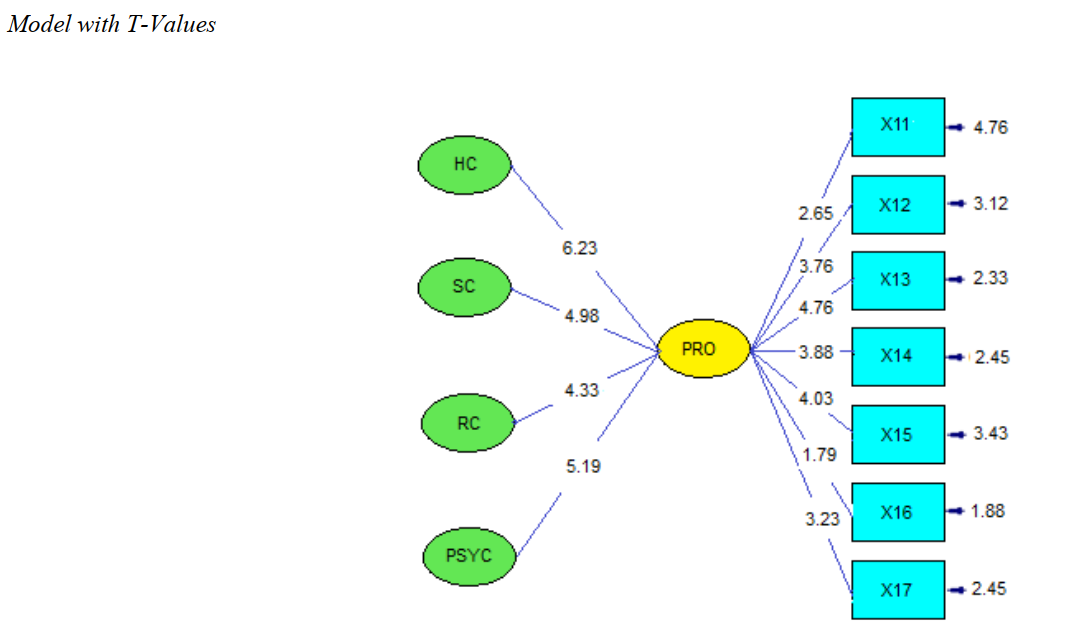
Findings: The results revealed that intellectual capital significantly and positively influenced human resource productivity. Among its components, human capital exerted the strongest effect (path coefficient = 0.37), followed by structural capital (0.29) and relational capital (0.23). In addition, psychological capital had a positive and significant impact on human resource productivity, with a standardized coefficient of 0.32. All path coefficients were statistically significant (t-values > 1.96), confirming the robustness of the relationships. Goodness-of-fit indices indicated that the proposed structural model adequately fit the data, with RMSEA = 0.077, GFI = 0.90, and AGFI = 0.89.
Conclusion: The study underscores the dual importance of intellectual capital and psychological capital as complementary intangible resources that jointly enhance human resource productivity. By investing in knowledge-based assets and fostering positive psychological states among employees, organizations—particularly in knowledge-intensive industries like banking—can achieve sustainable improvements in productivity and competitiveness.
Downloads
References
Al Kahtani, N. S., & Sulphey, M. M. (2022). A study on how psychological capital, social capital, workplace wellbeing, and employee engagement relate to task performance. Sage Open, 12(2). https://doi.org/10.1177/21582440221095010
Almurumudhe, L. K. A., Mahdad, A., Abdulkadhim Johni, A., & Yousefi, Z. (2024). The Mediating Role of Self-Esteem in the Relationship between Psychological Capital, Academic Engagement, and Academic Procrastination with Academic Performance among Students in Al-Diwaniyah, Iraq [Research Article]. Iranian Journal of Educational Sociology, 7(3), 1-9. https://doi.org/10.61838/kman.ijes.7.3.1
Alshebami, A. S. (2021). The influence of psychological capital on employees’ innovative behavior: Mediating role of employees’ innovative intention and employees’ job satisfaction. Sage Open, 11(3). https://doi.org/10.1177/21582440211040809
Anam, R. K. (2024). Study of the influence of capital and intellectual capital on employee performance using structural equation modeling. Modern Management Review, 29(3), 123-135. https://doi.org/10.7862/rz.2024.mmr.12
Asutay, M., & Ubaidillah. (2023). Examining the Impact of Intellectual Capital Performance on Financial Performance in Islamic Banks. Journal of the Knowledge Economy. https://doi.org/10.1007/s13132-023-01114-1
Chantabutr, P., & Wanarat, S. (2024). The effect of human capital, employee performance on work process improvement and employee performance on work productivity on sustainable competitive advantage in Thai banks. International Journal of Learning and Intellectual Capital, 21(1), 6-29. https://doi.org/10.1504/IJLIC.2024.136375
Cosa, M., Pedro, E., & Urban, B. (2024). How to assess the intellectual capital of firms in uncertain times: A systematic literature review and a proposed model for practical adoption. Journal of Intellectual Capital, 25(7), 1-22. https://doi.org/10.1108/JIC-05-2023-0096
Emami, D., Ahmadi, M., & Ghaffari, R. (2024). Presenting a Pattern of Flexible working Hours in Government Organizations with an Emphasis on Increasing the Productivity Level of Academic Employees in the Ministry of Cooperation, Labor and Social Welfare [Research Article]. Iranian Journal of Educational Sociology, 7(1), 57-65. https://doi.org/10.61838/kman.ijes.7.1.6
Faridi, A., Djamil, M., Saluy, A. B., & Nurhayati, M. (2022). Relationship of intellectual capital, work environment and human resources engagement with community health center performance using the SEM-PLS approach. Endless: International Journal of Future Studies, 5(3), 227-246. https://doi.org/10.22216/endless.v5i3.110
Frank, B., Eckrich, H., & Rohr, J. (1997). Quality nursing care, leadership makes the difference. Journal of Nursing Administration, 27(3), 13-14.
Hatum, A. (2010). Next generation talent management. Palgrave Macmillan. https://doi.org/10.1057/9780230295094
Hu, X., Zhang, Y., Wang, S., & Li, L. (2023). Assessing the effects of organizational support, psychological capital, organizational identification on job performance among nurses: A structural equation modeling approach. BMC Health Services Research, 23, 705. https://doi.org/10.1186/s12913-023-09705-z
Husain, F., Yulia, R., Syaifudin, A., Karyadi, S., & Alatas, A. R. (2025). Human Resource Development in Increasing Work Productivity. International Journal Of Education, Social Studies, And Management (IJESSM)VL - 5(2), 845-850. https://doi.org/10.52121/ijessm.v5i2.794
Kengatharan, N. (2019). A knowledge-based theory of the firm: Nexus of intellectual capital, productivity and firms' performance. International Journal of Manpower, 40(6), 1056-1074. https://doi.org/10.1108/IJM-03-2018-0096
Mutonyi, B. R. (2021). Employees’ psychological capital and innovative behavior in higher education. International Journal of Quality and Service Sciences, 13(2), 198-215. https://doi.org/10.1108/IJQSS-02-2020-0024
Ognjanović, J., Mandarić, M., & Sekulić, D. (2022). Intellectual Capital and Productivity of Managers: The Case Study of Hotel Industry in Serbia. Bizinfo Blace, 13(1), 1-9. https://doi.org/10.5937/bizinfo2201001o
Pigola, A., De Santi, P. V., da Costa, P. R., & Storopoli, J. (2022). Intellectual capital on performance: A meta-analysis study enhancing a new perspective of the components. Journal of Intellectual Capital, 23(6), 1379-1403. https://doi.org/10.1108/JIC-01-2021-0025
Trivedi, K., & Srivastava, K. B. L. (2024). The impact of intellectual capital-enhancing HR practices and culture on innovativeness—Mediating role of knowledge management processes. Journal of Organizational Effectiveness: People and Performance, 11(3), 573-593. https://doi.org/10.1108/JOEPP-05-2023-0174
Vilariño del Castillo, M. (2022). Antecedents of psychological capital at work: A systematic review of moderator–mediator effects and a new integrative proposal. European Management Review, 19(3), 363-379. https://doi.org/10.1111/emre.12460
Downloads
Additional Files
Publication Timeline
- Submitted
- Revised
- Accepted
Issue
Section
License
Copyright (c) 2025 Morteza Robatmili (Author)

This work is licensed under a Creative Commons Attribution-NonCommercial 4.0 International License.