Identification and Ranking of Organizational Factors Affecting the Formation of Deviant Behaviors in the Workplace of Al-Qadisiyah University, Republic of Iraq
DOI:
https://doi.org/10.61838/kman.ijimob.3681Keywords:
Deviant employee behaviors, workplace, organizational factors, ranking, Al-Qadisiyah UniversityAbstract
Objective: The present study aimed to identify and rank the organizational factors influencing the formation of deviant behaviors in the workplace at Al-Qadisiyah University, Iraq.
Methodology: This research employed a mixed-method approach (qualitative-quantitative). The participants in the qualitative section included 21 experts and administrative and educational managers from Al-Qadisiyah University, Iraq, who were interviewed using semi-structured interviews until theoretical saturation was reached. Data were analyzed using a three-stage coding process (initial, organizing, and overarching) for thematic analysis. In the quantitative section, the statistical population consisted of 180 managers and employees at Al-Qadisiyah University. Using the Krejcie and Morgan table and stratified random sampling, 120 individuals were selected as the sample. The validity of the questionnaire was confirmed through convergent and discriminant validity, and its reliability was confirmed using Cronbach’s alpha (0.862). Data were analyzed using factor analysis and covariance-based structural equation modeling with the AMOS graphical software.
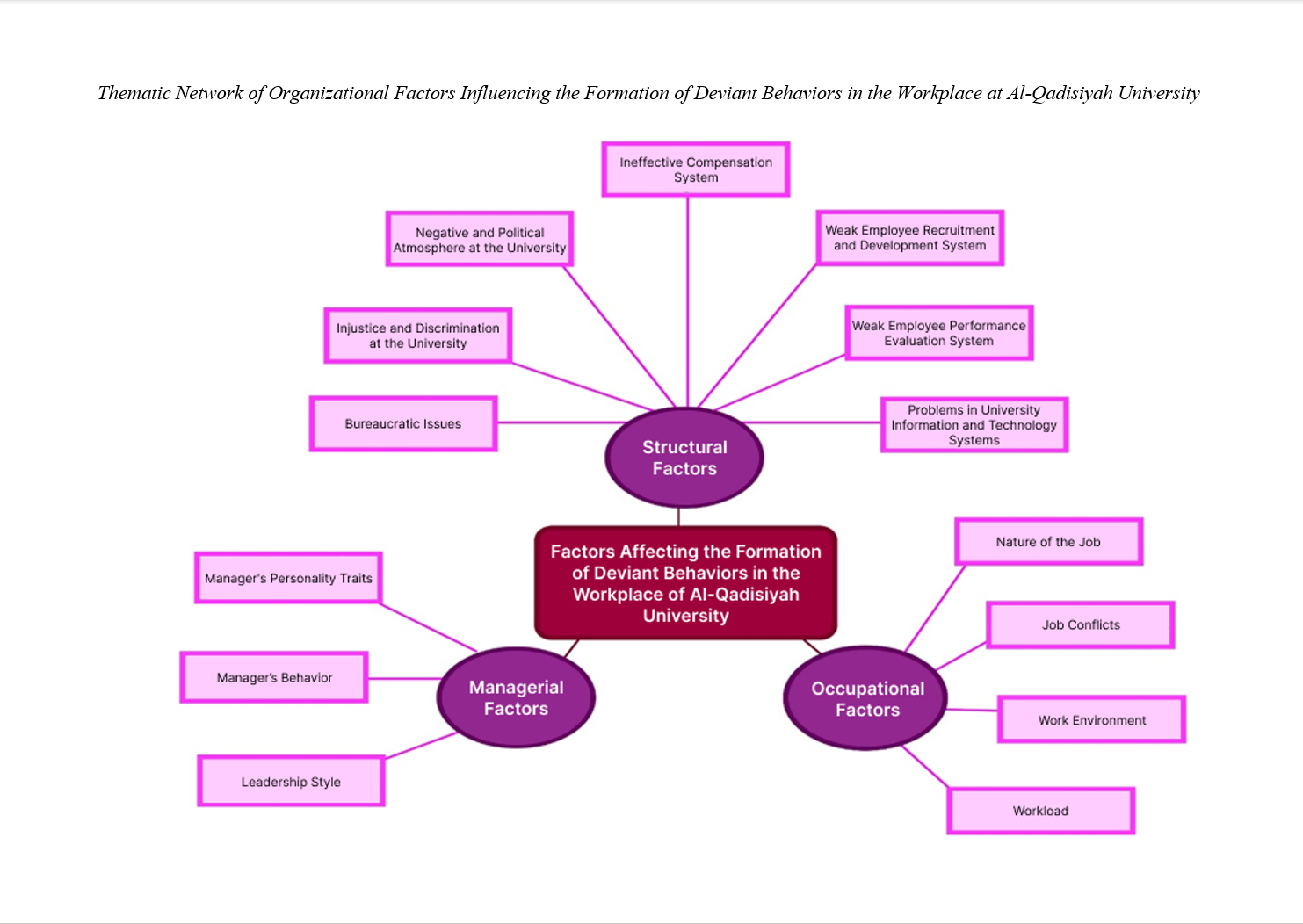
Findings: The findings from the qualitative section identified 101 indicators, 14 components, and 3 dimensions, which included managerial factors, job-related factors, and structural factors. The quantitative findings indicated a good fit for all dimensions and components. The ranking results for organizational factors influencing the formation of deviant behaviors in the workplace were as follows: managerial factors, job-related factors, and structural factors.
Conclusion: It can be concluded that managerial factors play a significant role in the formation of deviant behaviors in the workplace, and therefore, stakeholders should pay attention to these factors.
Downloads
References
Abbaspour, A., Nikmorad, Z., Taheri, M., & Rahimian, H. (2022). Controlling the Factors Affecting Deviant Workplace Behaviors of Administrative Staff of Universities. Organizational Behavior Studies Quarterly, 11(44), 69-91. https://obs.sinaweb.net/article_697548.html
Bazzy, J. D. (2012). Integrity, self-control, and the impact of ego depletion on counterproductive behavior University of Tennessee]. https://trace.tennessee.edu/cgi/viewcontent.cgi?referer=&httpsredir=1&article=2481&context=utk_graddiss
Chirasha, V., & Mahapa, M. (2012). An analysis of the causes and impact of deviant behaviour in the workplace: the case of secretaries in state universities. Journal of Emerging Trends in Economics andManagement Sciences, 3(5), 415-421. https://www.semanticscholar.org/paper/An-analysis-of-the-causes-and-impact-of-deviant-in-Chirasha-Mahapa/31b5c4ca6a9774ae4bdfda56180692f99d0e645d
Connor Peter J. O. Stone, S., Walker, B. R., & Jackson Chris, J. (2019). Deviant behavior in constrained environments: Sensation-Seeking predicts workplace deviance in shallow learners. Personality and individual differences, 27(108), 20-25. https://doi.org/10.1016/j.paid.2016.11.062
Di Stefano, G., Scrima, F., & Parry, E. (2022). The effect of organizational culture on deviant behaviors in the workplace. The International Journal of Human Resource Management, 1-22.
Everton, W. J., Jolton, J. A., & Mastrangelo, P. M. (2017). Be Nice and Fair or Else:Understanding Reasons for Employees' Deviant Behaviors. Journal of Management Development, 26(2), 117-131. https://doi.org/10.1108/02621710710726035
Fine, S., Horowitz, I., Weigler, H., & Basis, L. (2009). Is good character good enough? The effects of situational variables on the relationship between integrity and counterproductive work behaviors. Human Resource Management Review, 19(4), 271-356. https://journals.copmadrid.org/jwop/art/tr2014a1
Gamasiwi, R. J. (2023). How to Reduce Workplace Deviant Behavior : Through Ethical Leadership and Workplace Spirituality With Organizational Commitment as Mediation. International Journal of Scientific Research and Management, 11(12), 5596-5613. https://doi.org/10.18535/ijsrm/v11i12.em10
Ghaedamini Harouni, A., Ebrahimzadeh Dastjerdi, R., & Sadeghi Deh Cheshmeh, M. (2022). Identifying the Dimensions of Deviant Behaviors in the Workplace Using a Meta-Synthesis Approach. Organizational Culture Management Quarterly, 20(3), 647-676. https://doi.org/10.52547/JABM.3.1.19
Griffin, R. W., & Lopez, Y. P. (2012). Bad behavior in organizations: a review and typology for future research. Journal of Management, 31(6), 988-1005. https://doi.org/10.1177/0149206305279942
Hashish, E. A. A. (2020). Nurses' Perception of Organizational Justice and its Relationship to Their Workplace Deviance. Nursing Ethics, 27(1), 273-288. https://doi.org/10.1177/0969733019834978
Kareem, R. F., Ojeleye, C. I., & Sodamade, I. O. (2023). Work Engagement as the Mediator of the Relationship between Workplace Civility and Workplace Deviant Behaviour among Employees of Tertiary Institutions in Zamfara State. Lapai Journal of Economics, 7(1), 70-87. https://doi.org/10.4314/lje.v7i1.5
Khodabakhshi, N. (2024). Examining the Impact of Organizational Democracy on the Citizenship Behavior of Employees in the Foundation for the Needy, with the Mediating role of Job Satisfaction and Organizational Commitment. Dynamic Management and Business Analysis, 2(4), 64-73. https://doi.org/10.22034/dmbaj.2024.2022329.1017
Lee, K., & Allen, N. J. (2002). 'Organisational citizenship behaviour and workplace deviance: The role of affect and cognition'. Journal of Applied Psychology, 87(1), 131-142. https://doi.org/10.1037/0021-9010.87.1.131
Liao, H., Joshi, A., & Chuang, A. (2022). 'Sticking out like a sore thumb: Employee dissimilarity and deviance at work'. Personnel psychology, 57(4), 969-989. https://doi.org/10.1111/j.1744-6570.2004.00012.x
Mach, M., Abrantes, A. C. M., & Alvarado, J. R. (2024). The Role of Perceived Human Resource Management Practices in Organizational Citizenship Behaviors: Evidence From the Healthcare Sector. Employee Relations, 47(1), 127-147. https://doi.org/10.1108/er-07-2023-0386
Magholi, F., & Rudgarnezhad, F. (2024). The Effect of Organizational Cynicism on Perceived Organizational Pride According to the Moderating Role of Demographic Variables of Gilan Oil Company Employees. Dynamic Management and Business Analysis, 2(4), 53-63. https://doi.org/10.22034/dmbaj.2024.2022329.1016
Malmir, A., Abasi, H., Honari, E., & Vafaie, P. (2019). The impizenship behavioract of job burnout on organizational anti-cit. traffic management studies, 1398(54), 31-56. https://www.researchgate.net/publication/363555250
Manaa, Y., Marcus, B., & Schuler, H. (2022). "The Effect of Toxic Leadership on CounterProductive Work Behaviors and Intention to Leave: An Empirical Study" Antecedents of counterproductive behavior at work: A general perspective. International Business Research, Canadian Center of Science and Education, 15(11), 1-11. https://doi.org/10.5539/ibr.v15n11p1 10.1037/0021-9010.89.4.647
Neves, P., & Story, J. (2013). Ethical leadership and reputation: Combined indirect effects on organizational deviance. Journal of Business Ethics, 115(1), 1-12. https://doi.org/10.5465/ambpp.2013.15878abstract
Othman, A. K., Maulud, F. S. F., Rahman, M. K. B. A., & Isa, M. F. M. (2022). Factors Contributing to Employee Workplace Deviant Behaviors in Public Sector Organizations. International Journal of Academic Research in Economics and Management and Sciences, 11(1), 192-207. https://doi.org/10.6007/IJAREMS/v11-i1/12181
Pletzer, J. L., Oostrom, J., & Voelpel, S. C. (2023). Age and workplace deviance: A meta-analytic test and a trait-based examination of 343 why older employees engage in less workplace deviance. Work, Aging and Retirement, 9(2), 153-168. https://doi.org/10.1093/workar/waab033
Rastgar, A., Alavi Matin, F., & Vishlaghi, M. (2022). Social Undermining and Deviant Organizational Behaviors: Investigating the Mediating Role of Organizational Silence and Emotional Exhaustion. Organizational Culture Management, 20(4), 751-779. https://doi.org/10.22059/jomc.2022.342429.1008459
Ray Cherry Hill, T. G. (2024). Influence of Psychological Capital and Employee Engagement on Organizational Citizenship Behavior Among Teaching Personnel in DepEd Davao Del Norte. International Journal of Research Publications, 143(1). https://doi.org/10.47119/ijrp1001431220246095
Robinson, S. L., & Bennett, R. J. (1995). 'A typology of deviant workplace behaviours: A multidimensional scaling study'. Academy of Management journal, 38(2), 555. https://doi.org/10.2307/256693
Robinson, S. L., & Bennett, R. J. (1997). Workplace deviance: Its definition, its nature and its causes. In R. J. Lewicki,B. H. Sheppard, & R. J. Bies (Eds.), Research on negotiation in organization, 6(1), 3-27. https://thomaslawrence.wordpress.com/wp-content/uploads/2008/08/lawrence-and-robinson-2007-ain_t-misbehavin-workplace-deviance-as-organizati.pdf
Sackett, P. R., & Devore, C. (2011). Counterproductive behaviors at work. in N.Anderson, D.S. https://journals.sagepub.com/doi/10.1177/0149206313503019
Shad, S., & Zeinali, M., & Mohammadi, A., & Badavar Nahandi, Y. (2021). The Psychological Role of WorkPlace and Organizational Socialization in Improving Auditors' Ethics by Reducing Deviant Behaviors. Journal of Financial and Behavioral Researches in Accounting, 1(1), 87-106. https://www.magiran.com/paper/2361599
Spector, P. E., & Fox, S. (2009). An emotion-centered model of voluntary work behavior: Some parallels between counterproductive work behavior and organizational citizenship behavior. Human Resource Management Review, 12(1), 269-292. https://doi.org/10.1016/S1053-4822(02)00049-9
Wech, B. A., Howard, j., & Autrey, P. (2022). Workplace Bullying Model : A Qualitative Study on Bullying in Hospitals. Employee Responsibilities and Rights Rights, 32(2), 73-96. https://doi.org/10.1007/s10672-020-09345-z
Yadav, H., Jegasothy, R., Ramakrishnappa, S., Mohanraj, J., & Senan, P. (2019). Unethical Behavior and Professionalism among Medical Students in a private Medical University in Malaysia. BMC Medical Education, 19(1), 1EP - 15. https://doi.org/10.1186/s12909-019-1662-3
Zekipour, S., Farokhseresht, B., Taghipourian, M., & Aghajani, H. (2020). Analysis of Effective Factors on Reducing Abnormal Workplace Behaviors in the Health Sector Based on Meta-Synthesis Technique. Peyavarde Salamat Quarterly, 14(3), 228-240. https://sid.ir/FA/JOURNAL/SearchPaper.aspx?journal=&subject=&writer=143804&year=1399&PDF=&Filter=
Downloads
Additional Files
Publication Timeline
- Submitted
- Revised
- Accepted
Issue
Section
License
Copyright (c) 2025 Sadegh Sarhan Muhammad Sajet, Mehraban Hadi Peykani, Zaki Muhammad Abbas Behiyeh, Badri Shahtalebi (Author)

This work is licensed under a Creative Commons Attribution-NonCommercial 4.0 International License.