Meta-Synthesis of Identifying Servant Leadership Components Based on Employees' Innovative Behavior
DOI:
https://doi.org/10.61838/kman.ijimob.3600Keywords:
Servant Leadership, Innovative Behavior, Meta-SynthesisAbstract
Objective: This study seeks to systematically review the findings of prior studies on this subject through a meta-synthesis approach, analyzing them based on the formation process and outcomes.
Methodology: This research utilizes the meta-synthesis technique and is applied in nature. Accessible and credible documents and records available on websites were examined, focusing on English-language sources from 2010 to 2024 and Persian sources from 2010 to 2024. Among a large number of initial articles, 63 suitable articles were identified. To analyze the selected articles, the concepts, dimensions, and influential components were studied using content analysis. For validating the extracted concepts, a Delphi panel comprising several experts and scholars was employed.
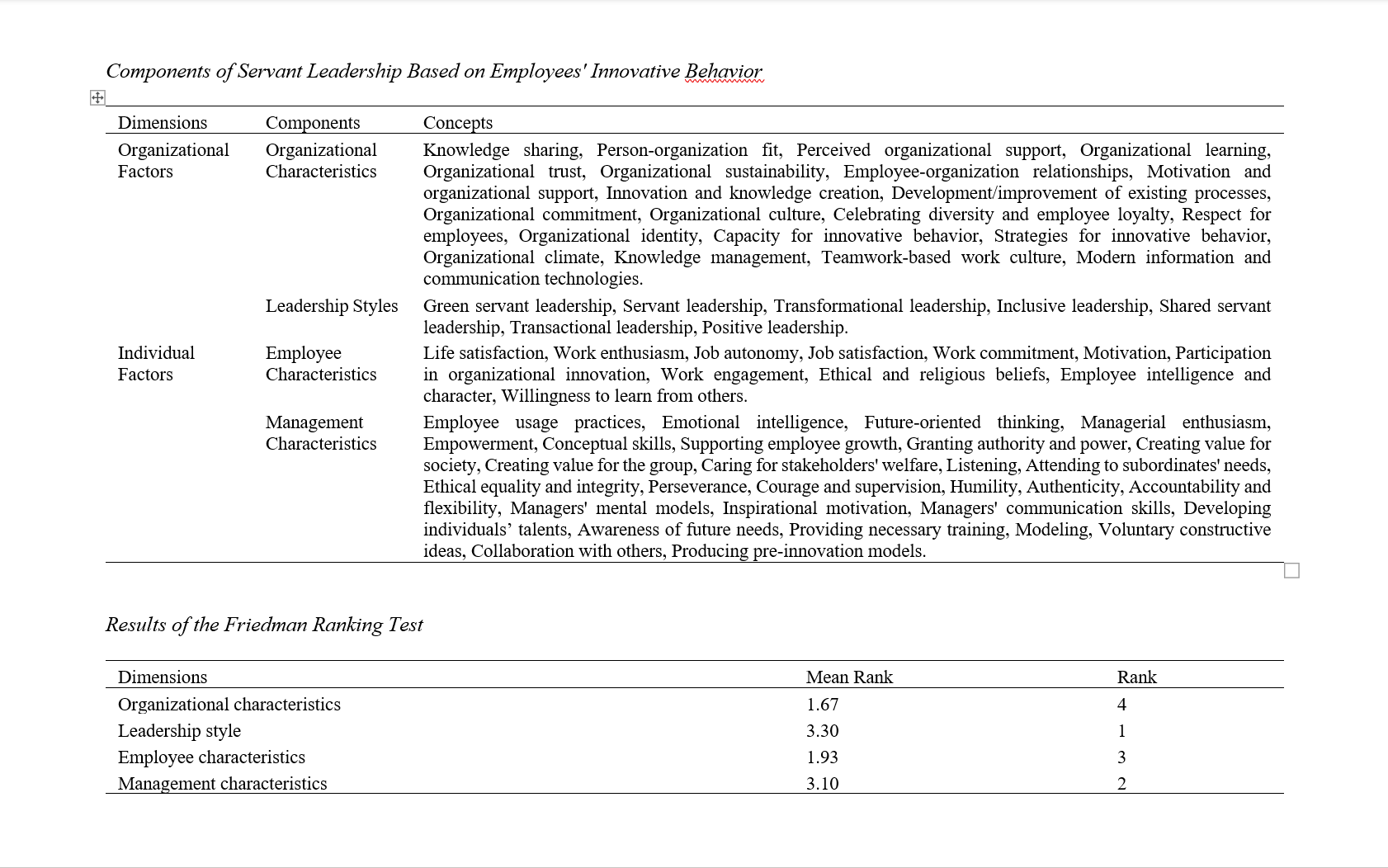
Findings: The results indicated four main components: organizational characteristics, leadership style, employee characteristics, and management characteristics. Additionally, experts ranked the importance of servant leadership dimensions based on employees' innovative behavior in the following order: leadership style, management characteristics, employee characteristics, and organizational characteristics.
Conclusion: It can be concluded that focusing on the components identified in this research facilitates the development of servant leadership based on employees' innovative behavior.
Downloads
References
Askari Dehfa, J., Salehi, M., & Yousefi Saeedabadi, R. (2020). Investigating and identifying the components of servant leadership in the education system of Tehran province. Scientific-Research Quarterly Journal of Jundishapur Educational Development, 11, 200-212. https://www.sid.ir/paper/364447/
Azimpour, E., & Jalilian, S. (2019). A causal model of the impact of job hardiness on teachers' job engagement with the mediating role of innovative work behaviors. Journal of New Advances in Behavioral Sciences, 4(31), 21-40. https://ijndibs.com/article-1-306-fa.html
Bakker, A. B., Albrecht, S. L., & Leiter, M. P. (2010). Key Questions Regarding Work Engagement. European Journal of work and organizational psychology, 20, 24-28. https://doi.org/10.1080/1359432X.2010.485352
Bench, S., & Day, T. (2010). The user experience of critical care discharges: meta-synthesis studies. International journal of nursing studies, 47(4), 487-499. https://doi.org/10.1016/j.ijnurstu.2009.11.013
Brewer, C. (2010). Servant leadership: A review of literature. Online Journal of Workforce Education and Development, 4(2), 1-12. https://ersj.eu/journal/1722/download/Servant+Leadership+Characteristics+Organisational+Commitment+Followers+Trust+Employees+Performance+Outcomes+A+Literature+Review.pdf
Daft, R. (2012). Management. Cengage Learning. http://books.google.de/books/about/New_Era_of_Management.html?id=NSw3YgEACAAJ
Emami Fard, A. S., Imani, M. N., & Hassan Moradi, N. (2016). The impact of servant leadership on job engagement with the mediating role of job satisfaction among primary school teachers in District 1 of Tehran. Behavioral Studies in Management, 7(13), 1-13. https://civilica.com/doc/1356353/
Ghafari, M., Forbani Qaljo, R., & Yerdar, S. (2021). Investigating the relationship between servant leadership and organizational commitment in the municipality of District 1 of Tehran. Quarterly Journal of Management and Accounting Studies, 7(1), 217-240. https://civilica.com/doc/1842182/
Ghorbanizadeh, V., & Behfar, S. (2013). Meta-analysis of research on organizational e-readiness in Iran. Quarterly Journal of Information Technology Management Studies, 2(6), 1-22. https://civilica.com/doc/602231/
Gloet, M., & Samson, D. (2017). Linking Knowledge Management, Business Excellence and Innovation Performance.
Huo, Y., & Liu, Z. (2023). Servant leadership and negative feedback-seeking behavior: integrating three theoretical perspectives. Current Psychology, 42, 27733-27743. https://doi.org/10.1007/s12144-022-03883-5
Jamshidi, E., Seyed Ameri, M. H., & Abbasi, H. (2020). The effect of organizational governance on innovative behavior of experts in the Ministry of Sports and Youth of Iran with the moderating role of organizational trust. Applied Research in Sports Management, 9(2), 23-40. https://arsmb.journals.pnu.ac.ir/article_7215.html
Kamali Karsalari, S. N., Zamani, F., & Safarian Hamadani, S. (2018). Presenting a model of the impact of servant leadership style on organizational virtue in Islamic Azad Universities of Mazandaran province. Quarterly Journal of Health-Centered Lifestyle, 2(3), 179-186. https://arsmb.journals.pnu.ac.ir/article_7215.html
Khalil, S. H., Shah, S. M. A., & Khalil, S. M. (2024). Servant Leadership, Job Crafting Behaviours, and Work Outcomes: Does Employee Conscientiousness Matters? Journal of Knowledge Economy, 15, 2607-2627. https://doi.org/10.1007/s13132-023-01290-0
Majidian Fard, M. B., & Rahimian, H. (2017). Investigating the relationship between servant leadership style and organizational commitment of employees in the education system of Kohgiluyeh and Boyer-Ahmad. Nama, 5(1), 11-19. https://civilica.com/doc/1863449/
Mughal, M. F., Cai, S., Faraz, N. A., & et al. (2024). Green servant leadership and employees' workplace green behavior: interplay of green self-efficacy, green work engagement, and environmental passion. Current Psychology, 43, 26806-26822. https://doi.org/10.1007/s12144-024-06320-x
Nazari, S., Hemmati, S., & Mohammadi, J. (2023). The impact of coaching leadership on innovative work behavior with the mediating role of public service motivation and trust-based relationships among employees of the Ministry of Sports and Youth. Strategic Studies in Sports and Youth. https://civilica.com/doc/2026527/
Norouzi, M., Shahabi, M., & Naderi Hashi, K. (2022). The impact of servant leadership on organizational citizenship behavior and employee performance with the mediating role of organizational culture and organizational commitment. Exploration and Intelligent Processing of Knowledge, 2(5), 64-85. https://civilica.com/doc/1631920/
Sarvari, R., Sadeghi, H., & Yadollahi Farsi, J. (2023). The impact of entrepreneurial leadership on employees' innovative behavior: The role of innovation climate and ethical climate. Journal of Entrepreneurship Research, 2(4), 1-14. https://civilica.com/doc/1924685/
Sharifzadeh, F., Ghorbanizadeh, V., Mohammadi, H., & Rokni Lamouki, F. (2015). The relationship between servant leadership and organizational trust and employee empowerment (Case study: Mazandaran Gas Company). Scientific-Research Quarterly Journal of Human Resource Management in the Oil Industry, 7(24), 105-136. https://civilica.com/doc/1718357/
Downloads
Additional Files
Publication Timeline
- Submitted
- Revised
- Accepted
Issue
Section
License
Copyright (c) 2025 Seyed Meysam Torabi, Hamed Aramesh, Nour Mohammad Yaghoubi (Author)

This work is licensed under a Creative Commons Attribution-NonCommercial 4.0 International License.