Identification of Causal Factors Affecting Teamwork Coaching in Iranian Public Organizations
DOI:
https://doi.org/10.61838/kman.ijimob.5.4.8Keywords:
Coaching, teamwork, public organization, grounded theoryAbstract
Objective: The aim of the present study is to identify the causal factors affecting teamwork coaching in Iranian public organizations.
Methodology: The research is a mixed-method study in terms of strategy, developmental and applied in terms of purpose, and descriptive-exploratory in terms of method. For this purpose, open interviews were conducted with 10 experts and experienced individuals in the fields of teamwork or coaching. Ultimately, the influential factors were identified through grounded theory analysis and a three-stage coding process, based on the Strauss and Corbin model.
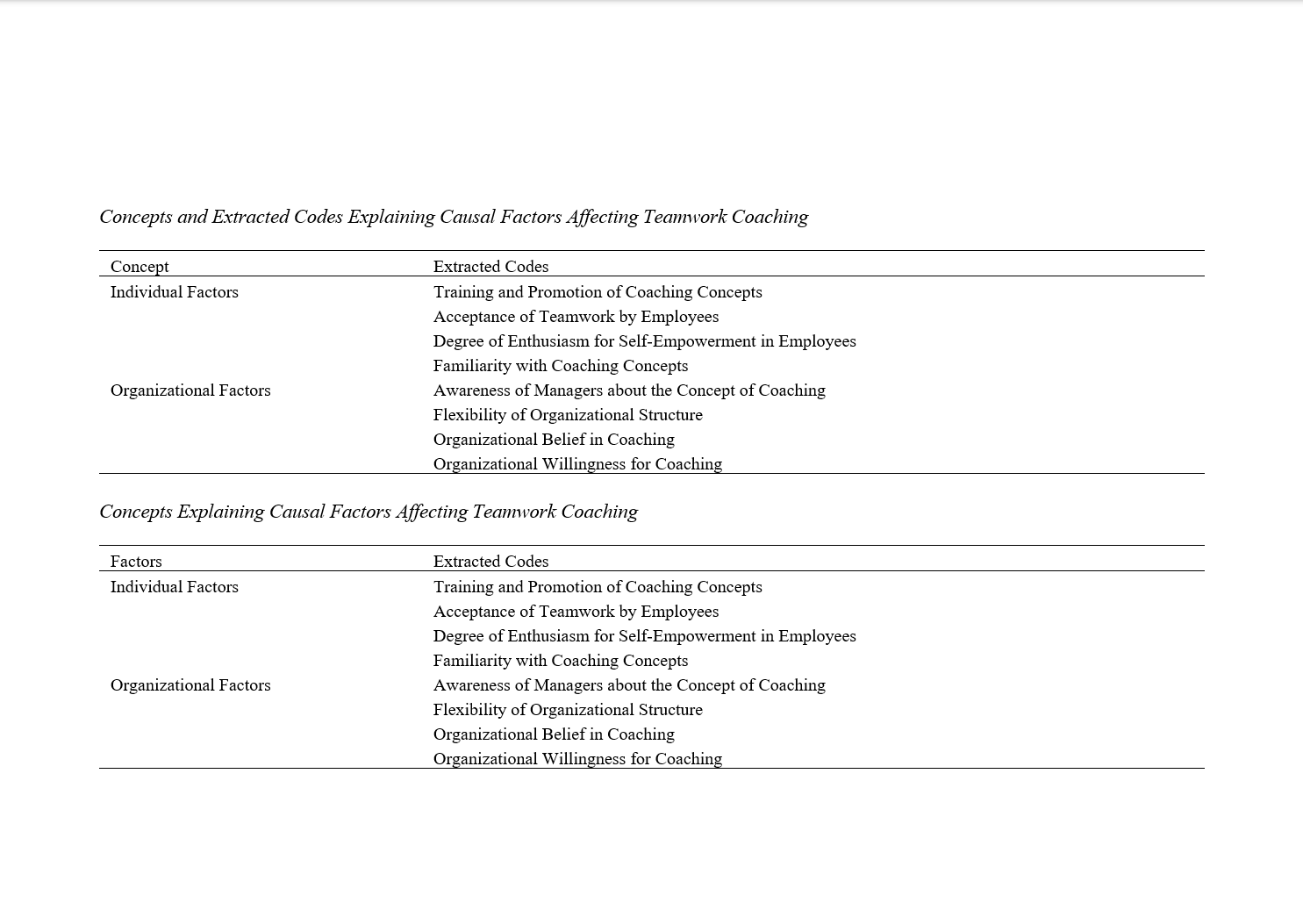
Findings: According to the results, eight causal codes or factors were identified, which were subsequently categorized into two dimensions: individual (promotion of coaching concepts, employees’ acceptance of teamwork, employees' enthusiasm for self-empowerment, and familiarity with coaching concepts) and organizational (managers' awareness of the coaching concept, organizational structure flexibility, organizational belief in coaching, and the organizational will for coaching).
Conclusion: This study identifies key individual and organizational factors influencing the establishment of teamwork coaching in Iranian government organizations, emphasizing the importance of coaching promotion, organizational flexibility, and leadership awareness.
Downloads
References
Farzadnia, F. (2011). Coaching and Leading Models in Management (A novel approach in front management based on creativity). 1st Annual Conference of Management, Innovation, Entrepreneurship, Shiraz.
Fathivajarah, K., Khorasani, A., & Daneshmandi, S. (2015). Coaching in Training Development. Tehran, Industrial Research and Training Center of Iran. http://irtci.com/irtci-monitoring.aspx
Ghafari, F., Ahmadi, K., & Salvati, A. (2021). Designing a model for conceptual expansion of employee performance coaching in Iranian public organizations. Naja Human Resource, 15(65), 67-92. https://www.sid.ir/paper/1038277/en
Hajizadeh, H., Makvandi, F., & Amirnejad, G. (2022). Design a coaching model for operational managers of the Persian Gulf Petrochemical Company for motivating human resources. Quarterly Journal of Human Resources Training and Development, 59(16), 141-169. http://ensani.ir/fa/article/474439/%D8%B7%D8%B1%D8%A7%D8%AD%DB%8C-%D8%A7%D9%84%DA%AF%D9%88%DB%8C-%D9%85%D8%B1%D8%A8%DB%8C-%DA%AF%D8%B1%DB%8C-%D9%85%D8%AF%DB%8C%D8%B1%D8%A7%D9%86-%D8%B9%D9%85%D9%84%DB%8C%D8%A7%D8%AA%DB%8C-%D8%B4%D8%B1%DA%A9%D8%AA-%D8%B5%D9%86%D8%A7%DB%8C%D8%B9-%D9%BE%D8%AA%D8%B1%D9%88%D8%B4%DB%8C%D9%85%DB%8C-%D8%AE%D9%84%DB%8C%D8%AC-%D9%81%D8%A7%D8%B1%D8%B3-%D8%AF%D8%B1-%D8%B1%D8%A7%D8%B3%D8%AA%D8%A7%DB%8C-%D8%A7%D9%86%DA%AF%DB%8C%D8%B2%D8%B4-%D9%86%DB%8C%D8%B1%D9%88%DB%8C-%D8%A7%D9%86%D8%B3%D8%A7%D9%86%DB%8C
Heslin, P. A., Vande Walle, D., & Latham, G. P. (2006). Keen to help? Managers' implicit person theories and their subsequent employee coaching. Personnel psychology, 59-87. https://doi.org/10.1111/j.1744-6570.2006.00057.x
Mashhadi, F., & Ghoroneh, D. (2021). Identify Mechanisms and Barriers to Employing Coaching for Managers' Succession (Case Study: Khorasan Razavi Relief Committee). Quarterly Journal of Training and Development of Human Resources, 8(24), 168-193. https://doi.org/10.52547/istd.31185.8.28.168
Podolchak, N. Y., Prokopyshyn-Rashkevych, L. M., & Karkovska, V. Y. (2019). The influence of coaching on the development of manager's leadership skills. Scientific Bulletin of National Mining University, 1(4), 254-261. https://doi.org/10.29202/nvngu/2019-4/22
Renard, L. (2005). Executive Coaching for Professional Organizations The American University of London]. https://upload.wikimedia.org/wikipedia/commons/8/8b/LRthesisExecutiveCoaching.PDF
Tahmasebzadeh, D., & Jafari, K. (2020). Compare the viewpoints of faculty members and students about the quality of the use of coaching method in educational activities of faculty members. Educ Strategy Med Sci, 12(2), 18-25. http://ensani.ir/fa/article/416368/%D9%85%D9%82%D8%A7%DB%8C%D8%B3%D9%87-%D8%AF%DB%8C%D8%AF%DA%AF%D8%A7%D9%87-%D8%A7%D8%B3%D8%A7%D8%AA%DB%8C%D8%AF-%D9%88-%D8%AF%D8%A7%D9%86%D8%B4%D8%AC%D9%88%DB%8C%D8%A7%D9%86-%D8%AF%D8%B1-%DA%A9%DB%8C%D9%81%DB%8C%D8%AA-%DA%A9%D8%A7%D8%B1%D8%A8%D8%B3%D8%AA-%D8%B1%D9%88%D8%B4-%D9%85%D8%B1%D8%A8%DB%8C-%DA%AF%D8%B1%DB%8C-%DA%A9%D9%88%DA%86%DB%8C%D9%86%DA%AF-%D8%AF%D8%B1-%D9%81%D8%B9%D8%A7%D9%84%DB%8C%D8%AA-%D9%87%D8%A7%DB%8C-%D8%A2%D9%85%D9%88%D8%B2%D8%B4%DB%8C-%D8%A7%D8%B9%D8%B6%D8%A7%DB%8C-%D9%87%DB%8C%D8%A6%D8%AA-%D8%B9%D9%84%D9%85%DB%8C
Tangestani, M., & Moradi, B. M. (2023). An Introduction to the State Function of "Eliminating Unnecessary Organizations". Quarterly Journal of Public Law Knowledge, 12(39), 47-70. https://volunteeractivists.nl/en/%D8%AE%D8%B7%D8%B1-%D8%BA%DB%8C%D8%B1-%D9%82%D8%A7%D9%86%D9%88%D9%86%DB%8C-%D8%B4%D8%AF%D9%86-%D9%87%D9%85%D9%87-%D8%B3%D8%A7%D8%B2%D9%85%D8%A7%D9%86-%D9%87%D8%A7%DB%8C-%D8%BA%DB%8C%D8%B1-%D8%AF-2/
Downloads
Additional Files
Publication Timeline
- Submitted
- Revised
- Accepted
Issue
Section
License
Copyright (c) 2025 Hosain Ghafari (Author); Kumars Ahmadi (Corresponding Author); Reza Salehi, Adel Salvati (Author)

This work is licensed under a Creative Commons Attribution-NonCommercial 4.0 International License.