Ranking the Indicators of the Model for Enhancing the Quality of Virtual University Education with a Knowledge Management Approach
DOI:
https://doi.org/10.61838/kman.ijimob.5.3.14Keywords:
Quality enhancement, virtual university education, knowledge managementAbstract
Objective: The present study aims to rank the indicators of a model for enhancing the quality of virtual university education with a knowledge management approach, conducted at the Electronic Branch of the Islamic Azad University.
Methodology: This study employs a mixed-methods approach with an exploratory objective. The statistical population comprises professors and faculty members of the Electronic Branch of the Islamic Azad University, with 20 individuals purposefully selected for interviews. Data collection tools include semi-structured interviews for qualitative data and a researcher-made questionnaire for quantitative data. Qualitative data were analyzed using Glaser's (1992) coding method, while the Importance-Performance Analysis (IPA) method was applied in the quantitative phase to assess the significance and performance of the indicators. Additionally, Interpretive Structural Modeling (ISM) was utilized to stratify the dimensions of the model.
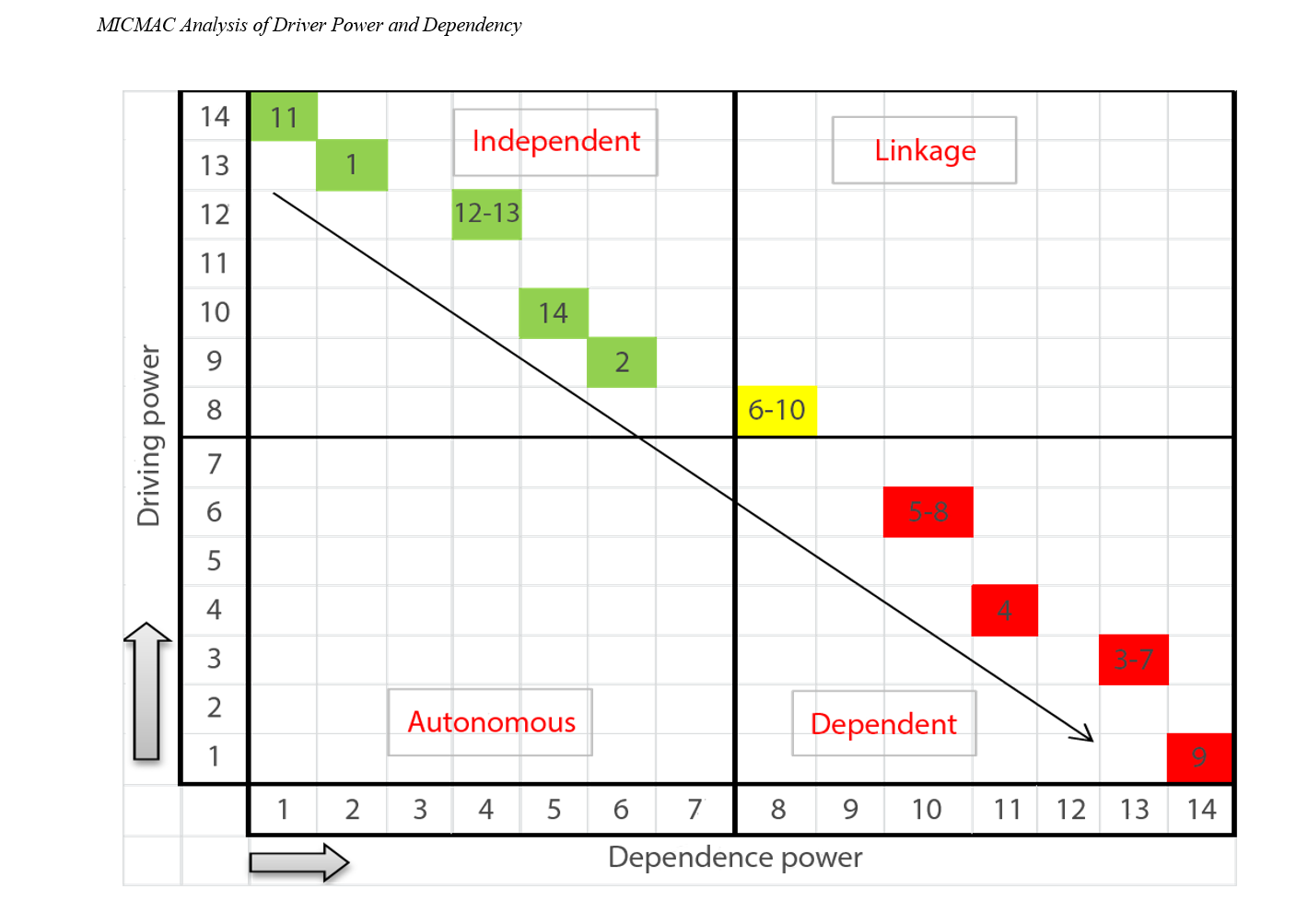
Findings: The study identified 68 quality enhancement components for virtual university education. The indicator "educational system capabilities" (code 4) ranked first with a weight of 0.0294, positioned in the first quadrant of the Importance-Performance Matrix, where importance is high, but performance is low. For knowledge management indicators, "knowledge retention and prevention of misuse" (code 17) ranked first with a weight of 0.0545. Using ISM, dimensions were stratified, with "university management and leadership" placed at the highest level (Level 10) and "services and responsiveness" at the lowest level (Level 1).
Conclusion: The findings highlight that knowledge management dimensions significantly impact the quality enhancement of virtual university education. The hierarchical structure underscores the importance of "university management and leadership" as a foundational element, cascading down to "services and responsiveness" as an outcome influenced by other dimensions.
Downloads
References
Ahmadian, Z., Azizi, M., & Amjadi Hoor, J. (2020). Modeling the Relationship Between Virtual Education and Intellectual Capital with the Mediation of Knowledge Management in Higher Education. Information Management, 6(1). https://www.google.com/url?sa=t&source=web&rct=j&opi=89978449&url=https://www.aimj.ir/article_125464_d6b5ac70948fae6f155c957fc9c3ca34.pdf&ved=2ahUKEwiul7DM-ImKAxWGQvEDHZw4Jo0QFnoECBkQAQ&usg=AOvVaw35y4xQVqVnjPHODZ5IPyXS
Delghandi, M., karimi, M., Nodehi, H., & Cherabin, M. (2024). Designing an Efficient Virtual Education Pattern in Farhangian University. Sociology of Education, 10(1), 280-294. https://doi.org/10.22034/ijes.2024.2012176.1469
Ebrahimi, M., Alishah, F., & Zamani Pour, F. (2021). Identifying and Analyzing Opportunities and Challenges of Virtual Education from the Perspective of Students. New Educational Approaches, 16(2). https://www.google.com/url?sa=t&source=web&rct=j&opi=89978449&url=https://nea.ui.ac.ir/article_26778.html&ved=2ahUKEwjQoM3i-ImKAxXcSfEDHW9vBu0QFnoECBgQAQ&usg=AOvVaw0WU6LZP_UCkyWYVQUvBHhM
Fischer, C., & Pöhler, A. (2018). Supporting the Change to Digitalized Production Environments through Learning Organization Development. In C. Harteis (Ed.), The Impact of Digitalization in the Workplace: An Educational View (pp. 141-160). Springer International Publishing. https://doi.org/10.1007/978-3-319-63257-5_10
Gloet, M., & Samson, D. (2020). Knowledge Management and Systematic Innovation Capability. 4(2), 1198-1218. https://doi.org/10.4018/978-1-5225-9273-0.ch059
Gutiérrez, R. A. C. (2024). Staff Affection, the Key Factor in the Loyalty of University Students Using Virtual Library Services That Are Accessible by a Physical Access Space, in Developing Countries. Tem Journal, 502-513. https://doi.org/10.18421/tem131-52
Homburg, V. (2018). ICT, E-Government and E-Governance: Bits & Bytes for Public Administration. In E. Ongaro & S. Van Thiel (Eds.), The Palgrave Handbook of Public Administration and Management in Europe (pp. 347-361). Palgrave Macmillan UK. https://doi.org/10.1057/978-1-137-55269-3_18
Hoseinbar, K. a.-N., Hasanimoghadam, A., Vazifeh, Z., & Shokouhi, J. (2016). Examining the Role of Knowledge Management in Virtual Education. First National Conference on Global Management and Economics, Tehran.
Hsing, C., & Liu, S. (2018). Examining Social Capital, Organizational Learning and Knowledge Transfer in Cultural and Creative Industries of Practice. Tourism Management, 64, 258-270. https://doi.org/10.1016/j.tourman.2017.09.001
Kaminska, R., & Borzillo, S. (2018). Challenges to the Learning Organization in the Context of Generational Diversity and Social Networks. The Learning Organization, 25(2), 92-101. https://doi.org/10.1108/TLO-03-2017-0033
Kazerooni Shamiri, H., & Moradi, S. (2019). The Role of Virtual Education and IT Governance in the Meritocracy of Islamic Azad University Managers in Khuzestan Province. Research in Educational Systems, 13(44). https://www.google.com/url?sa=t&source=web&rct=j&opi=89978449&url=http://ensani.ir/fa/article/404841/%25D9%2586%25D9%2582%25D8%25B4-%25D8%25A2%25D9%2585%25D9%2588%25D8%25B2%25D8%25B4-%25D9%2587%25D8%25A7%25DB%258C-%25D9%2585%25D8%25AC%25D8%25A7%25D8%25B2%25DB%258C-%25D9%2588-%25D8%25AD%25D8%25A7%25DA%25A9%25D9%2585%25DB%258C%25D8%25AA-%25D9%2581%25D9%2586-%25D8%25A2%25D9%2588%25D8%25B1%25DB%258C-%25D8%25A7%25D8%25B7%25D9%2584%25D8%25A7%25D8%25B9%25D8%25A7%25D8%25AA-%25D8%25AF%25D8%25B1-%25D8%25B4%25D8%25A7%25DB%258C%25D8%25B3%25D8%25AA%25D9%2587-%25D8%25B3%25D8%25A7%25D9%2584%25D8%25A7%25D8%25B1%25DB%258C-%25D9%2585%25D8%25AF%25DB%258C%25D8%25B1%25D8%25A7%25D9%2586-%25D8%25AF%25D8%25A7%25D9%2586%25D8%25B4%25DA%25AF%25D8%25A7%25D9%2587-%25D8%25A2%25D8%25B2%25D8%25A7%25D8%25AF-%25D8%25A7%25D8%25B3%25D9%2584%25D8%25A7%25D9%2585%25DB%258C-%25D8%25A7%25D8%25B3%25D8%25AA%25D8%25A7%25D9%2586-%25D8%25AE%25D9%2588%25D8%25B2%25D8%25B3%25D8%25AA%25D8%25A7%25D9%2586&ved=2ahUKEwjLrIL7-ImKAxU8bvEDHeaXO6YQFnoECBkQAQ&usg=AOvVaw0EeRXYLkSvBVRKYaBHuxng
Moisil, I. (2020). A Model of the Student Behaviour in a Virtual Educational Environment. International Journal of Computers Communications & Control, 3(1), 108-115. https://www.google.com/url?sa=t&source=web&rct=j&opi=89978449&url=https://www.researchgate.net/publication/291987675_A_model_of_the_student_behaviour_in_a_virtual_educational_environment&ved=2ahUKEwi5wY6I-YmKAxULc_EDHce_Hz4QFnoECBYQAQ&usg=AOvVaw2-4RhKpN32trzGV30Xi_se
Raghuram, S., Hill, N. S., Gibbs, J. L., & Maruping, L. M. (2019). Virtual Work: Bridging Research Clusters. Academy of Management Annals, 13(1), 308-341. https://doi.org/10.5465/annals.2017.0020
Rizun, M. (2016). Intellectual Capital as a Key Factor of Knowledge Management in Organizations. International Conference on Information System Development,
Schlacht, I. L., Del, M. A., & Nazir, S. (2017). Virtual Reality for Safety, Entertainment or Education: The Mars Mission Test. In Advances in Applied Digital Human Modeling and Simulation (pp. 75-83). Springer. https://doi.org/10.1007/978-3-319-41627-4_8
Sepahvand, R., Shariatnejad, A., & Arefnejad, M. (2015). The Impact of Information Technology on Intellectual Capital and Knowledge Management Strategies with the Moderating Effect of Organizational Agility. Organizational Resource Management Research, 5(3), 71-96. https://www.google.com/url?sa=t&source=web&rct=j&opi=89978449&url=https://ormr.modares.ac.ir/article-28-11407-fa.html&ved=2ahUKEwjo9dua-YmKAxVCRvEDHbovOskQFnoECBcQAQ&usg=AOvVaw0e8GM8pwysR6pktvEnl5A4
Shariati, F., Niazazari, K., & Jabbary, N. (2024). Presenting a Model for Virtual Education Considering Educational Equity with a Phenomenological Approach in Schools of Golestan Province [Research Article]. Iranian Journal of Educational Sociology, 7(1), 66-78. https://doi.org/10.61838/kman.ijes.7.1.7
Downloads
Additional Files
Publication Timeline
- Submitted
- Revised
- Accepted
Issue
Section
License
Copyright (c) 2025 Amir Sadeghi Samarjani (Author); Ali Maghool (Corresponding Author); Mohammad Karimi, Moslem Cherain (Author)

This work is licensed under a Creative Commons Attribution-NonCommercial 4.0 International License.