A Model of Organizational Culture for Clinical Staff at the Ministry of Health, Treatment, and Medical Education
DOI:
https://doi.org/10.61838/kman.ijimob.5.3.7Keywords:
Organizational Culture, Nurses, Medical UniversityAbstract
Objective: The objective of this study was to present a model of organizational culture for clinical staff at the Ministry of Health, Treatment, and Medical Education.
Methodology: This research employed a qualitative approach, using the Delphi technique, and was applied in its purpose. A sample of 15 experts was utilized. Initially, a qualitative exploration was undertaken to design the organizational culture model. Following this, based on previous studies and relevant literature, a list of dimensions, components, and indicators was extracted. Using expert opinions and the Delphi technique, a culturally adapted organizational culture model was developed over three rounds. The qualitative validation of the model was conducted through the Delphi technique and feedback from the initial interviewees. The sample size was determined by purposive and snowball sampling methods based on the criterion of theoretical saturation. The questionnaire's validity was confirmed through content validity and expert opinions, and its reliability was verified by Cronbach's alpha. The validated and expert-approved questionnaire was then distributed to the sample.
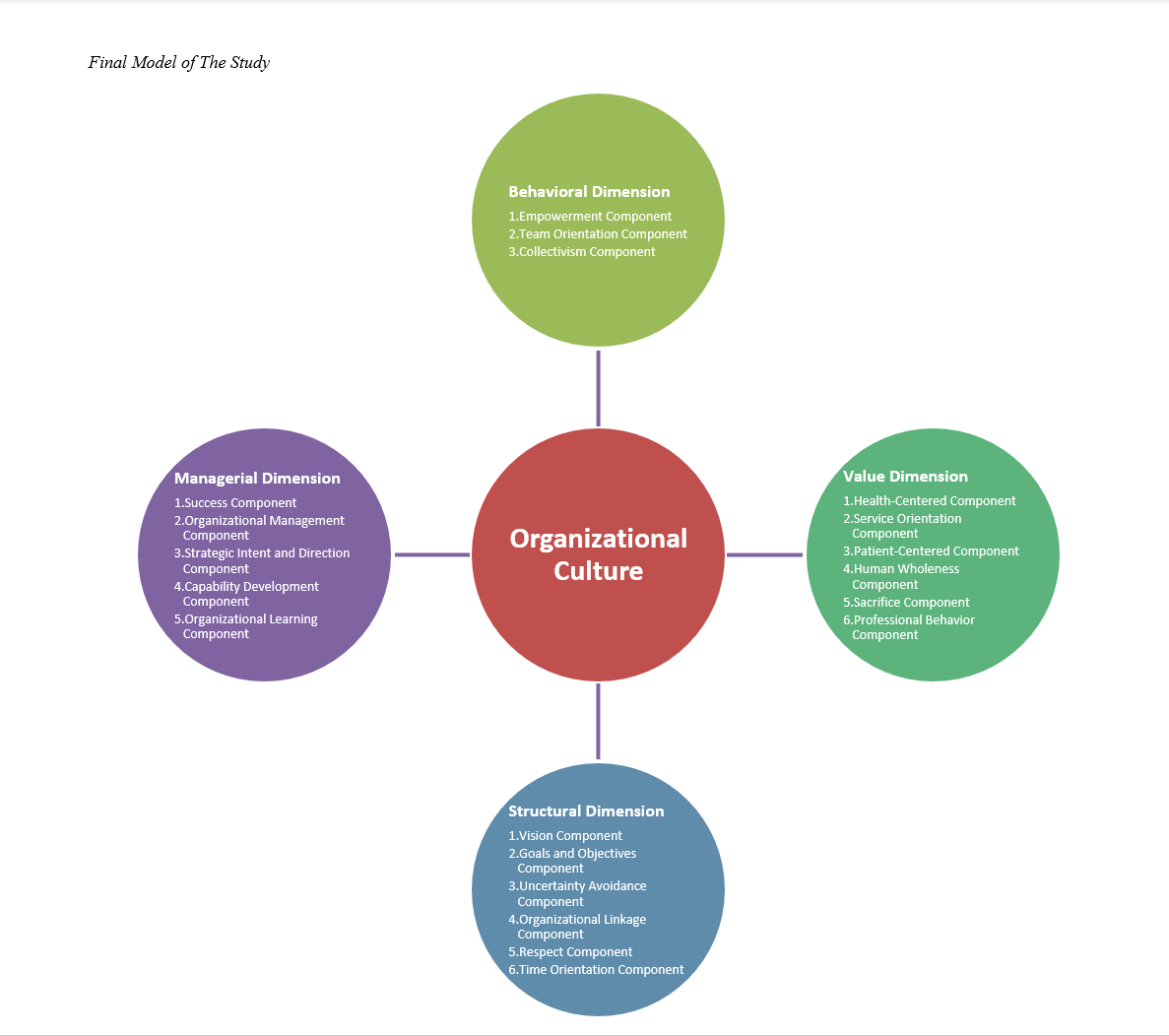
Findings: The findings revealed that the organizational culture comprised four dimensions (behavioral, organizational and structural, managerial, and value and ideological), 20 components, and 60 indicators, with a Kendall coefficient of 0.170.
Conclusion: It can be concluded that organizational culture comprises various dimensions and components. Accordingly, university planners and administrators can enhance organizational culture at medical universities by emphasizing each of these components.
Downloads
References
Ahvazian, Z., Ghaiyoomi, A., & Kavosi, E. (2016). The Role of Organizational Culture Components in Improving Employees' Quality of Work Life Case Study: Tehran Municipality Cultural and Art Organization. Journal of Cultural Management, 33(10), 86-109. https://srb.sanad.iau.ir/fa/Article/817604?FullText=FullText
Altinok, V. (2021). Examining the Relationship between Organizational Culture Model and Management Practices. Journal of Educational Leadership and Policy Studies(Spec Iss Spr). https://files.eric.ed.gov/fulltext/EJ1308452.pdf
Attar, M. M. (2020). Organizational Culture, Knowledge Sharing, and Intellectual Capital: Directions for Future Research. International Journal of Business and Economics Research, 9(1), 11-20. https://doi.org/10.11648/j.ijber.20200901.12
Bakshi Haji Khajehlu, S., Rasouli, E.-h., & Teimorian, M. (2021). The Relationship between Organizational Culture and Organizational Learning and the Impact of Individual Variables (Case Study: Social Security Hospitals and Clinics in Ardabil Province). Social Security Quarterly, 16(3), 83-137. https://qjo.ssor.ir/article_153074.html
Balthazard, P. A., & Cooke, R. A. (2004). Organizational Culture and Knowledge Management Success: Assessing the Behavior-Performance Continuum. Proceedings of the 37th Annual Hawaii International Conference on System Sciences,
Costa, J., Rodrigues, A. C., & Ferreira, M. R. (2020). Organizational Culture in Social Economy Organizations. Economics & Sociology, 13(3), 156-170. https://doi.org/10.14254/2071-789X.2020/13-3/10
Denison, D. R., Hooijberg, R., Lane, N., & Lief, C. (2012). Culture in the Multinational Corporations. John Wiley & Sons. https://books.google.fr/books/about/Leading_Culture_Change_in_Global_Organiz.html?id=Yr9zERfJgG8C&redir_esc=y
Emami, D., Ahmadi, M., & Ghaffari, R. (2024). Presenting a Pattern of Flexible working Hours in Government Organizations with an Emphasis on Increasing the Productivity Level of Academic Employees in the Ministry of Cooperation, Labor and Social Welfare [Research Article]. Iranian Journal of Educational Sociology, 7(1), 57-65. https://doi.org/10.61838/kman.ijes.7.1.6
Eyibio, A. (2022). Dimensions of Organizational Culture and Employee Performance. World Journal of Management and Business Studies, 2(3), 419-430. https://www.wjomabs.com/wp-content/uploads/2022/05/DIMENSIONS-OF-ORGANISATIONAL-CULTURE-AND-EMPLOYEE-PERFORMANCE.pdf
Ghaiyoomi, A., Mozafar, H., & Mohamadpanah, M. (2014). Identify and Prioritize the Components of Organizational Culture that Affect Organizational Transformation. Journal of Cultural Management, 25, 35-49. https://srb.sanad.iau.ir/en/Article/818308
Ginting, J. G. (2023). Organizational culture: An overview and bibliometric analysis. Asian Journal of Economics and Business Management, 2(2), 534-542. https://doi.org/10.53402/ajebm.v2i2.318
Gregory, B. T., Harris, S. G., Armenakis, A. A., & Shook, C. L. (2009). Organizational Culture and Effectiveness: A Study of Values, Attitudes, and Organizational Outcomes. Journal of Business Research, 62(7), 673-679. https://doi.org/10.1016/j.jbusres.2008.05.021
Isensee, C., Teuteberg, F., Griese, K. M., & Topi, C. (2020). The Relationship between Organizational Culture, Sustainability, and Digitalization in SMEs: A Systematic Review. Journal of Cleaner Production, 275. https://doi.org/10.1016/j.jclepro.2020.122944
Jain, M. S. (2024). Workplace Ostracism, Organizational Culture, and Work-Life Balance Among Academicians – Navigating EdTech Realms. Eatp, 7551-7561. https://doi.org/10.53555/kuey.v30i5.4209
Keykhanejad, M., Safarian Hamedani, S., & Zameni, F. (2018). Presenting a Model of Organizational Culture in Farhangian University of Mazandaran Province. Quarterly Journal of Educational Leadership and Management, 12(2), 173-186. https://sanad.iau.ir/en/Journal/edu/Article/543298?jid=543298
Kiakojouri, D. (2024). Analysis of the relationships among Organizational Culture Indicators Using the DEMATEL Method at the Islamic Azad University in the West of Mazandaran Province. Dynamic Management and Business Analysis, 2(4), 1-12. https://doi.org/10.22034/dmbaj.2024.2022946.1020
Lee, D. (2020). Impact of Organizational Culture and Capabilities on Employee Commitment to Ethical Behavior in the Healthcare Sector. Service Business, 14(1), 47-72. https://doi.org/10.1007/s11628-019-00410-8
Mingaleva, Z., Shironina, E., Lobova, E., Olenev, V., Plyusnina, L., & Oborina, A. (2022). Organizational Culture Management as an Element of Innovative and Sustainable Development of Enterprises. Sustainability, 14(10), 6289. https://doi.org/10.3390/su14106289
Mohseni, R., Alhoseini, S., & Ansari, M. (2018). The Impact of Citizenship Culture Dimensions on Organizational Cultural Behavior (Case Study: Farhangian University of Markazi Province). Social Studies and Research in Iran, 2(7), 395-412. https://jisr.ut.ac.ir/article_67619.html?lang=en
Mosaddegh Rad, A. M., Parsaeian, M., & Hedayati, S. P. (2023). Organizational Culture in Hospitals of Tehran University of Medical Sciences. 22(4), 375-385. https://doi.org/10.61186/payesh.22.4.375
Mosaddegh Rad, A. M., & Sokhanvar, M. (2019). Organizational Culture in Nursing Departments of Hospitals in Tehran. Journal of the Health Sciences Research Institute, 18(2), 113-126. http://payeshjournal.ir/article-1-1036-fa.html
Mosadeghrad, A., & Sokhanvar, M. (2019). Organizational Culture of Nursing Wards in Tehran Hospitals. Journal of Institute for Health Sciences Research, 18(2), 113-126. https://payeshjournal.ir/browse.php?a_id=1036&sid=1&slc_lang=en
Omidi, N. (2017). Assessment of Organizational Learning Level of Nurses in Tehran University of Medical Sciences Hospitals and its Impact on Organizational Culture Component. Journal of nursing education, 5(6), 32-40. https://doi.org/10.21859/jne-06055
Pranitasari, D. (2022). Development of Work Engagement Model Based on Organizational Culture Method. International Journal of Instruction, 15(2), 861-884. https://doi.org/10.29333/iji.2022.15247a
Rastehmoghadam, A., Rahimian, H., & Abaspoor, A. (2014). Identifying the Challenges of Organizational Culture and Proposing Solutions to Change It: Government Organizations in Tehran. Manage of Organizational Culture, 11(4), 111-135. https://jomc.ut.ac.ir/article_36642.html?lang=en
Reidhead, C. (2020). Impact of Organizational Culture on Employee Satisfaction: A Case of Hilton Hotel, United Kingdom. Journal of Economics and Business, 3(1), 432-437. https://doi.org/10.31014/aior.1992.03.01.209
Robbins, S. (2015). Organizational Behavior Management. Institute of Business Studies and Research.
Robbins, S. (2017). Organization Theory: Structure and Organizational Design. Safar Publications. https://www.amazon.com/Organization-Theory-Structures-Designs-Applications/dp/0136424716
Robbins, S. (2019). Organizational Behavior. Cultural Research Office. https://books.google.com/books/about/Organisational_Behaviour.html?id=-C7iBAAAQBAJ
Rostamigoran, N., Vosoghimogadam, A., Salarianzadeh, M., Esmailzadeh, H., & Demari, B. (2016). A Study of Organizational Culture in the Ministry of Health and Medical Education. Journal of School of Public Health and Institute of Health Research, 14(3), 1-14. https://sjsph.tums.ac.ir/article-1-5405-en.html
Samur, S. (2021). Examination of Organizational Culture Variables in Sports Organizations (Perspective from Turkey). Journal of Educational Issues, 7(1), 392-412. https://doi.org/10.5296/jei.v7i1.18531
Shoghi, B., Aghajani, T., & Mortazavi, S. (2014). The Effect of Mediation on the Relationship Between Managers and Employee Creativity (Study: Saveh Modares Hospital). Efficiency Management, 26, 93-124. https://en.civilica.com/doc/1382735/
Wang, D., Su, Z. F., & Yang, D. (2011). Organizational Culture and Knowledge Creation Capability. Journal of Knowledge Management, 15(3), 363-373. https://doi.org/10.1108/13673271111137385
Wheelen, T. L., & Hunger, J. D. (2010). Strategic Management and Business Policy: Achieving Sustainability. Pearson Education. https://books.google.com/books/about/Strategic_Management_and_Business_Policy.html?id=A8k6PgAACAAJ
Downloads
Additional Files
Publication Timeline
- Submitted
- Revised
- Accepted
Issue
Section
License
Copyright (c) 2025 Raheleh Safi Khani (Author); Mohammad Hasan Pardakhtchi (Corresponding Author); Esmaeil Kavousy, Gholamali Ahmadi (Author)

This work is licensed under a Creative Commons Attribution-NonCommercial 4.0 International License.