Identification of Factors Influencing the Design of a Structural Model for Employees' Unconventional Administrative Behaviors in Governmental Organizations Using Grounded Theory
DOI:
https://doi.org/10.61838/kman.ijimob.5.2.9Keywords:
Model design, unconventional administrative behaviors, governmental organizations, grounded theoryAbstract
Objective: The purpose of this study was to identify the factors influencing the design of a structural model for employees' unconventional administrative behaviors in governmental organizations using grounded theory.
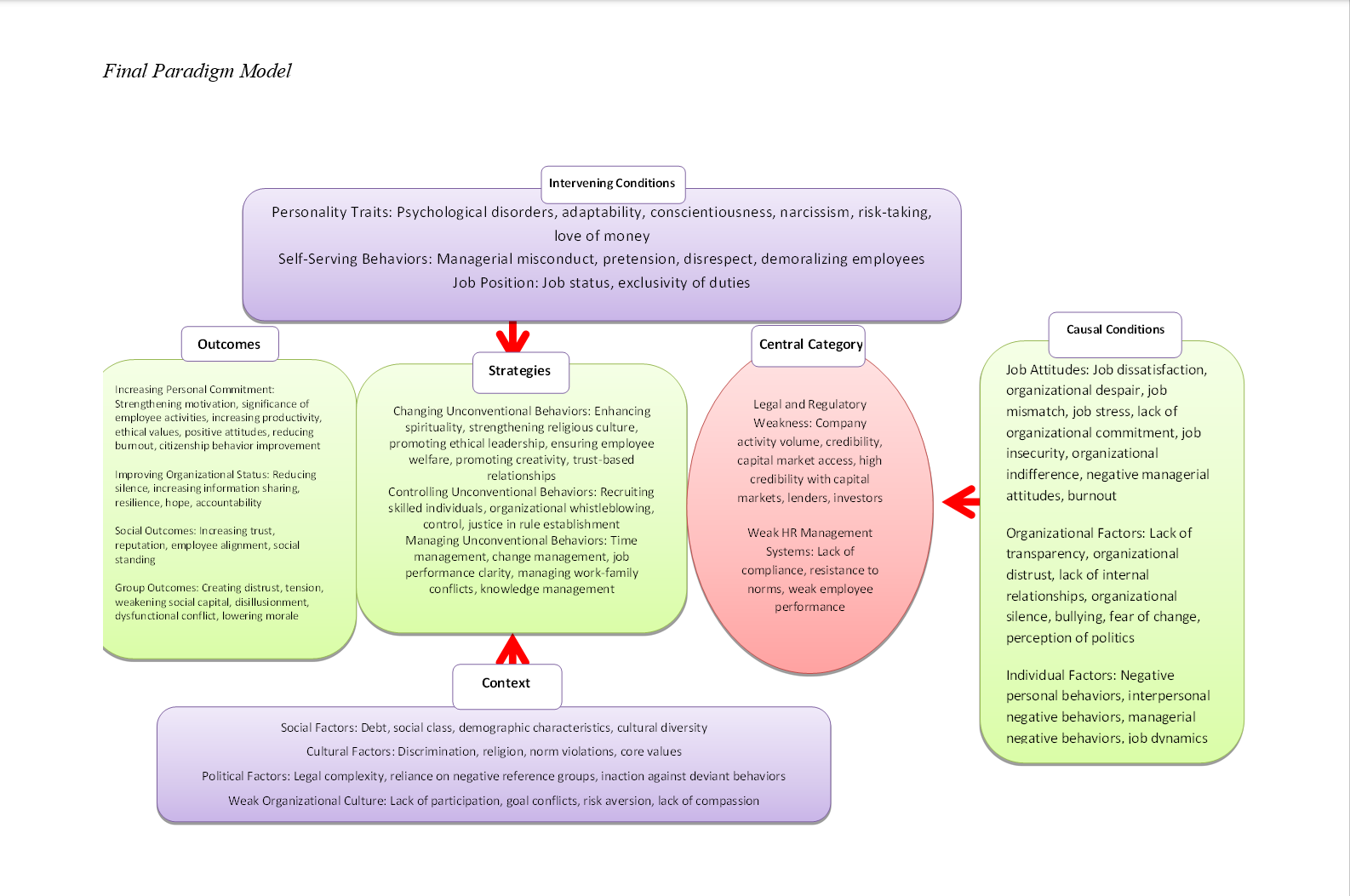
Methodology: The research methodology employed both qualitative and quantitative approaches. Data were collected through interviews. The study population included experts, academics, and specialists in the research field, with no fixed limit, and 18 individuals were selected until theoretical saturation was reached. The sampling method was snowball sampling. Primary data were collected via interviews. In line with methodological procedures, during the three stages of open coding, axial coding, and selective coding, relevant codes were extracted from a large volume of primary data. Subsequently, through the constant comparison method, a concept was extracted from several codes, and similarly, other codes were transformed into concepts, yielding a total of 93 concepts. In the next stage, several concepts were categorized into one theme, resulting in 20 themes for this study.
Findings: The study findings indicated that two themes emerged as central categories: legal and regulatory weaknesses and weaknesses in human resource management systems. Other themes were categorized into five groups for presentation in the model: causal conditions (4 themes), context (4 themes), intervening conditions (3 themes), strategies (3 themes), and outcomes (4 themes).
Conclusion: Managers in governmental organizations should make every effort to leverage effective human resources, policies, and programs, and develop content strategies with a particular focus on employees' unconventional administrative behaviors within organizational processes to achieve more effective outcomes.
Downloads
References
Annisa, A. S. S., Saleh, L. M., Naiem, F., Russeng, S. S., Wahyu, A., Riskiyani, S., & Anwar, A. A. (2024). The Effect of Workload on Work Productivity Through Job Stress in Air Traffic Controller (ATC) Employees at Makassar International Airport Sultan Hasanuddin Makassar. Journal of Law and Sustainable Development, 12(1), e2764. https://doi.org/10.55908/sdgs.v12i1.2764
Ashna, M., Abbaspour, A., Dehghanan, H., & Haghighi Kafash, M. (2019). Identifying deviant workplace behaviors of employees and mechanisms to reduce them in regulatory organizations: Application of the Q-sort method. Public Management Perspective, 10(1), 39-57. https://jpap.sbu.ac.ir/article_96481.html
Boyas, J., & Wind, L. H. (2016). Employment-based social capital, job stress, and employee burnout: A public child welfare employee structural model. Children and Youth Service Review, 23(3), 380-388. https://doi.org/10.1016/j.childyouth.2009.10.009
Dadkhah, A., & Qeitani, A. (2021). The role of organizational commitment, Islamic work ethics, and job alienation in the relationship between job and organizational satisfaction with the likelihood of employee lawbreaking. Scientific Quarterly of NAJA Supervision and Inspection, 15(55). https://www.sid.ir/paper/378820/fa
Emami, D., Ahmadi, M., & Ghaffari, R. (2024). Presenting a Pattern of Flexible working Hours in Government Organizations with an Emphasis on Increasing the Productivity Level of Academic Employees in the Ministry of Cooperation, Labor and Social Welfare [Research Article]. Iranian Journal of Educational Sociology, 7(1), 57-65. https://doi.org/10.61838/kman.ijes.7.1.6
Ghosh, A., & Shum, C. (2019). Why do employees break rules? Understanding organizational rule-breaking behaviors in hospitality. International Journal of Hospitality Management, 81, 1-10. https://doi.org/10.1016/j.ijhm.2019.02.003
Golparvar, M., Javadian, Z., Salimian, N., Ismailian Ardestani, Z., & Mohammadi, A. (2012). The Relationship between Oppressive Leadership and Immoral Behaviors: The Approach to Normative Pathological Systems. Journal of Management Improvement, 6(2), 4-22. https://doi.org/10.5539/ijps.v4n2p28
Islam, M. N., Furuoka, F., & Idris, A. (2020). Employee championing behavior in the context of organizational change: a proposed framework for the business organizations in Bangladesh. Journal of Asia Business Studies. https://doi.org/10.1108/JABS-01-2019-0019
Karami, M., Karami, Z., & Sahranvard, Y. (2017). Study of job stress and workload on job satisfaction in Sarcheshmeh copper mine employees. Occupational Health and Health Promotion, 1(2), 104-110. http://ohhp.ssu.ac.ir/browse.php?a_id=49&sid=1&slc_lang=en
Krasikova, V., Green, S. G., & LeBreton, J. M. (2013). Destructive leadership: A theoretical review, integration, and future research agenda. Journal of Management, 10, 1-13. https://doi.org/10.1177/0149206312471388
Mathisen, G. E., & Bergh, L. I. V. (2016). Action errors and rule violations at offshore oil rigs: The role of engagement, emotional exhaustion and health complaints. Safety Science, 85, 8-130. https://doi.org/10.1016/j.ssci.2016.01.008
Moghaddam, A., & Mahmoudi Meymand, M. (2018). The effect of organizational pessimism on the tendency to deviant behaviors. Journal of Management Studies (Improvement and Transformation), 27(89), 73-89. https://jmsd.atu.ac.ir/article_9092.html
Nikolić, J. L. (2023). Occupational Burnout Among Employees in Serbian Banking Sector: Evidence During Covid-19 Pandemic. Engineering Economics, 34(5), 500-513. https://doi.org/10.5755/j01.ee.34.5.31558
Pihlaja, M., Tuominen, P. P. A., Peräkylä, J., & Hartikainen, K. M. (2022). Occupational Burnout Is Linked with Inefficient Executive Functioning, Elevated Average Heart Rate, and Decreased Physical Activity in Daily Life - Initial Evidence from Teaching Professionals. Brain Sciences, 12(12), 1723. https://doi.org/10.3390/brainsci12121723
Puteri, D. F. (2024). Impact of Job Satisfaction and Job Burnout on Nurses' Turnover Intention at X Regional Hospital. Journal of Community Empowerment for Health, 7(1), 47. https://doi.org/10.22146/jcoemph.87883
Putra, G. A., Badruzaman, J., & Supriadi, A. (2024). The Effect of Training, Job Stress, and Motivation on Work Productivity with Unsafe Actions as An Intervening Variable. Review on Islamic Accounting, 4(1). https://doi.org/10.58968/ria.v4i1.440
Rahgoi, A. (2024). The Relationship Between Perceived Social Support, Psychological Capital, Job Burnout, and Work Engagement in Nurses Working on the Front Line of the Fight Against the Coronavirus. https://doi.org/10.21203/rs.3.rs-4281322/v1
Sa'adabadi, A. A., & Qolipour, A. (2014). Formulating a model of development and progress in light of Imam Ali's (A.S.) guidance. Islam and Management, 1(2). http://ensani.ir/fa/article/330535/%D8%AA%D8%AF%D9%88%DB%8C%D9%86-%D8%A7%D9%84%DA%AF%D9%88%DB%8C-%D8%AA%D9%88%D8%B3%D8%B9%D9%87-%D9%88-%D9%BE%DB%8C%D8%B4%D8%B1%D9%81%D8%AA-%D8%AF%D8%B1-%D9%BE%D8%B1%D8%AA%D9%88-%D8%B1%D9%87%D9%86%D9%85%D9%88%D8%AF-%D9%87%D8%A7%DB%8C-%D8%A7%D9%85%D8%A7%D9%85-%D8%B9%D9%84%DB%8C-%D8%B9-
Taheri, M., & Ataiee, M. (2022). Designing a model of political behavior in government organizations. Journal of New Research Approaches in Management and Accounting, 5(83), 1142-1162. https://www.majournal.ir/index.php/ma/article/view/1180
Tomczak, M., & Kulikowski, K. (2023). Toward an Understanding of Occupational Burnout Among Employees With Autism – The Job Demands-Resources Theory Perspective. Current Psychology, 43(2), 1582-1594. https://doi.org/10.1007/s12144-023-04428-0
Vosoughi Nairi, A., RuhollahI, A. A., & Mohammad Hossein, H. (2016). The effect of job stress on general health and job performance of flight attendants. Iranian Journal of Occupational Health, 13(1), 47-57. https://www.sid.ir/paper/129217/fa
Wang, A. C., Chiang, J., Ting, J., Tsai, C. Y., Lin, T. T., & Cheng, B. S. (2013). Gender makes the difference: The moderating role of leader gender on the relationship between leadership styles and subordinate performance. Organizational Behavior and Human Decision Processes, 122(2), 101-113. https://doi.org/10.1016/j.obhdp.2013.06.001
Witczak-Błoszyk, K., Krysińska, K., Andriessen, K., Stańdo, J., & Czabański, A. (2022). Work-Related Suicide Exposure, Occupational Burnout, and Coping in Emergency Medical Services Personnel in Poland. International journal of environmental research and public health, 19(3), 1156. https://doi.org/10.3390/ijerph19031156
Downloads
Additional Files
Publication Timeline
- Submitted
- Revised
- Accepted
Issue
Section
License
Copyright (c) 2024 Elham Chashm Barah (Author); Seraj al-Din Mahbibi (Corresponding Author); Mohsen Ameri Shahrabi (Author)

This work is licensed under a Creative Commons Attribution-NonCommercial 4.0 International License.