



















Investigating the Effect of Artificial Intelligence Capabilities on Operational Performance with the Mediating Role of Production System Resilience and the Moderating Role of Human–Organization–Technology Fit in the Abadan Oil Industry
Objective: The present study investigated the effect of artificial intelligence capabilities on operational performance, with the mediating role of production system resilience and the moderating role of human–organization–technology fit in the Abadan oil industry.
Methods and Materials: In terms of purpose, this study was applied and quantitative, and in terms of nature, it was descriptive-survey and correlational. The statistical population included 420 managers and experts working in the Abadan oil industry. Based on Cochran’s formula, the sample size was calculated as 201. The questionnaires were distributed randomly among the participants, and 200 completed questionnaires were returned. To examine the research questions, structural equation modeling (SEM) was used through the structural equation modeling approach with the assistance of SmartPLS 3 software.
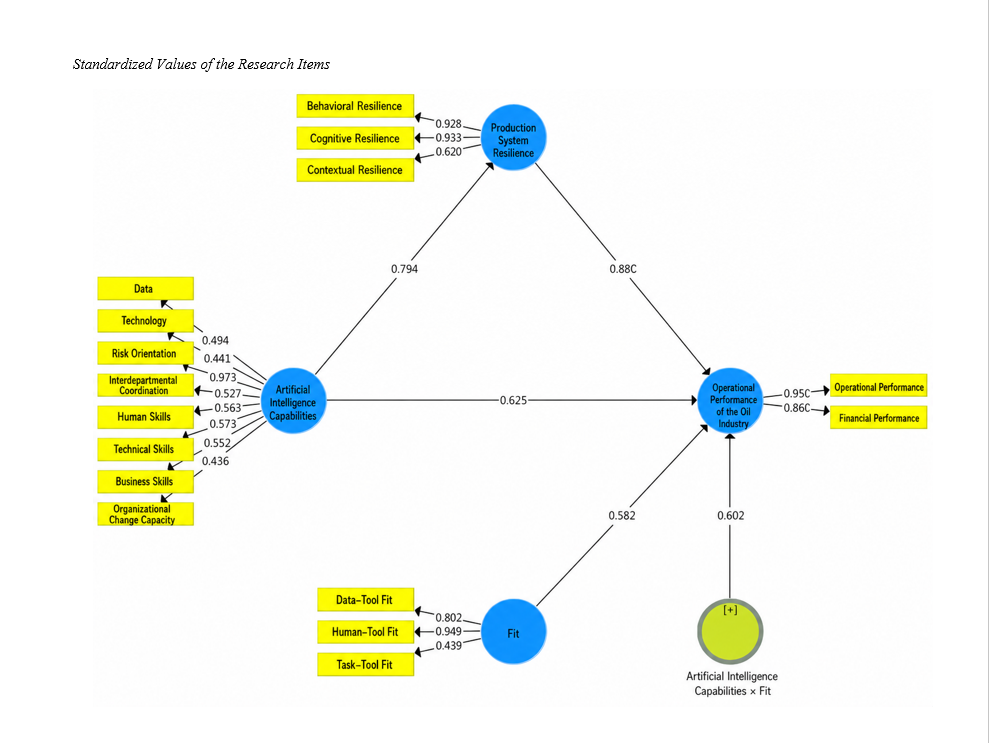
Findings: The findings showed that the path coefficient between artificial intelligence capability and production system resilience was 0.794, with a t-statistic of 9.053. The path coefficient between production system resilience and operational performance was 0.880, with a t-statistic of 10.574. The path coefficient for the moderating role of human–organization–technology fit was 0.602, with a t-statistic of 8.029. This means that fit positively moderates the effect of artificial intelligence capability on production system resilience. Therefore, artificial intelligence capability positively improves operational performance through production system resilience.
Conclusion: The findings indicate that artificial intelligence capabilities indirectly improve the refinery’s operational performance by strengthening production system resilience. Moreover, human–organization–technology fit plays a positive moderating role in the relationship between artificial intelligence and resilience. These results emphasize the necessity of simultaneous attention to technological infrastructure, personnel training, and the preparation of organizational structures in order to achieve sustainable and resilient operations in the Abadan oil industry.