






















Modeling Marital Burnout Based on Love Styles with the Mediating Role of Emotion Regulation Strategies among Married Adults in Bushehr
Objective: This study aimed to develop and test a structural model of marital burnout based on love styles, with emotion regulation strategies as mediating variables among married women and men in Bushehr, Iran.
Methods and Materials: This applied study employed a descriptive-correlational design and structural equation modeling (SEM) to examine the proposed relationships among the study variables. The statistical population consisted of married women and men attending selected centers in Bushehr, Iran, in 2025. A total of 420 eligible participants were recruited through non-probability convenience sampling. Data were collected using the Pines Marital Burnout Questionnaire (1996), the Emotion Regulation Questionnaire developed by Gross and John (2003), and Sternberg’s Love Scale (1986). Pearson correlation analysis and path analysis within the SEM framework were used to evaluate direct and indirect relationships among love styles, emotion regulation strategies, and marital burnout.
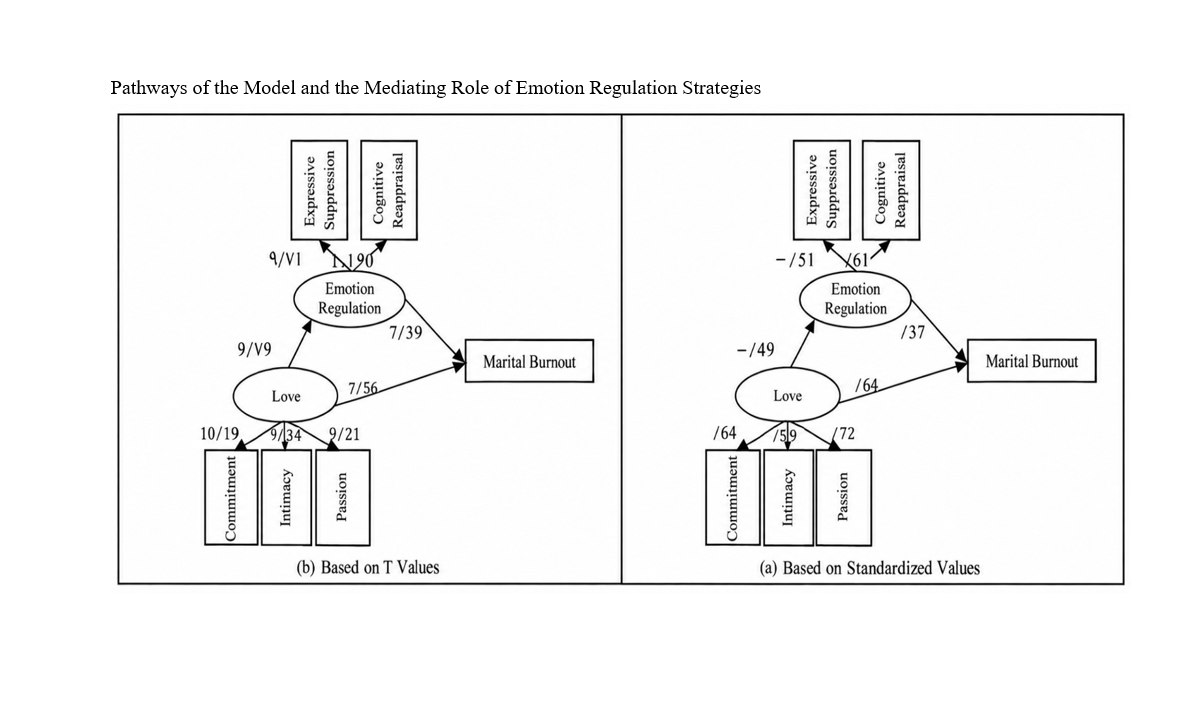
Findings: The inferential analyses indicated that the dimensions of love, including passion, intimacy, and commitment, exerted significant indirect effects on marital burnout through the mediating roles of emotion regulation strategies, namely cognitive reappraisal and expressive suppression. Love styles significantly predicted the use of emotion regulation strategies, which, in turn, were significantly associated with marital burnout. Accordingly, variations in emotion regulation contributed to either decreasing or increasing marital burnout depending on the regulatory strategy employed. The indirect pathways linking love dimensions to marital burnout through emotion regulation were statistically significant. Furthermore, the proposed structural model demonstrated an acceptable overall fit to the observed data, and the model fit indices supported the adequacy of the hypothesized relationships among the constructs (p < .01).
Conclusion: The findings support an integrated explanatory model in which love styles are associated with marital burnout partly through emotion regulation processes. These results highlight emotion regulation as an important psychological mechanism connecting the quality of romantic love with marital functioning and suggest that interventions aimed at strengthening adaptive emotion regulation and constructive dimensions of love may contribute to reducing marital burnout and improving marital relationship quality.