Designing a Conceptual Model of Family Relationship Quality among Adoptive Couples: A Meta-Synthesis Study
Keywords:
Family Relationship Quality, Couples, Adoption, Adoptive Parents, Family Cohesion, Meta-SynthesisAbstract
Objective: This study aimed to develop a comprehensive conceptual model of family relationship quality among adoptive couples by synthesizing evidence from previous qualitative and empirical studies.
Methods and Materials: This qualitative study was conducted using a meta-synthesis approach based on the seven-step model proposed by Sandelowski and Barroso (2007). A systematic search was performed in relevant national and international scientific databases using keywords related to adoption, adoptive couples, family relationships, marital relationships, parent–child relationships, and family cohesion. After identifying potentially relevant records, the studies were screened according to predefined inclusion and exclusion criteria and subsequently subjected to methodological quality appraisal. Ultimately, 20 eligible articles were included in the final synthesis. Data extracted from the selected studies were organized into initial codes and analyzed through secondary coding, conceptual comparison, and thematic integration. The codes were progressively classified into concepts, categories, and overarching themes to construct the final conceptual model.
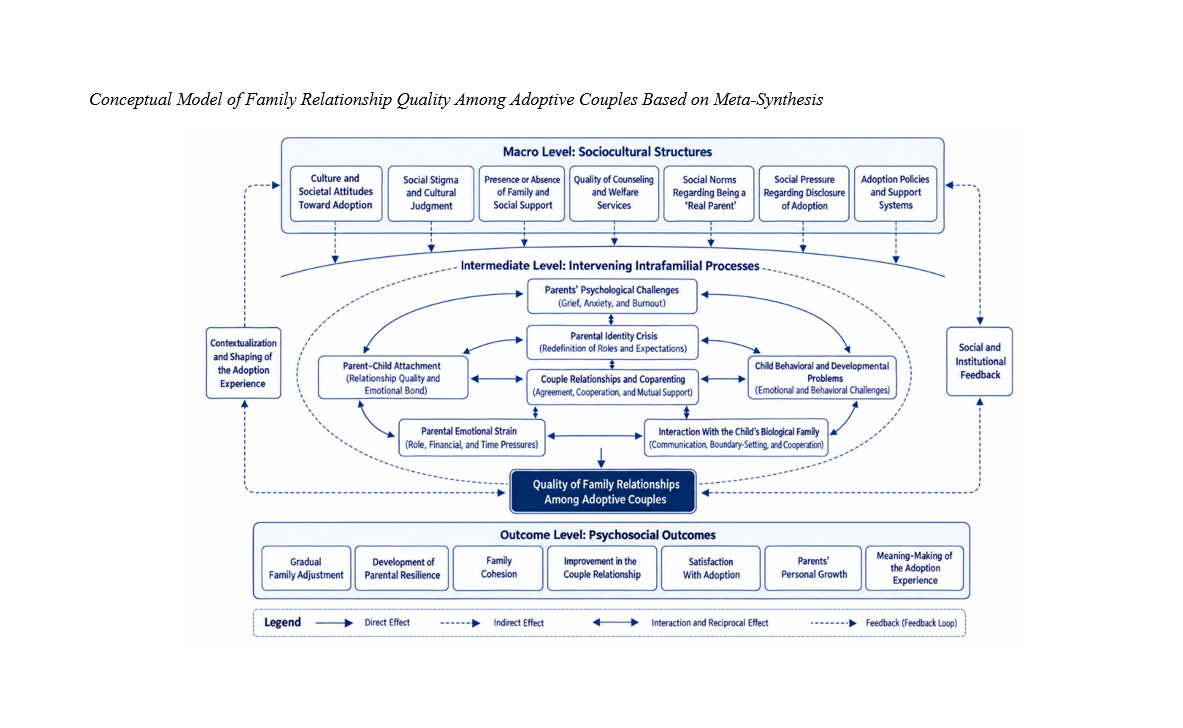
Findings: The meta-synthesis indicated that family relationship quality among adoptive couples is a multidimensional phenomenon shaped by the interaction of psychological–identity, relational, and sociocultural factors. Psychological and identity-related challenges included unresolved infertility grief, anxiety, feelings of inadequacy, and difficulties in reconstructing parental identity. At the relational level, the quality of parent–child attachment, marital cohesion, emotional communication, mutual support, and adaptive patterns of interaction emerged as central determinants of family stability. Sociocultural influences included adoption-related stigma, social pressure, cultural attitudes, and limitations in formal and institutional support. Conversely, adequate social support, access to counseling services, cultural acceptance, and supportive family environments facilitated psychological adjustment, relational cohesion, and positive adaptation following adoption.
Conclusion: Adoption should be conceptualized as a dynamic and transformative family process rather than a single event. The proposed model demonstrates that favorable family relationships emerge through the reciprocal interaction of psychological adjustment, effective couple and parent–child relationships, and supportive sociocultural conditions. The model may provide a useful framework for assessment, counseling, and interventions designed to strengthen family functioning among adoptive couples.
Downloads
References
Ali Akbari, F., & Tavakol, K. (2010). Examining the Psychological Experiences of Families with Adopted Children. Behavioral Sciences Research, 8(2), 125-132.
Anbari, M., & Nazari bin Abdulrahman, M. (2024). Behavioral and Attachment Challenges in Iranian Adoptive Families: A Qualitative Phenomenological Study. Payesh, 24(1), 81-94.
Arab, S., Ebrahimzadeh Pezeshki, R., & Morovati Sharifabadi, A. (2015). Designing a Meta Synthesis Model of Factors Affecting Divorce by Systematic Review of Previous Studies. irje, 10(4), 10-22.
Baltimore, D. L., & Crase, S. J. (2009). A Phenomenological Exploration of Adoption. Journal of Ethnographic & Qualitative Research, 3(2).
Canzi, E., Molgora, S., Ferrari, L., Ranieri, S., Mescieri, L., & Rosnati, R. (2021). 'Writing About Our Adoption': A Qualitative Study on Intercountry Adoptive Parents' Narratives During the First Post-Adoption Year. Adoption & Fostering, 45(2), 122-137. https://doi.org/10.1177/03085759211003171
Cooley, M. E., & Petren, R. E. (2020). A Qualitative Examination of Coparenting Among Foster Parent Dyads. Children and Youth Services Review, 110, 104776. https://doi.org/10.1016/j.childyouth.2020.104776
Dehghan Manshadi, M., Fallah, M. H., Sadrpushan, N., & Mohammadi, F. (2024). Examining the Psychological Experiences of Infertile Couples with an Adopted Child. Toloo-e-Behdasht, 23(4), 80-101.
Domyancich-Lee, S. C. (2022). The Yin & Yang of Belonging: A Phenomenological Study of Adult Korean Adoptees' Attachment Styles in Romantic Relationships. Adoption Quarterly, 25(4), 351-372. https://doi.org/10.1080/10926755.2021.2005729
Duncan, M., Fearon, P., & Woolgar, M. (2024). A Qualitative Exploration of How Adoptive Parents Experience the Direct and Indirect Trauma of Their Child's Early Maltreatment. Adoption & Fostering, 48(2), 167-183. https://doi.org/10.1177/03085759241251854
Foli, K. J., Hebdon, M., Lim, E., & South, S. C. (2017). Transitions of Adoptive Parents: A Longitudinal Mixed Methods Analysis. Archives of Psychiatric Nursing, 31(5), 483-492. https://doi.org/10.1016/j.apnu.2017.06.007
Foli, K. J., South, S. C., Lim, E., & Jarnecke, A. M. (2016). Post-Adoption Depression: Parental Classes of Depressive Symptoms Across Time. Journal of affective disorders, 200, 293-302. https://doi.org/10.1016/j.jad.2016.01.049
Frost, R. L., & Goldberg, A. E. (2020). Adopting Again: A Qualitative Study of the Second Transition to Parenthood in Adoptive Families. Adoption Quarterly, 23(2), 85-109. https://doi.org/10.1080/10926755.2019.1627450
Genis, C., Harf, A., El Husseini, M., Skandrani, S., & Moro, M. R. (2020). Réflexions autour de la notion de fonction réflexive parentale dans l'adoption. Neuropsychiatrie de l'Enfance et de l'Adolescence, 68(6), 320-326. https://doi.org/10.1016/j.neurenf.2020.07.006
Grigoropoulos, I. (2022). Adoption Openness and Adoption Stigma: A Retrospective Study of Adult Adoptees. Sn Social Sciences, 2(4), 34. https://doi.org/10.1007/s43545-022-00339-2
Groves, B. T. (2012). The Experiences and Narratives of Adoptive Parents: A Constructionist Family Perspective [Thesis, University of South Africa]. South Africa.
Kamrani Fakour, S., Rasoulzadeh Tabatabaei, K., Razaghi, R., & Ahmadi, F. (2019). Adoptive Families' Experiences of Adopted Children's Problems: A Grounded Theory Approach. Social Welfare, 19(74), 167-206.
Kohn-Willbridge, C., Pike, A., & de Visser, R. O. (2021). 'Look After Me Too': A Qualitative Exploration of the Transition into Adoptive Motherhood. Adoption & Fostering, 45(3), 300-315. https://doi.org/10.1177/03085759211050043
Melero, S., & Sánchez-Sandoval, Y. (2017). Mental Health and Psychological Adjustment in Adults Who Were Adopted During Their Childhood: A Systematic Review. Children and Youth Services Review, 77, 188-196. https://doi.org/10.1016/j.childyouth.2017.05.006
Mohammadi, F., Dehghan, M., Fallah, M. H., & Sadrpushan, N. (2023). Lived Experiences of Infertile Couples Regarding the Challenges of Adoption in Yazd. Journal of Disability Studies, 13, 176-176.
Mostajeran, M., Ghazanfari, A., & Ghasemi Pirbalouti, M. (2026). A Phenomenological Explanation of Adoptive Parents' Lived Experiences of Parenting Challenges. Rooyesh-e-Ravanshenasi, 15(1), 259-270.
Nemati Sogli Tappeh, F., Salehi, K., Rahimi, F. S., & Khaledian, M. (2020). Components of Marital Quality of Life: A Meta-Synthesis Study. Family Counseling and Psychotherapy, 10(1), 45-68.
Ottaway, H. (2012). Sibling Connections: An Exploration of Adopted People's Birth and Adoptive Sibling Relationships Across the Life-Span [Doctoral dissertation, University of East Anglia].
Parker, O., Kloess, J. A., Saveker, S., & Law, G. U. (2024). Making Sense of Adoption Disruption: An Interpretative Phenomenological Analysis of the Lived Experiences of Adoptive Parents. Children and Youth Services Review, 166, 107916. https://doi.org/10.1016/j.childyouth.2024.107916
South, S. C., Lim, E., Jarnecke, A. M., & Foli, K. J. (2019). Relationship Quality from Pre- to Postplacement in Adoptive Couples. Journal of Family Psychology, 33(1), 64.
Tavakol, Z., Nasrabadi, A. N., Moghadam, Z. B., & Salehiniya, H. (2019). The Presence of the Child, the Opportunity or a Threat to Marital Satisfaction: A Qualitative Study. Journal of education and health promotion, 8(1), 67. https://doi.org/10.4103/jehp.jehp_250_18
Wingfield, M., & Gurney-Smith, B. (2019). Adoptive Parents' Experiences of Dyadic Developmental Psychotherapy. Clinical Child Psychology and Psychiatry, 24(4), 661-679. https://doi.org/10.1177/1359104518807737
Downloads
Additional Files
Publication Timeline
- Submitted
- Revised
- Accepted