Predicting Marital Burnout from Emotional Intimacy and Perceived Partner Responsiveness: The Mediating Role of Dyadic Coping
Keywords:
Marital Burnout, Emotional Intimacy, Perceived Partner Responsiveness, Dyadic Coping, Marriage, Structural Equation ModelingAbstract
Objective: The present study aimed to predict marital burnout from emotional intimacy and perceived partner responsiveness and to examine the mediating role of dyadic coping among married adults in Canada.
Methods and Materials: This quantitative, cross-sectional correlational study was conducted on 384 married adults residing in Canada in 2026. Participants were recruited through convenience and online purposive sampling. Data were collected using the Couple Burnout Measure, Emotional Intimacy Scale, Perceived Partner Responsiveness Scale, Dyadic Coping Inventory, and a demographic questionnaire. Pearson correlation coefficients were used to examine bivariate relationships among the study variables. Confirmatory factor analysis and structural equation modeling were performed using IBM SPSS Statistics and AMOS to test the hypothesized direct and indirect relationships. Model fit was evaluated using χ²/df, CFI, TLI, RMSEA, and SRMR. The mediating effects of dyadic coping were assessed using a nonparametric bootstrap procedure with 5,000 resamples and bias-corrected 95% confidence intervals.
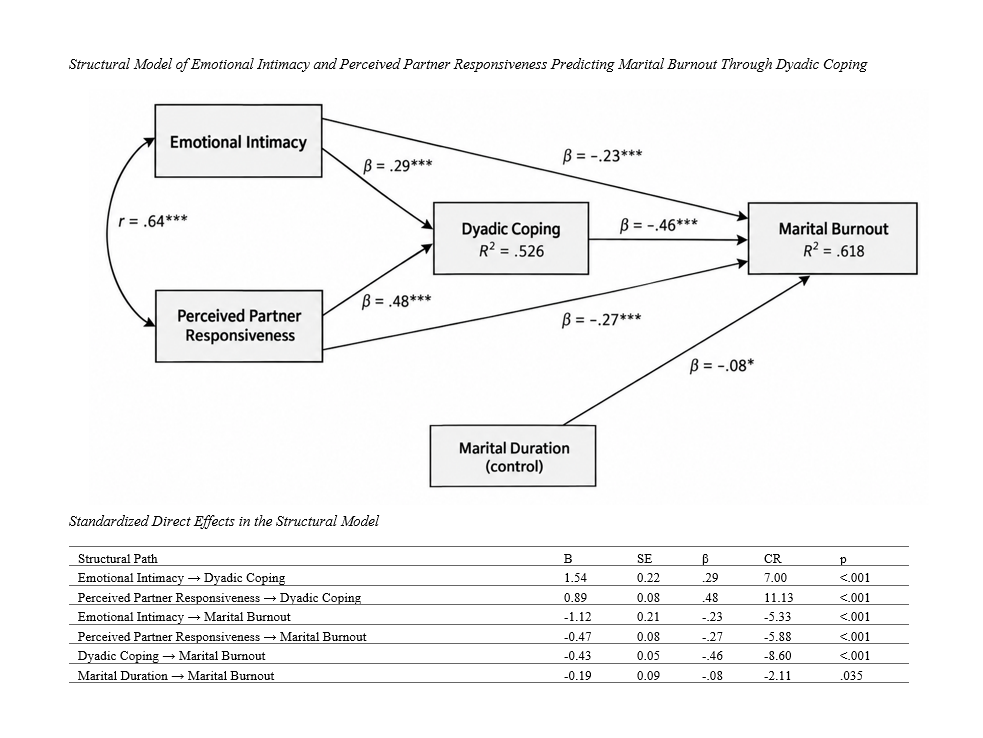
Findings: Emotional intimacy was significantly associated with lower marital burnout (r = -.61, p < .001) and greater dyadic coping (r = .58, p < .001). Perceived partner responsiveness was also negatively correlated with marital burnout (r = -.66, p < .001) and positively correlated with dyadic coping (r = .67, p < .001). Dyadic coping showed a strong inverse correlation with marital burnout (r = -.71, p < .001). In the structural model, emotional intimacy (β = -.23, p < .001), perceived partner responsiveness (β = -.27, p < .001), and dyadic coping (β = -.46, p < .001) significantly predicted marital burnout. Emotional intimacy (β = .29, p < .001) and perceived partner responsiveness (β = .48, p < .001) significantly predicted dyadic coping. Bootstrap analyses confirmed significant indirect effects of emotional intimacy (β = -.133, 95% CI [-.190, -.084]) and perceived partner responsiveness (β = -.221, 95% CI [-.293, -.158]) on marital burnout through dyadic coping, indicating partial mediation.
Conclusion: Greater emotional intimacy and perceived partner responsiveness are associated with lower marital burnout both directly and indirectly through more adaptive dyadic coping, highlighting dyadic coping as an important relational mechanism for reducing marital exhaustion.
Downloads
References
Carasso, E., & Segel‐Karpas, D. (2024). Marital Strain and Emotional Intimacy in Midlife Couples: The Moderating Role of Empathy. Personal Relationships, 31(3), 648-663. https://doi.org/10.1111/pere.12559
Carvalho, M., & Matias, M. (2023). Parental Exhaustion During COVID-19 Pandemic: Links to Relationship Outcomes and Dyadic Coping. Current Psychology, 43(18), 17007-17017. https://doi.org/10.1007/s12144-023-04658-2
Castro, R., Araújo, S., Marques, A., Ferreira, D., Rocha, H., Aguiar, S., Pieramico, S., Quinta-Gomes, A. L., Tavares, I. M., Carvalho, J., & Nobre, P. (2024). Mapping the Contributions of Dyadic Approaches to Couples’ Psychosocial Adaptation to Prostate Cancer: A Scoping Review. https://doi.org/10.31234/osf.io/ef6nd
Diest, S. L. v., Oudsten, B. L. D., Aaronson, N. K., Beaulen, A., Verboon, P., Aarnoudse, B., & Lankveld, J. v. (2023). Emotionally Focused Couple Therapy in Cancer Survivor Couples With Marital and Sexual Problems: A Replicated Single-Case Experimental Design. Frontiers in psychology, 14. https://doi.org/10.3389/fpsyg.2023.1123821
Duca, D. S., Ursu, A., Bogdan, I., & Rusu, P. P. (2023). Emotions and Emotion Regulation in Family Relationships. Revista Romaneasca pentru Educatie Multidimensionala, 15(2), 114-131. https://doi.org/10.18662/rrem/15.2/724
Grané-Morcillo, J., López-i-Martín, X., Lorente-De-Sanz, J., Castillo‐Garayoa, J. A., Testor, C. P., & Vall, B. (2026). Couple Resilience Assessment and Related Constructs: A Systematic Review. Psychological Trauma Theory Research Practice and Policy. https://doi.org/10.1037/tra0002210
Hamedani, K. H., Majzoobi, M. R., & Forstmeier, S. (2024). The Relationship Between Perfectionism and Marital Outcomes: A Systematic Review and Meta-Analysis. Frontiers in psychology, 15. https://doi.org/10.3389/fpsyg.2024.1456902
Ibrahim, M., Palit, M., & Matthews, R. (2023). Intergenerational Attachment Styles, Emotional Regulation and Relational Outcomes in Couples Therapy. https://doi.org/10.5772/intechopen.108492
Idulfilastri, R. M., Khaerunissa, M. R., & Zakaria, S. M. (2024). Harmonious Husband and Wife Relationship. Edunity Kajian Ilmu Sosial Dan Pendidikan, 3(1), 14-31. https://doi.org/10.57096/edunity.v3i1.208
Karaköse, S., & Ledermann, T. (2026). Insecure Attachment and Mental Health in Married Couples. Couple and Family Psychology Research and Practice, 15(1), 16-31. https://doi.org/10.1037/cfp0000276
Kuswanto, M. S., Ginanjar, A. S., & Rumondor, P. C. B. (2024). The Role of Common Dyadic Coping as Mediator Between Attachment Styles and Marital Satisfaction in Transition to Parenthood. Jppi (Jurnal Penelitian Pendidikan Indonesia), 10(2), 665. https://doi.org/10.29210/020243058
Naseh, M., Badiezadeh, S., Rafieifar, M., Taridashti, S., Reddy, S. M., & Panisch, L. S. (2024). Solution‐Focused Brief Therapy for Improving Couple Dyadic Relationships in Iran: A Systematic Review. Journal of marital and family therapy, 51(1). https://doi.org/10.1111/jmft.12758
Nguyen, P. (2023). Investigating Assortative Mating Patterns by Expanding Personality Assessments Beyond Static and Universal Personality Traits: Written Doctoral Preliminary Exam. https://doi.org/10.31234/osf.io/c3q7x
Obioma, I. F., Raina, M., Jaga, A., Asekun, W. A., Misurya, P., & Bark, A. S. H. (2025). Gender and Marital Burnout Within Four Countries: Examining the Effects of Conflict Negotiation Styles. Journal of Social and Personal Relationships, 42(12), 3509-3533. https://doi.org/10.1177/02654075251371383
Shinan‐Altman, S., Wertheimer, A., Frankel, B.-E., & Hamama‐Raz, Y. (2024). Her, His, and Their Journey With Endometriosis: A Qualitative Study. Frontiers in Global Women S Health, 5. https://doi.org/10.3389/fgwh.2024.1480060
Tang, N., Jia, Y., Zhao, Q., Liu, H., Li, J., Zhang, H., Lin, H., & Huangfu, C. (2022). Influencing Factors of Dyadic Coping Among Infertile Women: A Path Analysis. Frontiers in Psychiatry, 13. https://doi.org/10.3389/fpsyt.2022.830039
Temiz, Z. T., & Bilican, F. I. (2024). Daily External Stress, Internal Stress, Dyadic Coping, and Relationship Functioning of Turkish Couples During the COVID‐19: A Daily Diary Study. Stress and Health, 40(5). https://doi.org/10.1002/smi.3455
Thompson, A. E., Theis, R., Willhite, R. M., & Dębska, J. (2025). Love on Empty: The Development and Validation of a Comprehensive Scale to Measure Burnout in Modern Relationships. Behavioral Sciences, 15(12), 1737. https://doi.org/10.3390/bs15121737
Wang, Y., Zhang, J., Wang, S., Wu, Y., Hang, L., Hua, Y., & Shi, W. (2025). Feasibility and Preliminary Efficacy of a Systematic Transaction Model-Guided Dyadic Coping Nursing Intervention for Patients With Breast Cancer and Their Spousal Caregivers: A Pilot Study. Asia-Pacific Journal of Oncology Nursing, 12, 100621. https://doi.org/10.1016/j.apjon.2024.100621
Wendołowska, A., Czyżowska, N., & Czyżowska, D. (2022). The Role of Attachment and Dyadic Coping in Shaping Relational Intimacy: Actor–Partner Interdependence Model. International journal of environmental research and public health, 19(23), 16211. https://doi.org/10.3390/ijerph192316211
Wiener, L., Bedoya, S. Z., Goyal, A., Gordon, M., Deuitch, N., & Widemann, B. C. (2023). The Perceived Influence of Neurofibromatosis Type 1(NF1) on the Parents’ Relationship. Children, 10(3), 448. https://doi.org/10.3390/children10030448
Xie, B., Ma, D., Sun, X., Ouyang, Y.-Q., & Xu, Y. (2025). Influences of Parental Intimacy and Self-Disclosure on Dyadic Coping Among Parents Raising School-Aged Children Diagnosed With Autism Spectrum Disorder. Journal of Family Medicine and Primary Care, 14(7), 2774-2781. https://doi.org/10.4103/jfmpc.jfmpc_1875_24
Xie, B., Xu, Y., & Ouyang, Y.-Q. (2024). Effects of Parental Intimacy and Self-Disclosure on Dyadic Coping in Parents of Children With Autism Spectrum Disorder Entering School. https://doi.org/10.21203/rs.3.rs-3844754/v1
Yuan, H., You, J., Huang, J., Zhao, W., Jin, X., & Xu, W. (2026). An Actor-Partner Interdependence Mediation Model for Assessing the Association Between Dyadic Coping and Post-Traumatic Growth in Dyads of Patients With Stroke and Their Spouses: Cross-Sectional Study. BMC psychology, 14(1). https://doi.org/10.1186/s40359-026-04497-3
Zahedi, H., Alizadeh-Dibazari, Z., Mirghafourvand, M., Sahebihagh, M. H., & Hosseinzadeh, M. (2024). The Effectiveness of Couple-Based Interventions on the Marital Outcomes of Women With Genital and Breast Cancer and Their Partners: A Systematic Review and Meta-Analysis. BMC Cancer, 24(1). https://doi.org/10.1186/s12885-024-12088-x
Zhang, N., Zheng, T., Liu, X., Yu, X., & Wang, L. (2023). Burden, Coping and Resilience Among Caregivers for Patients With Chronic Obstructive Pulmonary Disease: An Integrative Review. Journal of clinical nursing, 33(4), 1346-1361. https://doi.org/10.1111/jocn.16954
Zhang, Q., & Cao, H. (2024). Relationships Between Dyadic Coping, Marital Adjustment, and Post-Traumatic Growth in Patients With Maintenance Hemodialysis Patients and Their Spouses. Frontiers in psychology, 15. https://doi.org/10.3389/fpsyg.2024.1487355
Zhao, H., Zhou, Y., Chin, C., Chong, M. C., Zheng, Y., Hou, Y., Chen, C., & Zhu, Y. (2023). Marital Self-Disclosure Intervention for the Fear of Cancer Recurrence in Chinese Patients With Gastric Cancer: Protocol for a Quasiexperimental Study (Preprint). https://doi.org/10.2196/preprints.55102
Zhao, H., Zhou, Y., Chin, C., Chong, M. C., Zheng, Y., Hou, Y., Chen, C., & Zhu, Y. (2024). Marital Self-Disclosure Intervention for the Fear of Cancer Recurrence in Chinese Patients With Gastric Cancer: Protocol for a Quasiexperimental Study. Jmir Research Protocols, 13, e55102. https://doi.org/10.2196/55102
Downloads
Additional Files
Publication Timeline
- Submitted
- Revised
- Accepted