Pre-to-Post Changes in Planned Change-of-Direction and Sprint Performance Following Eight Weeks of Adaptive Footwork Training in SL3 and SL4 Para-Badminton Athletes: A Preliminary Single-Group Study
Keywords:
para-badminton, footwork training, Agility, Speed, disability sportAbstract
Objective: Evidence on structured footwork training in standing lower-limb para-badminton athletes remains limited, particularly across SL3 and SL4 classifications. This preliminary exploratory study examined pre-to-post changes in planned change-of-direction and sprint performance following an eight-week adaptive footwork training programme and explored whether response patterns differed between SL3 and SL4 athletes.
Methods: Sixteen provincial-level para-badminton athletes (SL3, n = 8; SL4, n = 8) completed a single-group pretest–posttest intervention consisting of 24 sessions over eight weeks (three sessions/week). Planned change-of-direction performance was assessed using the T-test, and linear sprint performance was assessed using the 20-m sprint test. Paired-samples t-tests, Cohen’s dz, percentage change, and 2 × 2 mixed-design ANOVA (Time × Sport Classification) were used.
Results: T-test completion time decreased from 16.06 ± 0.52 to 15.50 ± 0.50 s (3.53%; p < 0.001; dz = 3.63), while 20-m sprint time decreased from 6.07 ± 0.70 to 5.54 ± 0.51 s (8.69%; p < 0.001; dz = 1.76). The Time × Classification interaction was not significant for T-test performance (p = 0.292) but was significant for sprint performance (p = 0.004), with a larger reduction in SL3 than SL4 athletes. Training adherence was high (95.50 ± 3.54%).
Conclusion: Lower post-intervention T-test and sprint times were observed following the programme, with a preliminary classification-related sprint pattern. Because of the single-group design, small sample, and exploratory subgroup analyses, these findings should not be interpreted as definitive evidence of causal intervention efficacy.
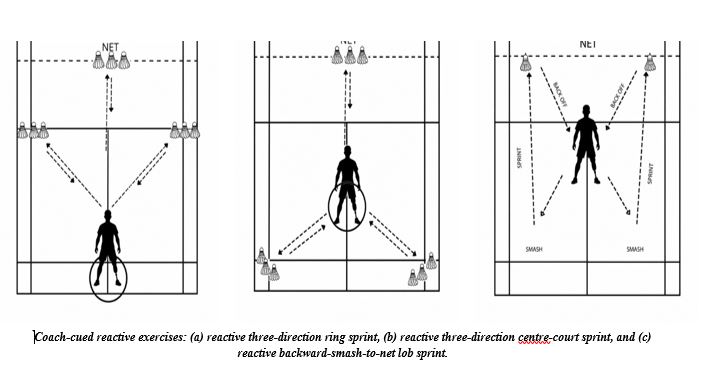
Methods: Sixteen athletes (SL3, n = 8; SL4, n = 8; age 24.44 ± 4.63 years) completed a single-group pretest–posttest intervention of 24 sessions (three/week, eight weeks) combining closed, pre-planned agility exercises (shadow footwork, explosive net approach) with open, reactive speed exercises (coach-cued ring sprints, a racket-based backward-smash-to-net lob). Agility and speed were assessed (T-test; 20-m sprint) at baseline and post-intervention, using paired t-tests and a 2×2 mixed-design ANOVA (Time × Classification). Results: Adherence was high (95.50 ± 3.54%). Agility time decreased from 16.06 ± 0.52 to 15.50 ± 0.50 s (Δ = 0.57 s, 95% CI [0.48, 0.65], t(15) = 14.54, p < .001, dz = 3.63); 20-m sprint decreased from 6.07 ± 0.70 to 5.54 ± 0.51 s (Δ = 0.53 s, 95% CI [0.37, 0.69], t(15) = 7.03, p < .001, dz = 1.76). The Time × Classification interaction was non-significant for agility (F(1,14) = 1.20, p = .292, ηp² = .079) but significant for sprint (F(1,14) = 11.62, p = .004, ηp² = .454), with SL3 improving more (0.72 s) than SL4 (0.33 s). Conclusion: An eight-week adaptive footwork program improved agility and sprint performance in standing lower para-badminton athletes, with a differential sprint response by classification. Given the single-group design, findings should be regarded as preliminary pending controlled replication.
Downloads