The Impact of the Sports Industry on Sustainable Economic Development: A Systematic Review
DOI:
https://doi.org/10.61838/kman.intjssh.5107Keywords:
Sports industry; Digital transformation; Sports entrepreneurship; SDG 11; Economic growthAbstract
Objective: This study aimed to analyze the role of the sports industry in promoting sustainable economic development and to provide a basis for future studies on sports industry development.
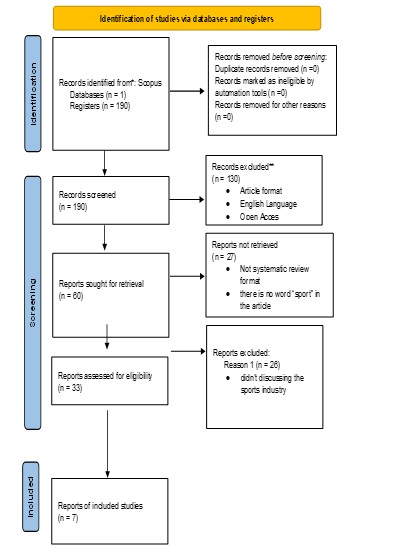
Methods and Materials: This systematic review followed the PRISMA guidelines. Articles were searched in the Scopus database using the keywords government, sport, industry, and impact. Of the 190 articles initially identified, screening based on predefined inclusion and exclusion criteria resulted in seven relevant articles for analysis. VOSviewer software was also used to identify keyword co-occurrence patterns among the included articles.
Findings: The reviewed studies indicate that the sports industry contributes to economic growth by increasing community income, creating employment opportunities, and supporting digital transformation in the health sector. Government policy support, financing models, governance strengthening, and sports entrepreneurship were identified as key contributing factors.
Conclusion: Human resource involvement across regions in sports industry development is consistent with Sustainable Development Goal (SDG) 11, particularly in strengthening community capacity for sustainable development. The sports industry may increase community income and requires government policy support to advance sustainable city and national development.
Downloads
References
[1] Ge, X. J., & Liu, X. (2021). Urban land use efficiency under resource-based economic transformation: A case study of Shanxi Province. Land, 10(8). https://doi.org/10.3390/land10080850.
[2] Khiali-Miab, A., Patt, A., & Krütli, P. (2024). Empowering a sustainable urban future: The key role of coordinated settlement development for optimising energy efficiency and socio-economic welfare. Sustainable Cities and Society, 107(April). https://doi.org/10.1016/j.scs.2024.105418.
[3] United Nations Human Settlements Programme (UN-Habitat). (2022). World Cities Report 2022: Envisaging the Future of Cities. UN-Habitat.
[4] Xu, J., Yang, S., Lin, Y., & Yang, R. (2021). An evaluation of coupling coordination between sports industry and health service industry in China. PLoS ONE, 16(8 August), 1-21. https://doi.org/10.1371/journal.pone.0256333.
[5] Zhang, W., & Mou, C. (2023). Analysis and improvement of sports industry development and public health strategy under low-carbon economic structure. Frontiers in Public Health, 11(March), 1-10. https://doi.org/10.3389/fpubh.2023.1152452.
[6] Andreff, W., & Szymanski, S. (Eds.). (2006). Handbook on the Economics of Sport. Edward Elgar Publishing.
[7] World Health Organization. (2022). Global Status Report on Physical Activity 2022. World Health Organization.
[8] Bradbury, J. C., Coates, D., & Humphreys, B. R. (2022). The impact of professional sports franchises and venues on local economies: A comprehensive survey. Journal of Economic Surveys, 1-43. https://doi.org/10.1111/joes.12533.
[9] Gratton, C., Shibli, S., & Coleman, R. (2005). Sport and economic regeneration in cities. Urban Studies, 42(5-6), 985-999. https://doi.org/10.1080/00420980500107045.
[10] Liu, C. (2024). The role of sports industry in urban development. Journal of Management and Social Development, 1(3), 319-323. https://doi.org/10.62517/jmsd.202412344.
[11] Chang, C., Zhang, B., & Xu, J. (2023). The impact of women's economic development on the sports industry: Based on the Petty-Clark theorem. SHS Web of Conferences, 171, 03033. https://doi.org/10.1051/shsconf/202317103033.
[12] Orunbayev, A. (2023). Globalization and sports industry. American Journal of Social Sciences and Humanity Research, 3(11), 164-182. https://doi.org/10.37547/ajsshr/Volume03Issue11-18.
[13] Wei, X., Zhang, J., Lyulyov, O., & Pimonenko, T. (2023). The role of digital economy in enhancing the sports industry to attain sustainable development. Sustainability (Switzerland), 15(15), 12009. https://doi.org/10.3390/su151512009.
[14] United Nations Department of Economic and Social Affairs. (n.d.). Goal 11: Make cities and human settlements inclusive, safe, resilient and sustainable. United Nations Sustainable Development Goals. https://sdgs.un.org/goals/goal11.
[15] Cong, X., & Liu, H. (2019). The cross-boundary integration development of Internet + sports industry. 52-60. https://doi.org/10.4236/jss.2019.710005.
[16] Zeimers, G., Shilbury, D., & McLeod, J. (2025). Examining sport board leadership: How chairs manage passion. Managing Sport and Leisure, 30(3), 452-468. https://doi.org/10.1080/23750472.2023.2192723.
[17] Hao, Y., Qiu, Z., Xu, Q., He, Q., Fang, X., & Wang, C. (2023). Innovation strategy design of public sports service governance based on cloud computing. Journal of Cloud Computing, 12(1). https://doi.org/10.1186/s13677-023-00448-0.
[18] Neal, S., Pang, B., Parry, K., & Rishbeth, C. (2024). Informal sport and leisure, urban space and social inequalities: Editors' introduction. Leisure Studies, 43(6), 875-886. https://doi.org/10.1080/02614367.2022.2162109.
[19] Savaş, D. A. (2024). Sports product market dynamics in Europe: Consumption and production insights. Sport Economics Research, 1(1), 39-58.
[20] Rich, K. A., Nelson, G., Borgen-Flood, T., & Pegoraro, A. (2024). Regional policy and organizational fields in multi-level sport governance. In Agency and Institutions in Sport (Vol. 24, Issue 1, pp. 51-71). https://doi.org/10.1080/16184742.2023.2257715.
[21] Mănescu, C. O. (2023). The economic and social impact of sport in local communities. Marathon, 15(2), 70-77. https://doi.org/10.24818/mrt.23.15.02.03.
[22] Abrahamyan, L. S. (2023). Interaction of management and economics in improving the efficiency of the development of the sports industry. Indonesian Journal of Sport Management, 3(1), 101-107. https://doi.org/10.31949/ijsm.v3i1.4535.
[23] Liqiang, Y., Zang, X., & Dunjie, L. (2024). Transforming youth sports team performance in the era of digitalization: The interplay of charismatic leadership, satisfaction, and team engagement drivers. Heliyon, 10(15), e34904. https://doi.org/10.1016/j.heliyon.2024.e34904.
[24] Madsen, D. Ø., & Glebova, E. (2025). Sports Industry 5.0: Reimagining sport through technology, humanity, and sustainability. Frontiers in Sports and Active Living, 7(December), 1-11. https://doi.org/10.3389/fspor.2025.1640362.
[25] Nuriddinov, A. (2023). Use of digital sports technologies in sports television. American Journal of Social Sciences and Humanity Research, 3(11), 107-120.
[26] Zhao, R., & Li, L. (2024). Does digitalization always benefit cultural, sports, and tourism enterprises quality? Unveiling the inverted U-shaped relationship from a resource and capability perspective. Humanities and Social Sciences Communications, 11(1), 1-20. https://doi.org/10.1057/s41599-024-03545-w.
[27] Popovic, S., Bjelica, D., Zarubica, M., Pekovic, S., & Matic, R. (2021). Attitudes of sport organization officials toward links between the sports sector, sports industry, and knowledge organizations with innovations in Montenegrin sport. Sport Mont, 19(2), 95-100. https://doi.org/10.26773/smj.210619.
[28] Sun, H., Cheng, M., & Jiang, F. (2025). Research on the influence mechanism of digital economy on the development of the sports and health industry in China. Scientific Reports, 15(1). https://doi.org/10.1038/s41598-025-16641-x.
[29] Dickson, G., & Zhang, J. J. (2020). Sports and urban development: An introduction. International Journal of Sports Marketing and Sponsorship, 22(1), 1-9. https://doi.org/10.1108/IJSMS-11-2020-0194.
[30] Zhang, Y., Wang, M., Zhao, X., Wang, M., & Wang, H. (2024). Unveiling the cumulative impact: Major sports events as catalysts for the construction of sport city in China. International Journal of Qualitative Methods, 23, 1-11. https://doi.org/10.1177/16094069241232348.
[31] Ekholm, D., & Lindström Sol, S. (2020). Mobilising non-participant youth: Using sport and culture in local government policy to target social exclusion. International Journal of Cultural Policy, 26(4), 510-523. https://doi.org/10.1080/10286632.2019.1595607.
[32] Nová, J. (2014). The managerial concepts of quality and performance and their integration in sports organizations. Sport Mont, XII(40-41-42), 73-80.
[33] Tinaz, C., & Knott, B. (Eds.). (2021). Sport and Development in Emerging Nations. Routledge.
Downloads
Publication Timeline
- Submitted
- Revised
- Accepted