Anxiety, Self-Confidence, and Performance Outcomes in Elite Iraqi Boxers
Keywords:
anxiety, selfconfidenceAbstract
Objective: Boxing competition involves technical decision-making, physical demands, and anticipatory psychological responses. This study aimed to compare precompetitive psychological characteristics and observed offensive performance between winning and losing elite Iraqi boxers across seven competitive bouts.
Methods: Fourteen male boxers participated in seven bouts. The 27-item Competitive State Anxiety Inventory-2 (CSAI-2) was administered approximately 60 minutes before competition. Bouts were recorded using two cameras, and punching actions were coded by three boxing specialists. Group comparisons involved t tests and Mann–Whitney U tests.
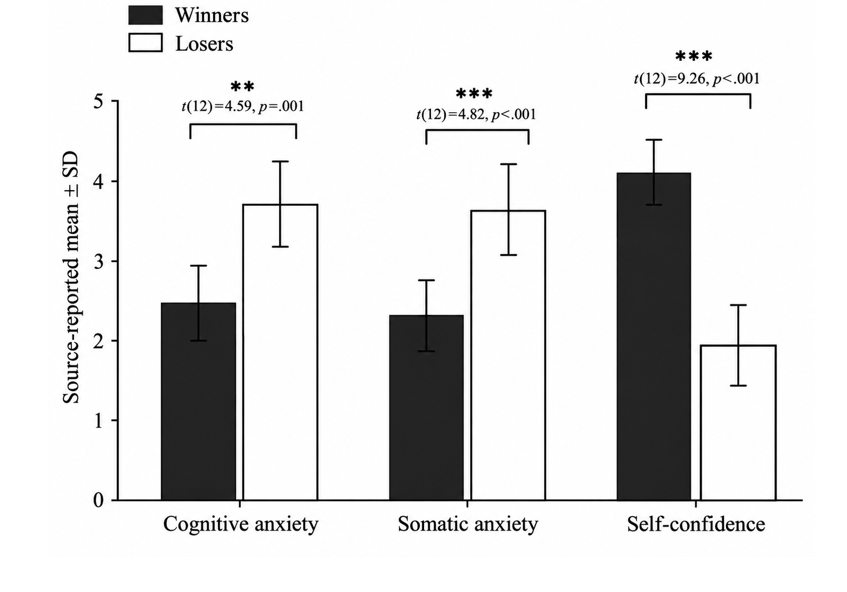
Results: Winning boxers exhibited lower cognitive anxiety (M = 2.46 vs. 3.71; t(12) = 4.59, p = .001, r = .80), lower somatic anxiety (M = 2.30 vs. 3.65; t (12) = 4.82, p < .001, r = .82), and higher self-confidence (M = 3.10 vs. 1.92; t(12) = 9.26, p < .001, r = .94) compared with losing boxers. Mann–Whitney U test results indicated significant differences favoring winners in five offensive skills: jab (Z = −3.00), cross (Z = −2.74), lead hook (Z = −2.63), rear hook (Z = −3.15), and lead uppercut (Z = −2.51), whereas the rear uppercut showed no statistically significant difference (Z = −1.74). Inter-rater reliability was high, with Cohen’s kappa coefficients ranging from .861 to .921.
Conclusions: Winning and losing boxers differed in reported anxiety, self-confidence, and offensive performance measures. Given the small paired competition sample and inconsistencies in the statistical summaries, these findings should be interpreted cautiously and do not establish causation or prediction.
Downloads