Effectiveness of Mentalization-Based Treatment in Reducing Suicidal Ideation Among Middle-Aged Women: A Quasi-Experimental Study
Keywords:
Mentalization-Based Treatment, Suicidal Ideation, Middle-Aged Women, PsychotherapyAbstract
Objective: This study aimed to determine the effectiveness of mentalization-based treatment (MBT) in reducing suicidal ideation among middle-aged women and to examine whether its therapeutic effects were maintained at a one-month follow-up.
Methods and Materials: This quasi-experimental study employed a pretest–posttest control-group design with a one-month follow-up. The statistical population consisted of women aged 40–60 years attending counseling and psychotherapy centers. Thirty eligible participants were selected and allocated to an intervention group (n = 15) and a control group (n = 15). The intervention group received ten weekly 90-minute online group sessions of mentalization-based treatment, whereas the control group received no psychological intervention during the study period and was placed on a waiting list. Suicidal ideation was measured at pretest, posttest, and one-month follow-up using the Beck Scale for Suicide Ideation. Data were analyzed using inferential statistical procedures. Because the assumption of homogeneity of regression slopes was violated for suicidal ideation, between-group comparisons of change scores were used to complement covariance-based analyses.
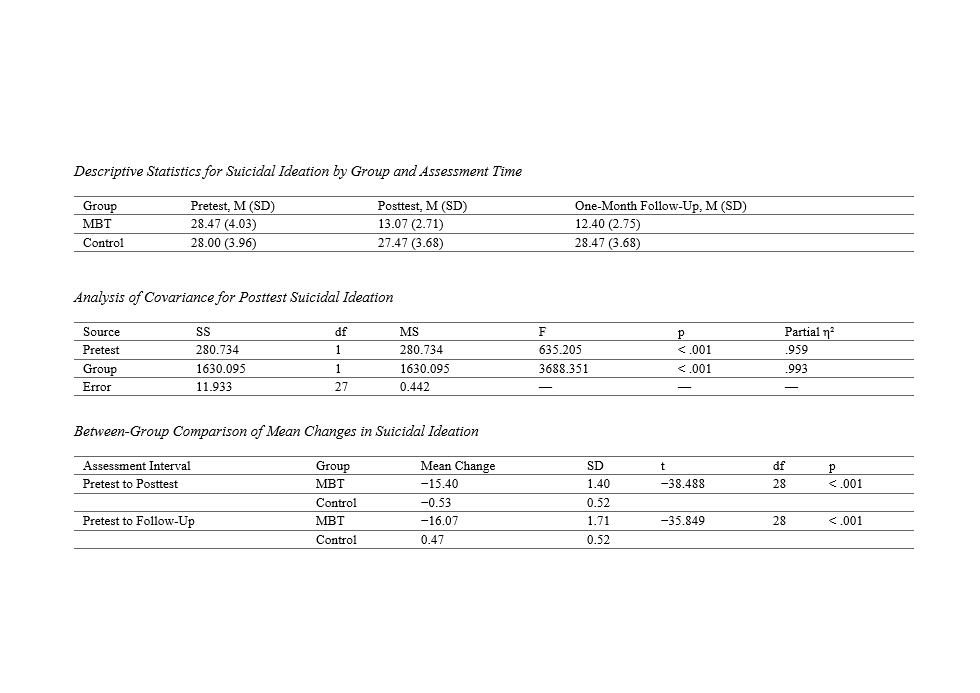
Findings: Inferential analyses demonstrated that the reduction in suicidal ideation from pretest to posttest was significantly greater in the mentalization-based treatment group than in the control group (t = −38.488, p < 0.001). Similarly, the change in suicidal ideation from pretest to the one-month follow-up differed significantly between the two groups (t = −35.849, p < 0.001), indicating that the therapeutic improvement achieved following the intervention was maintained during the follow-up period.
Conclusion: Mentalization-based treatment was effective in significantly reducing suicidal ideation among middle-aged women, and its beneficial effect persisted for at least one month after treatment. By strengthening individuals’ capacity to understand and interpret their own and others’ mental and emotional states, MBT may provide a useful psychotherapeutic approach for addressing suicidal thoughts in this population. Nevertheless, replication with larger samples and longer follow-up periods is recommended to establish the durability and generalizability of these findings.
Downloads
References
Bahamondes-Álvarez, R., van Hulst, B. M., Lund, C., Nooteboom, L. A., Oehm, L. M., Woermann, E., & Vermeiren, R. R. (2026). Understanding the Social Determinants of Suicidality Among Young People Aged 12-26 Years: A Mixed-Methods Systematic Review. Community Mental Health Journal, 1-25. https://doi.org/10.1007/s10597-026-01638-1
Beutel, M. E., Klein, E. M., Brähler, E., Reiner, I., Jünger, C., Michal, M., & Tibubos, A. N. (2017). Loneliness in the general population: Prevalence, determinants and relations to mental health. BMC psychiatry, 17(1), 97. https://doi.org/10.1186/s12888-017-1262-x
Drapkina, O. M., Kontsevaya, A. V., Kalinina, A. M., Avdeev, S. N., Agaltsov, M. V., Alekseeva, L. I., & Yakushin, S. S. (2024). Comorbidity of patients with noncommunicable diseases in general practice. Eurasian guidelines. Cardiovascular Therapy and Prevention, 23(3), 3996. https://doi.org/10.15829/1728-8800-2024-4154
Fan, X. F., Peng, J. Y., Zhang, L., Hu, Y. L., Li, Y., Shi, Y., & Zhang, T. M. (2024). The impact of mindfulness therapy combined with mentalization-based family therapy on suicidal ideation in adolescents with depressive disorder: Randomized intervention study. Annals of General Psychiatry, 23(1), 16. https://doi.org/10.1186/s12991-024-00503-3
Fogarty, A., McMahon, G., Findley, H., Hosking, C., Schulz, M., Seymour, M., & Giallo, R. (2024). Prevalence of suicidal and self-harm ideation in fathers during the perinatal and early parenting period: A systematic review and meta-analysis. Australian & New Zealand Journal of Psychiatry, 58(12), 1020-1033. https://doi.org/10.1177/00048674241267896
Fonagy, P., & Luyten, P. (2009). A developmental, mentalization-based approach to the understanding and treatment of borderline personality disorder. Development and Psychopathology, 21(4), 1355-1381. https://doi.org/10.1017/S0954579409990198
Hajek Gross, C., Oehlke, S. M., Prillinger, K., Goreis, A., Plener, P. L., & Kothgassner, O. D. (2024). Efficacy of mentalization-based therapy in treating self-harm: A systematic review and meta-analysis. Suicide and Life-Threatening Behavior, 54(2), 317-337. https://doi.org/10.1111/sltb.13044
Höller, I., Martens, J., Fönschau, C., & Forkmann, T. (2025). A cross-sectional study on the influence of emotion regulation strategies on the association between trait mindfulness and suicidality. BMC psychology, 13(1), 340. https://doi.org/10.1186/s40359-025-02530-5
Joiner, T. E. (2005). Why People Die by Suicide (Vol. 10). Harvard University Press.
Khadilkar, S., Divakar, H., Benedetto, C., Genazzani, A., Ramos, D., Argale, E., & Balkrishnan, M. (2026). FIGO best practice recommendations for the mental health of women at menopausal age. International Journal of Gynecology & Obstetrics, 173(2), 588-601. https://doi.org/10.1002/ijgo.70943
Komoróczy, E., Sörnyei, D., Vass, Á., Szuromi, B., Vizin, G., Réthelyi, J. M., & Farkas, K. (2024). Understanding depression in autism: The mediating role of mentalization, attachment, social support, and psychological flexibility. medRxiv. https://doi.org/10.1101/2024.07.12.24310324
Li, C., Wei, Z., Wang, Y., & Sun, L. (2022). Associations between suicidal ideation and relatives' physical and mental health among community residents: Differences between family members and lineal consanguinity. International journal of environmental research and public health, 19(23), 15997. https://doi.org/10.3390/ijerph192315997
Luyten, P., Campbell, C., Moser, M., & Fonagy, P. (2024). The role of mentalizing in psychological interventions in adults: Systematic review and recommendations for future research. Clinical psychology review, 108, 102380. https://doi.org/10.1016/j.cpr.2024.102380
McClelland, H., Evans, J. J., Nowland, R., Ferguson, E., & O'Connor, R. C. (2020). Loneliness as a predictor of suicidal ideation and behaviour: A systematic review and meta-analysis of prospective studies. Journal of affective disorders, 274, 880-896. https://doi.org/10.1016/j.jad.2020.05.004
O'Connor, R. C. (2011). The integrated motivational-volitional model of suicidal behavior. Crisis. https://doi.org/10.1027/0227-5910/a000120
Ryu, K. J., Park, H., Park, J. S., Lee, Y. W., Kim, S. Y., Kim, H., & Kim, T. (2022). Vasomotor symptoms and carotid artery intima-media thickness among Korean midlife women. Maturitas, 159, 1-6. https://doi.org/10.1016/j.maturitas.2021.12.005
Sander, L. B., Beisemann, M., Doebler, P., Micklitz, H. M., Kerkhof, A., Cuijpers, P., & Büscher, R. (2023). The effects of internet-based cognitive behavioral therapy for suicidal ideation or behaviors on depression, anxiety, and hopelessness in individuals with suicidal ideation: Systematic review and meta-analysis of individual participant data. Journal of medical Internet research, 25, e46771. https://doi.org/10.2196/46771
Tahmasebi Ashtiani, H. R., Karami, A., & Sohrabi, F. (2022). Effectiveness of Mentalization-Based Treatment (MBT) on Suicidal Ideation and Emotion Regulation Indicators in Women. Journal of Medical Sciences of Islamic Azad University, 32(4), 310-322.
Van Orden, K. A., Witte, T. K., Cukrowicz, K. C., Braithwaite, S. R., Selby, E. A., & Joiner, T. E., Jr. (2010). The interpersonal theory of suicide. Psychological review, 117(2), 575. https://doi.org/10.1037/a0018697
Wei, S., Qin, W., Yu, Z., Cao, Y., & Li, P. (2025). The effectiveness of mindfulness-based cognitive therapy on rumination and related psychological indicators: A systematic review and meta-analysis. BMC psychology, 13(1), 968. https://doi.org/10.1186/s40359-025-03348-x
Downloads
Additional Files
Publication Timeline
- Submitted
- Revised
- Accepted