Comparison of the Effectiveness of Existential Therapy and Schema Therapy in Reducing Death Anxiety among Women with Multiple Sclerosis
Keywords:
Existential Therapy; Schema Therapy; Death Anxiety; Multiple Sclerosis; WomenAbstract
Objective: This study aimed to compare the effectiveness of existential therapy and schema therapy in reducing death anxiety among married women with multiple sclerosis (MS).
Methods and Materials: This quasi-experimental study employed a pretest–posttest design with a control group. The statistical population comprised all married women diagnosed with multiple sclerosis in Tehran during the first six months of 2026 whose diagnosis had been confirmed by a specialist physician and who were receiving support from the Tehran Multiple Sclerosis Society. Using purposive sampling, 45 eligible women were selected and assigned to three groups of 15 participants: existential therapy, schema therapy, and control. Participants in the two intervention groups received the corresponding therapeutic programs, whereas the control group received no psychological intervention during the study period. Death anxiety was assessed at the pretest and posttest stages using the Templer Death Anxiety Scale. Data were analyzed using repeated-measures analysis of variance to examine changes in death anxiety across measurement occasions and differences among the three study groups.
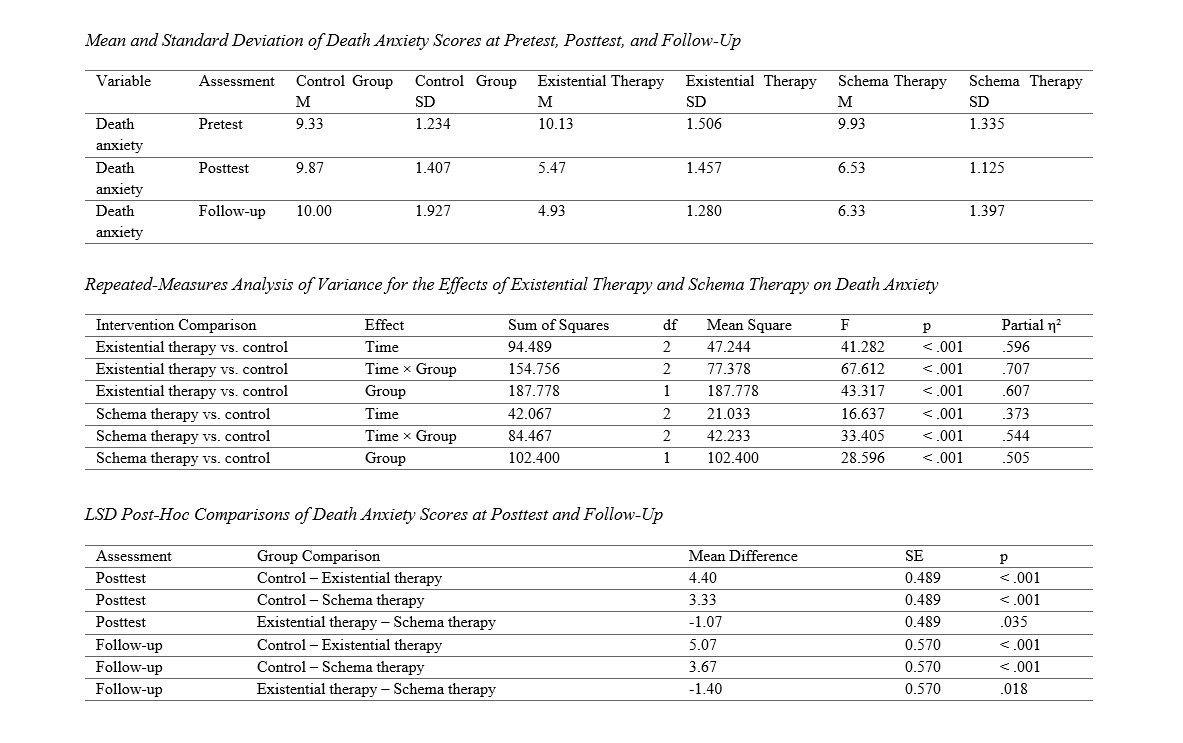
Findings: Repeated-measures analysis of variance demonstrated a statistically significant reduction in death anxiety following psychological intervention. Both existential therapy and schema therapy produced significant improvements in death anxiety compared with the control condition, indicating that each intervention was effective in reducing death-related anxiety among women with multiple sclerosis. The between-group comparison of the two active interventions further revealed a significant difference in their therapeutic effectiveness. Existential therapy produced a greater reduction in death anxiety than schema therapy, demonstrating its comparatively stronger effect on death-related psychological distress in the study population.
Conclusion: Both existential therapy and schema therapy appear to be effective psychological interventions for reducing death anxiety among married women with multiple sclerosis; however, existential therapy may provide greater therapeutic benefits.
Downloads
References
Arntz, A., Jacob, G. A., Lee, C. W., Brand-de Wilde, O. M., Fassbinder, E., Harper, R. P., & Farrell, J. M. (2022). Effectiveness of predominantly group schema therapy and combined individual and group schema therapy for borderline personality disorder: a randomized clinical trial. JAMA Psychiatry, 79(4), 287-299. https://doi.org/10.1001/jamapsychiatry.2022.0010
Dahmani, Z., Asgharnejad, A. A., & Golpour, R. (2024). Comparing the effectiveness of existential psychotherapy and acceptance and commitment therapy on psychosomatic symptoms and emotional distress tolerance among women with marital conflicts. Psychological Methods and Models, 15(55), 21-36.
Diamond, S. A. (2021). Existential therapy and Jungian analysis: Toward an existential depth psychology. Journal of Humanistic Psychology, 61(5), 665-720. https://doi.org/10.1177/0022167818809915
Dimitriou, N. G., Meuth, S. G., Martinez-Lapiscina, E. H., Albrecht, P., & Menge, T. (2023). Treatment of Patients with Multiple Sclerosis Transitioning Between Relapsing and Progressive Disease. CNS Drugs, 1-24. https://doi.org/10.1007/s40263-022-00977-3
Esmkhani Akbarnejad, H., Bayrampour, O., & Faroughi, P. (2021). Comparing the effectiveness of logotherapy and acceptance and commitment therapy on death anxiety, resilience and hopelessness among women with multiple sclerosis. Medical Sciences Journal of Islamic Azad University, Tehran, 31(1), 97-106.
Faghani Toulon, S. A., Golestanipour, M., & Sadati, S. Z. (2023). Comparing the effects of existential therapy and acceptance and commitment therapy on death anxiety, peak experiences and mental health in patients with Charcot-Marie-Tooth disease. Journal of Psychological Sciences, 22(125), 1001-1016.
Francalancia, J., Mavrogiorgou, P., Juckel, G., Mitrovic, T., Kuhle, J., Naegelin, Y., & Calabrese, P. (2021). Death anxiety and attitudes towards death in patients with multiple sclerosis: an exploratory study. Brain Sciences, 11(8), 964. https://doi.org/10.3390/brainsci11080964
Grady, J., & Viterito, J. (2025). The Evolution of Irvin Yalom's Existential Views on Death Anxiety. The Humanistic Psychologist. https://doi.org/10.1037/hum0000381
Güleç, Z. E. K., Uygunoğlu, U., Tütüncü, M., Saip, S., Siva, A., & Yalçınkaya, C. (2023). Analysis of determinants of treatment change in adult paediatric-onset MS patients. Multiple Sclerosis and Related Disorders, 69, 104463. https://doi.org/10.1016/j.msard.2022.104463
Harahap, N., Sasmita, H., & Rachmadanur, N. (2026). Evaluating the Effectiveness of Selected Existential Therapies for Death Anxiety in Advanced Cancer: A Systematic Review and Meta-Analysis. Central European Journal of Nursing & Midwifery, 17(2), 2466. https://doi.org/10.15452/cejnm.2026.17.0010
Hatami, A., & Tabatabaeinejad, F. S. (2023). The effectiveness of existential therapy on emotional capital, cognitive emotion regulation and subjective well-being among female undergraduate students with social anxiety: A quasi-experimental study. Journal of Rafsanjan University of Medical Sciences, 22(2), 129-146.
Joshua, P. R., Lewis, V., Kelty, S. F., & Boer, D. P. (2023). Is schema therapy effective for adults with eating disorders? A systematic review into the evidence. Cognitive behaviour therapy, 52(3), 213-231. https://doi.org/10.1080/16506073.2022.2158926
Luo, J., Han, R., Deng, Y., Liu, J., Liu, M., Huang, C., & Xiao, J. (2026). How Young Cancer Patients Cope with Death Anxiety: A Qualitative Study Based on Terror Management Theory. Supportive Care in Cancer, 34(3), 240. https://doi.org/10.1007/s00520-026-10479-3
Menzies, R. G. (2022). Failed potentialities, regret and their link to depression and related disorders. In Existential concerns and cognitive-behavioral procedures: An integrative approach to mental health (pp. 223-234). Springer International Publishing. https://doi.org/10.1007/978-3-031-06932-1_13
Menzies, R. G., & Menzies, R. E. (2024). Existential therapies and the extended evolutionary meta-model: Turning existential philosophy into process-based therapy. Journal of Contextual Behavioral Science, 34, 100840. https://doi.org/10.1016/j.jcbs.2024.100840
Özgüç, S., Kaplan Serin, E., & Tanriverdi, D. (2024). Death anxiety associated with coronavirus (COVID-19) disease: A systematic review and meta-analysis. OMEGA-Journal of Death and Dying, 88(3), 823-856. https://doi.org/10.1177/00302228211050503
Sabanagic-Hajric, S., Suljic, E., Memic-Serdarevic, A., Sulejmanpasic, G., & Mahmutbegovic, N. (2022). Quality of life in multiple sclerosis patients: influence of gender, age and marital status. Materia socio-medica, 34(1), 19. https://doi.org/10.5455/msm.2022.33.19-24
Soleimani, P. (2020). Comparing the effectiveness of acceptance and commitment group therapy and group schema therapy on perceived stress, pain perception, pain catastrophizing, depression and symptom severity among women with fibromyalgia [Doctoral dissertation, Islamic Azad University, Ardabil Branch].
Straarup, N. S., Renneberg, H. B., Farrell, J., & Younan, R. (2022). Group schema therapy for patients with severe anxiety disorders. Journal of Clinical Psychology, 78(8), 1590-1600. https://doi.org/10.1002/jclp.23351
Türker, E., & Demirkaya, Ş. (2026). The Mediating Role of Self-Compassion in the Relationship Between Perceived Stress and Death Anxiety in Patients With Multiple Sclerosis. Healthcare, 14(6), 743. https://doi.org/10.3390/healthcare14060743
Vatikioti, C. T. K. T. C., & Paparrigopoulos, T. (2024). Death anxiety, life's meaninglessness, and mental resilience among women with symptoms of behavioral addictions and alcohol use disorder: using the existential approach. Psychiatriki, 10. https://doi.org/10.22365/jpsych.2024.026
Versluis, M. A., de Vries, F. E., van der Linden, Y. M., Alradhi, H., Kool, M., Hunting, J. C., & Raijmakers, N. J. (2026). Death Anxiety during the Last Year of Life in Patients with Advanced Cancer: Longitudinal Results from the eQuiPe Study. Psycho-Oncology, 35(3), e70429. https://doi.org/10.1002/pon.70429
Vos, J. (2023). Existential psychological therapies: An overview of empirical research. Pratiques Psychologiques. https://doi.org/10.1016/j.prps.2023.06.001
Xue, K., Shang, J., Yang, C., Pan, L., Shi, H., Zuo, C., & Zeng, Y. (2026). Death Anxiety among Patients with Advanced Cancer: A Systematic Review and Meta-Analysis. Journal of Advanced Nursing, 82(6), 6916-6926. https://doi.org/10.1111/jan.70318
Zhang, K., Hu, X., Ma, L., Xie, Q., Wang, Z., Fan, C., & Li, X. (2023). The efficacy of schema therapy for personality disorders: a systematic review and meta-analysis. Nordic journal of psychiatry, 77(7), 641-650. https://doi.org/10.1080/08039488.2023.2228304
Downloads
Additional Files
Publication Timeline
- Submitted
- Revised
- Accepted