Ranking Empowerment Mechanisms in Group Therapy for Women
DOI:
https://doi.org/10.61838/kman.pwj.5053Keywords:
Empowerment, Group therapy, Women’s psychology, Agency, Emotional regulationAbstract
Objective: This study aimed to identify and rank the key empowerment mechanisms that emerge in group therapy for women through a mixed-method approach combining qualitative thematic analysis and quantitative prioritization.
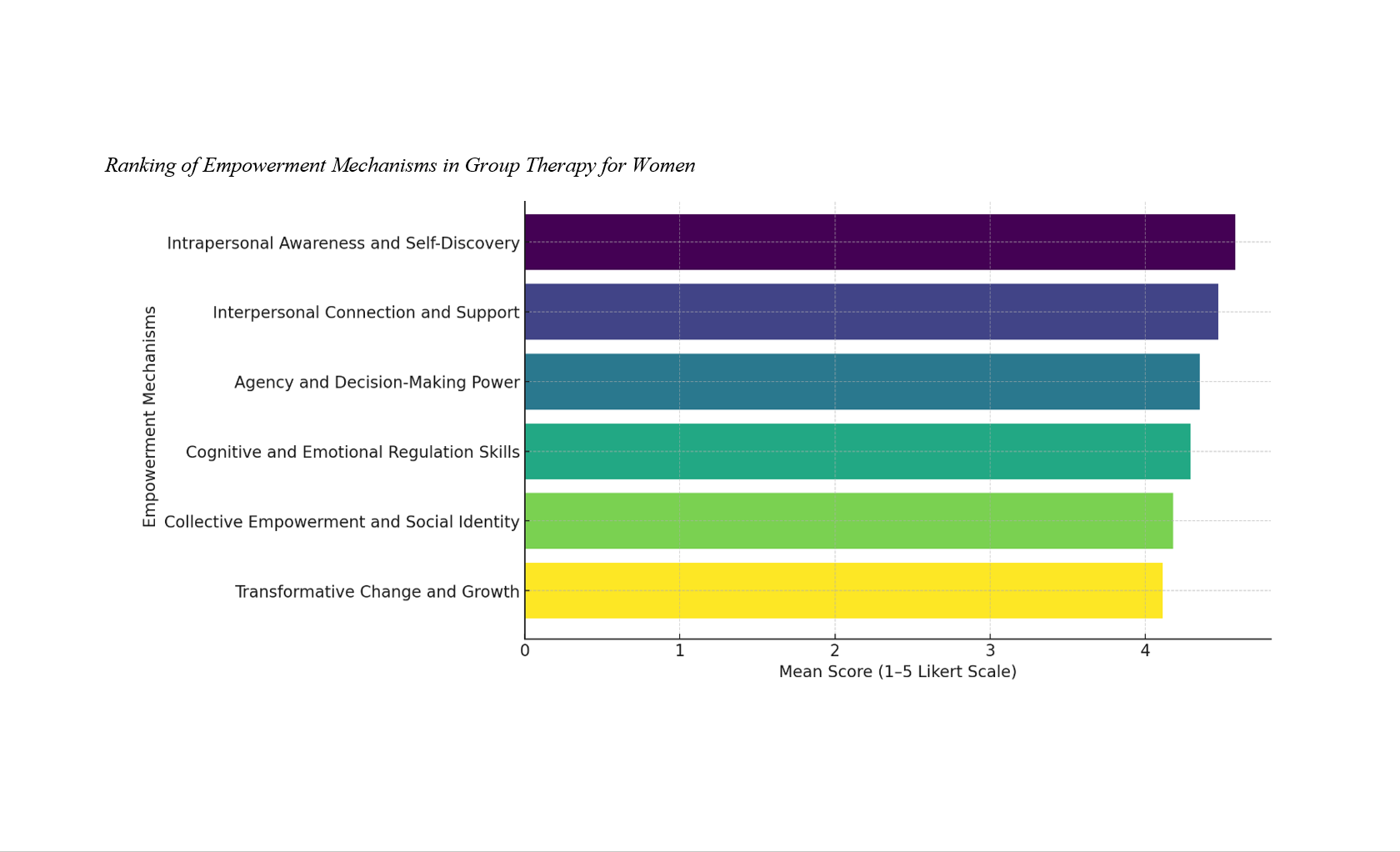
Methods and Materials: A sequential exploratory mixed-methods design was adopted. The first phase consisted of a qualitative literature-based thematic analysis using NVivo 14 to identify empowerment mechanisms from 68 peer-reviewed studies until theoretical saturation was achieved. Six main themes emerged: intrapersonal awareness and self-discovery, interpersonal connection and support, agency and decision-making power, cognitive and emotional regulation skills, collective empowerment and social identity, and transformative change and growth. The second phase involved quantitative ranking using SPSS 26. A structured questionnaire developed from the qualitative findings was distributed to 231 women participants from the United States who had attended group therapy sessions. Responses were analyzed using descriptive statistics and Kendall’s coefficient of concordance (W) to determine the degree of agreement among participants.
Findings: Results indicated a high level of consensus among participants (Kendall’s W = 0.83, p < 0.001). The mean ranking revealed that intrapersonal awareness and self-discovery (M = 4.58, SD = 0.41) was the most significant empowerment mechanism, followed by interpersonal connection and support (M = 4.47, SD = 0.44) and agency and decision-making power (M = 4.35, SD = 0.52). Lower-ranked mechanisms included cognitive and emotional regulation skills (M = 4.29, SD = 0.48), collective empowerment and social identity (M = 4.18, SD = 0.55), and transformative change and growth (M = 4.11, SD = 0.61).
Conclusion: The study concludes that empowerment in group therapy for women is a progressive process beginning with intrapersonal awareness and extending toward social identity and transformation.
Downloads
References
Abbas, S., Isaac, N., Zia, M., Zakar, R., & Fischer, F. (2021). Determinants of Women’s Empowerment in Pakistan: Evidence From Demographic and Health Surveys, 2012–13 and 2017–18. BMC public health, 21(1). https://doi.org/10.1186/s12889-021-11376-6
Abdu, A. A., Marquis, G. S., & Colecraft, E. K. (2023). Local Meanings and Perceptions of Women’s Empowerment: Qualitative Evidence From Female and Male Farmers in Rural Ghana. African Journal of Food Agriculture Nutrition and Development, 23(116), 22294-22309. https://doi.org/10.18697/ajfand.116.22925
Barak, F., Efitre, J., Odong, R., & Melgar‐Quiñonez, H. (2024). Intrahousehold Empowerment Patterns, Gender Power Relations, and Food Security in Uganda. World Food Policy, 10(1), 7-32. https://doi.org/10.1002/wfp2.12071
Choudhury, S. R., & Pal, A. (2025). Women Empowerment Through Self-Help Group Model: A Survey Based Study on South 24 Parganas Region, West Bengal. Journal of Research in Humanities and Social Science, 13(4), 37-40. https://doi.org/10.35629/9467-13043740
Crookston, B. T., West, J., Davis, S. F., Hall, C., Seymour, G., & Gray, B. (2021). Understanding Female and Male Empowerment in Burkina Faso Using the Project-Level Women’s Empowerment in Agriculture Index (Pro-Weai): A Longitudinal Study. BMC Women S Health, 21(1). https://doi.org/10.1186/s12905-021-01371-9
Fung, K., Liu, J. J. W., & Wong, J. P. (2021). Exploring Mechanisms of Mental Illness Stigma Reduction in Asian Canadian Men. The Canadian Journal of Psychiatry, 67(6), 490-498. https://doi.org/10.1177/07067437211018674
Keya, L., Jemutai, E., & Makori, A. (2025). Financial Availability and Its Influence on Women’s Economic Empowerment in Kakamega County, Kenya. International Journal of Research and Scientific Innovation, 12(8), 672-688. https://doi.org/10.51244/ijrsi.2025.120800054
Kilgallen, J. A., Mwijage, A., Charles, P., Chizi, T. M., John, A., Nicholaus, I., Sebarua, E., Urassa, M., & Lawson, D. W. (2025). “You Are Married by the Woman”: Divergent Understandings of Men’s Support for Women’s Empowerment in Northwestern Tanzania. Men and Masculinities, 28(3), 306-327. https://doi.org/10.1177/1097184x251326192
Kinati, W., Baker, D., Temple, E. C., Najjar, D., & Mulema, A. A. (2022). Empowerment Resources, Decision-Making and Gender Attitudes: Which Matter Most to Livestock Keepers in the Mixed and Livestock-Based Systems in Ethiopia? Cabi Agriculture and Bioscience, 3(1). https://doi.org/10.1186/s43170-022-00114-6
Kumar, N., Raghunathan, K., Arrieta, A., Jilani, A. H., & Pandey, S. (2021). The Power of the Collective Empowers Women: Evidence From Self-Help Groups in India. World Development, 146, 105579. https://doi.org/10.1016/j.worlddev.2021.105579
Kumari, M. (2024). Women Empowerment Through Self Employment (Shg’s) –With Special Reference to Kurnool District. Interantional Journal of Scientific Research in Engineering and Management, 08(01), 1-13. https://doi.org/10.55041/ijsrem28381
Lapuz, M. C. M., Manlapaz, C. R., & Francisco, J. A. (2024). Turning Challenges Into Opportunities Through Women Empowerment: Agritourism in Central Luzon, Philippines. Sage Open, 14(4). https://doi.org/10.1177/21582440241283172
Mandal, N. K. (2024). Women’s Empowerment and Financial Inclusion in India: 2006-2019. 104-116. https://doi.org/10.52756/bhstiid.2024.e01.007
Meena, B. S., & Jain, B. K. (2024). Exploring the Scope and Impact of Vocational Education and Skill Development Programs on Women’s Self-Help Groups. International Journal for Multidisciplinary Research, 6(5). https://doi.org/10.36948/ijfmr.2024.v06i05.28411
Ofosu-Koranteng, M., Okemwa, P., & Mwatha, R. (2022). Economic Empowerment of Refugee Women in Ghana and Its Influence on Household Decision Making. International Journal of Current Aspects, 6(1), 73-83. https://doi.org/10.35942/ijcab.v6i1.238
Sabri, S. A. A., & Nastiti, A. (2025). Unveiling Disparities: Empowerment and Access to Sanitation Among Urban Households in Jakarta, Indonesia. Journal of Water Sanitation and Hygiene for Development, 15(8), 639-651. https://doi.org/10.2166/washdev.2025.341
Sarawagi, A., & Singh, M. S. (2024). Enhancing Livelihoods and Empowering Tribal Women: Analyzing the Role of Self-Help Groups in Sonbhadra. Sachetas, 3(2), 23-30. https://doi.org/10.55955/320004
Sarawagi, A., & Singh, M. S. (2025). Mechanisms and Impact of Self-Help Groups on the Socio-Economic Empowerment of Tribal Women in Uttar Pradesh. 30-42. https://doi.org/10.58532/nbennursech4
Selvaraj, N. (2022). Women Social Empowerment - An Empirical Study in Theni District. Ictact Journal on Management Studies, 8(1), 1506-1512. https://doi.org/10.21917/ijms.2022.0219
Shata, A., & Seelig, M. I. (2021). The Dragonfly Effect: Analysis of the Social Media Women’s Empowerment Campaign. Journal of Creative Communications, 16(3), 331-346. https://doi.org/10.1177/09732586211036551
Sobieraj, S., & Humphreys, L. (2021). Forced Empowerment and the Paradox of Mobile Dating Apps. Social Media + Society, 7(4). https://doi.org/10.1177/20563051211068130
Thobejane, K., Swanepoel, J. W., Niekerk, J. A. V., & Merwe, H. V. d. (2023). Measuring Women’s Empowerment in Agriculture in the Gauteng Province of South Africa. South African Journal of Agricultural Extension (Sajae), 51(3), 161-185. https://doi.org/10.17159/2413-3221/2023/v51n3a15857
Uprety, D. (2024). Women Empowerment Through Participation in Open Defecation-Free Initiatives: A Qualitative Study. Education and Development, 33(1), 163-173. https://doi.org/10.3126/ed.v33i1.66591
Vashanth, S. D., & Sengottuvel, C. (2025). Exploring the Transformative Role of Micro Credit Services in Advancing Economic and Social Empowerment Among Women Through Self-Help Groups in the Banking Sector Context. Bm. https://doi.org/10.53555/bm.v11i4.6448
Vejdani, N., Ahmadian, H., Yārahmadi, Y., & Karimi, Q. (2025). Comparison of the Effectiveness of an Empowerment-Based Educational Program and Emotion-Focused Therapy on Resilience and Emotion Regulation in Women Experiencing Domestic Violence. Injoeacs, 6(1), 67-80. https://doi.org/10.61838/kman.ijecs.6.1.7
Wenda, B. D. S., & Fon, D. E. (2021). Evaluating Women’s Empowerment in Rural Cameroon Through the Abbreviated – Women’s Empowerment in Agriculture Index. European Journal of Humanities and Social Sciences, 1(3), 45-51. https://doi.org/10.24018/ejsocial.2021.1.3.69
Yang, S. Y., Xiao, Z., & Qian, D. (2025). The Impact and Mechanism of Femvertising in Male Consumers’ Gift Purchasing Intention. Journal of Theoretical and Applied Electronic Commerce Research, 20(2), 112. https://doi.org/10.3390/jtaer20020112
Downloads
Additional Files
Publication Timeline
- Submitted
- Revised
- Accepted