Ranking Identity Threats in Women in STEM: A Mixed-Method Analysis in the Brazilian Context
DOI:
https://doi.org/10.61838/kman.pwj.5051Keywords:
Identity threat, Women in STEM, Gender bias, Organizational culture, Stereotype threat, Work–life integrationAbstract
Objective: This study aimed to identify and rank the primary dimensions of identity threats experienced by women in Science, Technology, Engineering, and Mathematics (STEM) fields in Brazil.
Methods and Materials: The research adopted a two-phase sequential exploratory mixed-method design. In the qualitative phase, an extensive literature-based thematic analysis was conducted using NVivo 14, reviewing 75 academic and empirical sources published between 2010 and 2025 to achieve theoretical saturation. Seven overarching categories of identity threats were identified through open, axial, and selective coding. In the quantitative phase, a structured questionnaire derived from the qualitative findings was distributed to 220 women in STEM professions and graduate programs across Brazil. Participants rated the impact of each identified threat on a 5-point Likert scale. Data were analyzed using SPSS 26, employing descriptive statistics, Cronbach’s alpha for reliability, and the Friedman test for ranking.
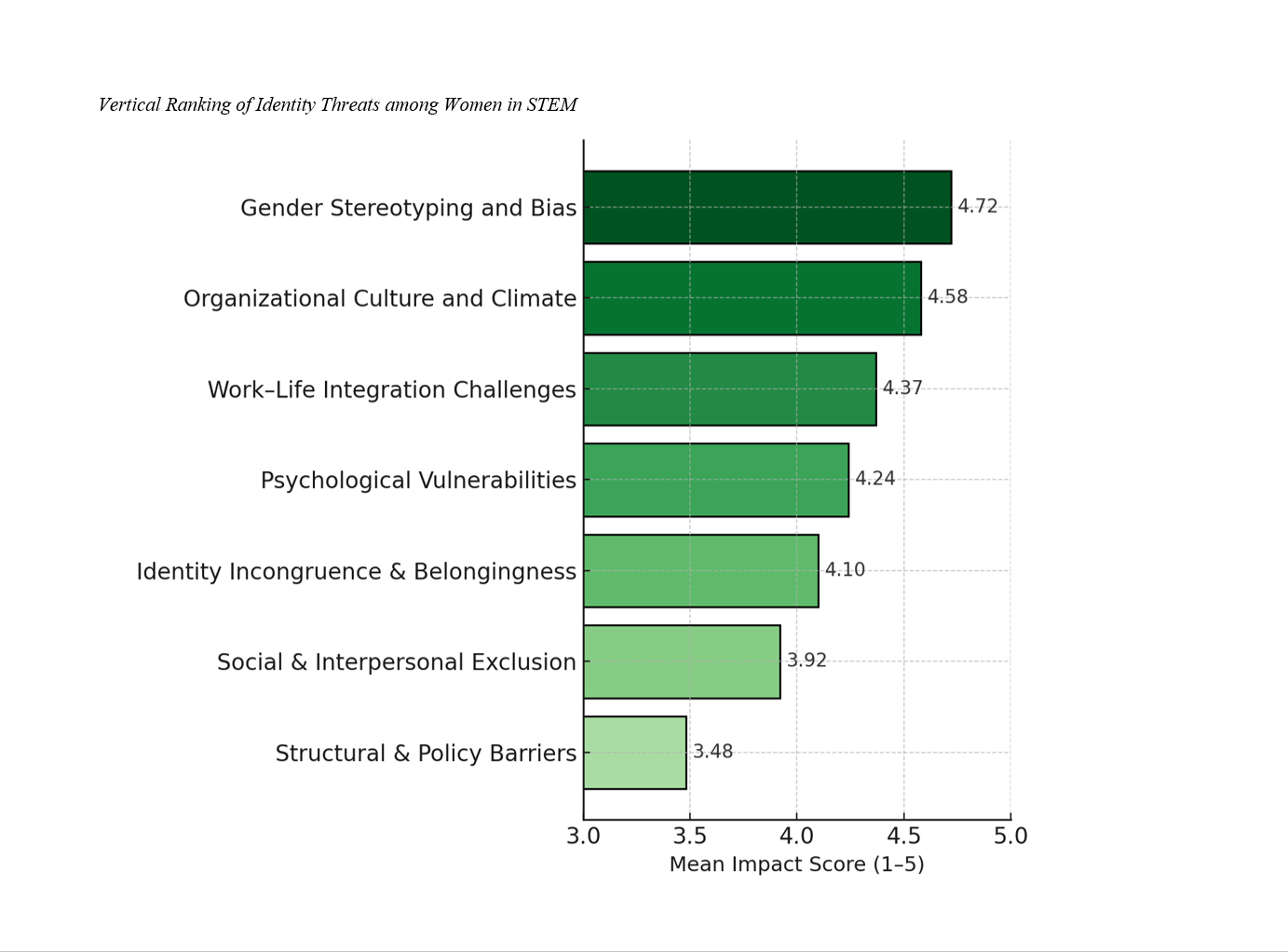
Findings: The Friedman analysis revealed significant differences among the perceived intensity of threat dimensions (χ² = 126.74, p < 0.001). Gender stereotyping and bias (Mean Rank = 5.96, M = 4.72, SD = 0.41) and organizational culture and climate (Mean Rank = 5.73, M = 4.58, SD = 0.46) emerged as the most dominant threats, followed by work–life integration challenges (Mean Rank = 5.28, M = 4.37, SD = 0.54). The least influential category was structural and policy barriers (Mean Rank = 3.39, M = 3.48, SD = 0.74). These differences were statistically significant, confirming a hierarchical pattern of identity threats.
Conclusion: Findings demonstrate that interpersonal and organizational dynamics exert a stronger impact on women’s identity threat experiences in STEM than structural policies. Targeted institutional reforms, inclusive mentoring systems, and identity-affirming interventions are essential to fostering equity and belonging in STEM professions.
Downloads
References
Bergsieker, H. B., Wilmot, M. O., Cyr, E., & Grey, C. B. (2020). A Threat in the Network: STEM Women in Less Powerful Network Positions Avoid Integrating Stereotypically Feminine Peers. Group Processes & Intergroup Relations, 24(3), 321-349. https://doi.org/10.1177/1368430219888274
Bertrams, A., Lindner, C., Muntoni, F., & Retelsdorf, J. (2022). Self-Control Capacity Moderates the Effect of Stereotype Threat on Female University Students’ Worry During a Math Performance Situation. Frontiers in psychology, 13. https://doi.org/10.3389/fpsyg.2022.794896
Chauke, T. A. (2022). Gender Differences in Determinants of Students’ Interest in STEM Education. Social Sciences, 11(11), 534. https://doi.org/10.3390/socsci11110534
Cruz, M., & Nagy, N. (2022). Profiles in Persistence: A Latent Profile Analysis of Multilevel Coping Strategies Enacted Among Women in the Sciences. Journal of Organizational Behavior, 45(3), 362-381. https://doi.org/10.1002/job.2657
Deemer, E. D., Dotterer, A. M., Duhon, S. A., Derosa, P. A., Lim, S., Bowen, J. R., & Howarter, K. B. (2024). Does University Context Play a Role in Mitigating Threatening Race-Stem Stereotypes? Test of the Stereotype Inoculation Model. Journal of Diversity in Higher Education, 17(2), 190-199. https://doi.org/10.1037/dhe0000403
Endendijk, J. J. (2023). A Person-Centered Approach Toward Balanced Gender Identity in Emerging Adults: Associations With Self-Esteem and Attitudes About Education. Education Sciences, 13(4), 424. https://doi.org/10.3390/educsci13040424
Fordham, J., Ratan, R., Huang, K.-T., & Silva, K. (2020). Stereotype Threat in a Video Game Context and Its Influence on Perceptions of Science, Technology, Engineering, and Mathematics (STEM): Avatar-Induced Active Self-Concept as a Possible Mitigator. American behavioral scientist, 64(7), 900-926. https://doi.org/10.1177/0002764220919148
Georgeac, O., & Rattan, A. (2023). The Business Case for Diversity Backfires: Detrimental Effects of Organizations’ Instrumental Diversity Rhetoric for Underrepresented Group Members’ Sense of Belonging. Journal of personality and social psychology, 124(1), 69-108. https://doi.org/10.1037/pspi0000394
Grimm, A., Steegh, A., Çolakoğlu, J., Kubsch, M., & Neumann, K. (2023). Positioning Responsible Learning Analytics in the Context of STEM Identities of Under-Served Students. Frontiers in Education, 7. https://doi.org/10.3389/feduc.2022.1082748
Gu, C., Liang, H., Xi, L., & Yang, D. (2023). Do Electronic Coupon-Using Behaviors Make Men Womanish? The Effect of the Coupon–Feminine Stereotype. Journal of Theoretical and Applied Electronic Commerce Research, 18(3), 1637-1659. https://doi.org/10.3390/jtaer18030083
Harmse, L. G., & Dichaba, M. (2025). Investigating the Factors Contributing to the Underrepresentation of Female Lecturers in STEM Disciplines at a TVET College. Journal of Culture and Values in Education, 8(1), 70-85. https://doi.org/10.46303/jcve.2025.5
Iraola-Real, I., & Carvalho, C. (2025). The Influence of Gender Stereotypes on Self-Efficacy and Mathematical Anxiety in Peruvian Students Aspiring to STEM Careers. Journal on Mathematics Education, 16(2), 407-422. https://doi.org/10.22342/jme.v16i2.pp407-422
Jensen, L. E., & Deemer, E. D. (2019). Identity, Campus Climate, and Burnout Among Undergraduate Women in STEM Fields. The Career Development Quarterly, 67(2), 96-109. https://doi.org/10.1002/cdq.12174
Johnson, I. R., & Pietri, E. S. (2022). Ally Endorsement: Exploring Allyship Cues to Promote Perceptions of Allyship and Positive STEM Beliefs Among White Female Students. Group Processes & Intergroup Relations, 26(3), 738-761. https://doi.org/10.1177/13684302221080467
Jones, A., Turner, R. N., & Latu, I. M. (2022). Resistance Towards Increasing Gender Diversity in Masculine Domains: The Role of Intergroup Threat. Group Processes & Intergroup Relations, 25(3), NP24-NP53. https://doi.org/10.1177/13684302211042424
Ladewig, A., Köller, O., & Neumann, K. (2022). Stereotypes in the German Physics Olympiad - Hurdle or No Harm at All? Frontiers in Education, 7. https://doi.org/10.3389/feduc.2022.957716
Lin, C., & Deemer, E. D. (2019). Stereotype Threat and Career Goals Among Women in STEM: Mediating and Moderating Roles of Perfectionism. Journal of Career Development, 48(5), 569-583. https://doi.org/10.1177/0894845319884652
MacIntyre, P. L. (2020). Supporting Career Choices for Women in the Sciences and Engineering. Academic Journal of Engineering Studies, 1(2). https://doi.org/10.31031/aes.2020.01.000510
McCarty, M. K., Kelly, J. R., & Williams, K. D. (2020). The Impact of Fleeting Exposure to Female Exemplars of Success in STEM. Group Processes & Intergroup Relations, 25(2), 474-488. https://doi.org/10.1177/1368430220975475
McKoy, T. L., Beane, C., Oyeteju, M., Hammond, M. S., & Hargrove, S. K. (2020). Persistence of African American Females in Engineering: The Mathematics Identity Factor. Urban Education, 7(1). https://doi.org/10.55370/uerpa.v7i1.902
Njogu, S., Wambu, C., & Chesikaw, L. (2025). Social Stereotypes on Enrolment and Completion Rates of Students in Stem Oriented Courses in Selected Public Universities in Kenya. Kabarak J. Res. Innov., 15(03), 80-97. https://doi.org/10.58216/kjri.v15i03.496
Picho, K., Ospina, T. R., & Caicedo, A. M. (2020). Exploring Latent Profiles of Stereotype Threat Susceptibility in U.S. and Colombian Students. Electronic Journal of Research in Educational Psychology, 18(52), 473-506. https://doi.org/10.25115/ejrep.v18i52.2729
Przymus, S. D., Sparks, D. M., García, S. J. V., Silveus, A., & Cartmill, C. (2021). From Imagined to in-Practice and Performed STEM Identities: Measuring the Impact of a Latina STEM Fellowship on the Educational Trajectories of Latina High School Students. Association of Mexican American Educators Journal, 15(1), 113-139. https://doi.org/10.24974/amae.15.1.435
Rahman, P. (2024). A Reflexive Thematic Analysis Exploring the Experiences of Undergraduate Women in STEM in Bangladesh. Discover Education, 3(1). https://doi.org/10.1007/s44217-024-00185-9
Salinas, A. G. E. (2024). Promoting Women's Participation in STEM Through a Digital Tool Based on Large Language Models (LLM). Avances en Interacción Humano-Computadora, 9(1), 268-271. https://doi.org/10.47756/aihc.y9i1.183
Stevens, S., Ruberton, P. M., Smyth, J. M., Cohen, G. L., Greenaway, V. P., & Cook, J. E. (2023). A Latent Class Analysis Approach to the Identification of Doctoral Students at Risk of Attrition. PLoS One, 18(1), e0280325. https://doi.org/10.1371/journal.pone.0280325
Veelen, R. v., Derks, B., & Endedijk, M. (2019). Double Trouble: How Being Outnumbered and Negatively Stereotyped Threatens Career Outcomes of Women in STEM. Frontiers in psychology, 10. https://doi.org/10.3389/fpsyg.2019.00150
Verdugo-Castro, S., García‐Holgado, A., Gómez, M. C. S., & García‐Peñalvo, F. J. (2021). Multimedia Analysis of Spanish Female Role Models in Science, Technology, Engineering and Mathematics. Sustainability, 13(22), 12612. https://doi.org/10.3390/su132212612
Wong, E. (2023). The Influence of Self-Efficacy, Interest, and Stereotype Threat on Career Intentions and Choices Related to Math and Science. https://doi.org/10.32920/ryerson.14664978
Zaman, S., Spychalska‐Waszek, H., Doerflinger, J. T., Gollwitzer, P. M., & Byrka, K. (2025). Outfits Serve as Symbols for Overlapping Feminine and STEM Identity Goals. Scandinavian journal of psychology, 66(3), 411-428. https://doi.org/10.1111/sjop.13093
Zhang, Y., & Rios, K. (2022). Exploring the Effects of Promoting Feminine Leaders on Women’s Interest in STEM. Social Psychological and Personality Science, 14(1), 40-50. https://doi.org/10.1177/19485506211069808
Downloads
Additional Files
Publication Timeline
- Submitted
- Revised
- Accepted