Prioritizing Barriers to Help-Seeking for Intimate Partner Violence
DOI:
https://doi.org/10.61838/kman.pwj.5049Keywords:
Intimate partner violence, help-seeking behavior, psychological barriers, social and cultural factorsAbstract
Objective: This study aimed to identify and prioritize the psychological, social, economic, structural, interpersonal, and informational barriers that prevent women from seeking help in cases of intimate partner violence (IPV).
Methods and Materials: The research was conducted in two phases. The first phase adopted a qualitative design, employing a systematic literature review of studies published between 2000 and 2025 to identify recurring themes related to help-seeking barriers for IPV survivors. Data were analyzed using NVivo 14 software until theoretical saturation was achieved, leading to six main categories: psychological, social and cultural, economic, structural and institutional, interpersonal and relational, and informational and awareness barriers. In the second quantitative phase, a structured questionnaire derived from these themes was distributed to 216 women in South Africa who had experienced or witnessed IPV. Responses were analyzed using SPSS version 26, with mean scores and ranking analysis applied to prioritize the identified barriers.
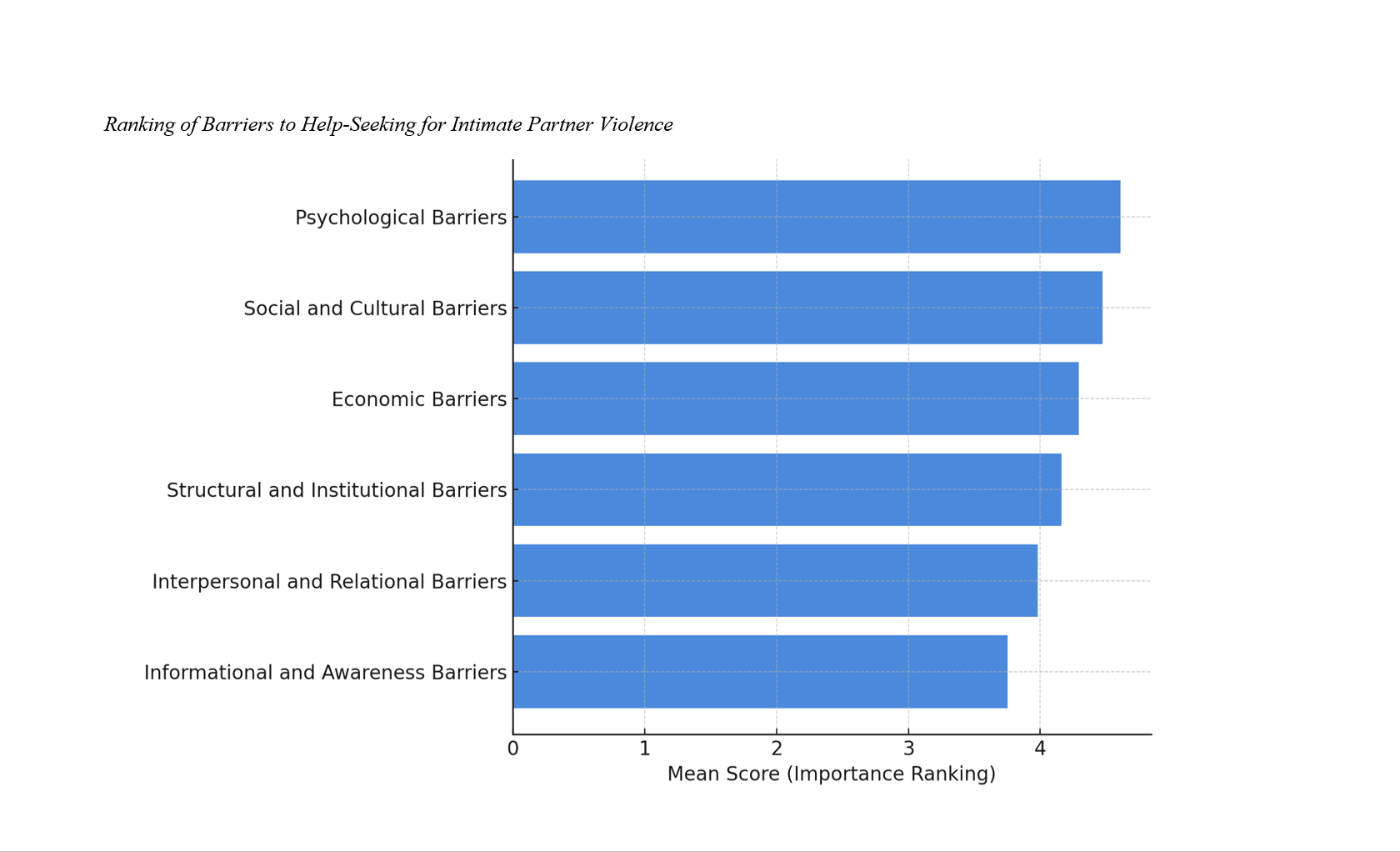
Findings: Results showed that psychological barriers ranked as the most significant deterrent to help-seeking (mean = 4.61, SD = 0.42), followed by social and cultural barriers (mean = 4.47, SD = 0.48) and economic barriers (mean = 4.29, SD = 0.51). Structural and institutional barriers ranked fourth (mean = 4.16, SD = 0.57), while interpersonal and relational barriers (mean = 3.98, SD = 0.62) and informational and awareness barriers (mean = 3.75, SD = 0.65) were of relatively lower but still notable importance. The hierarchical ranking highlights the interplay between internalized emotions, sociocultural pressures, and systemic inadequacies in shaping help-seeking behaviors.
Conclusion: The study underscores the primacy of psychological and cultural factors in deterring help-seeking among IPV survivors. Effective interventions should therefore combine trauma-informed psychological support, cultural awareness training, and systemic reforms to enhance accessibility, trust, and empowerment within survivor-centered service frameworks.
Downloads
References
Allen‐Leap, M., Hooker, L., Wild, K., Wilson, I. M., Pokharel, B., & Taft, A. (2022). Seeking Help From Primary Health-Care Providers in High-Income Countries: A Scoping Review of the Experiences of Migrant and Refugee Survivors of Domestic Violence. Trauma Violence & Abuse, 24(5), 3715-3731. https://doi.org/10.1177/15248380221137664
Alsinai, A., Reygers, M., DiMascolo, L., Kafka, J. M., Rowhani‐Rahbar, A., Adhia, A., Bowen, D., Shanahan, S., Dalve, K., & Ellyson, A. M. (2023). Use of Immigration Status for Coercive Control in Domestic Violence Protection Orders. Frontiers in Sociology, 8. https://doi.org/10.3389/fsoc.2023.1146102
Alves-Costa, F., Lane, R., Gribble, R., Taylor, A., Fear, N. T., & MacManus, D. (2022). Help-Seeking for Intimate Partner Violence and Abuse: Experiences of Civilian Partners of UK Military Personnel. Journal of family violence, 38(3), 509-525. https://doi.org/10.1007/s10896-022-00382-w
Bardwell, E. S., Elliott, S. A., Levine, E. C., & Goodman, K. L. (2024). LGBTQIA+ Identity-Related Concerns of Sexual Assault Survivors Who Access an Anonymous Online Hotline. Journal of interpersonal violence, 40(19-20), 4455-4478. https://doi.org/10.1177/08862605241291913
Brockdorf, A. N., Holland, K. J., Kumar, S. A., Jaffe, A. E., & DiLillo, D. (2022). Alcohol Use Before Sexual Violence and Cognitive Appraisals: Differential Associations With Barriers to Help-Seeking. Violence Against Women, 29(5), 777-799. https://doi.org/10.1177/10778012221097144
Fekri, S. D., Khoshnevis, N., Zareiyan, A., Kheirkhahi, E., Moghadam, Z. B., & Namazi, M. (2025). Breaking the Silence: Barriers to Help-Seeking Among Female Victims of Domestic Violence in Ardabil, Iran – A Qualitative Study. PLoS One, 20(7), e0326998. https://doi.org/10.1371/journal.pone.0326998
Harris, B., & Woodlock, D. (2022). ‘You Can’t Actually Escape It’: Policing the Use of Technology in Domestic Violence in Rural Australia. International Journal for Crime Justice and Social Democracy, 11(1), 135-148. https://doi.org/10.5204/ijcjsd.2190
Kim, E. Y. Y., Nelson, L. E., Pereira, T. L., & Shorey, S. (2023). Barriers to and Facilitators of Help-Seeking Among Men Who Are Victims of Domestic Violence: A Mixed-Studies Systematic Review. Trauma Violence & Abuse, 25(3), 2189-2203. https://doi.org/10.1177/15248380231209435
Kunasagran, P. D., Mokti, K., Ibrahim, M. Y., Syed Sharizman Syed Abdul, R., Robinson, F., Muyou, A. J., Mujin, S. M., Ali, N., Chao, G. G. C., Nasib, R., Chiu, A. E. L., Rahim, N. B. A., Ahmad, M. H., Dhanaraj, P. S., Arumugam, P., & Yusoff, J. (2024). The Global Landscape of Domestic Violence Against Women During the COVID-19 Pandemic: A Narrative Review. Korean Journal of Family Medicine, 45(1), 3-11. https://doi.org/10.4082/kjfm.23.0084
Leat, S. R., Ravi, K. E., Rai, A., Obenauf, C., & Bryant, S. M. (2023). Do I Belong Here? Experiences of Transgender Survivors of Intimate Partner Violence in Domestic Violence Shelters. Families in Society the Journal of Contemporary Social Services, 106(1), 245-255. https://doi.org/10.1177/10443894231196929
Martin, T. E., Gover, A. R., & Langton, L. (2022). The Relationship Between Formal Help-Seeking and Sexual Orientation Among Victims of Domestic Violence. Journal of interpersonal violence, 38(1-2), 156-182. https://doi.org/10.1177/08862605221080150
Newaz, M. S., Saha, S., Salekuzzaman, K., & Sultana, S. (2023). Victims of Gender-Based Violence at One-Stop Crisis Centers of Bangladesh. International Journal of Social Science Research and Review, 6(1), 132-143. https://doi.org/10.47814/ijssrr.v6i1.886
Reed, S. M., Kibler, M. A., & Avalos, S. (2024). “. . .It’s Just the Barriers That Can Be So Vast and Different”: Domestic Violence Advocates’ Perceived Barriers for Service Across Survivor Subpopulations. Crime & Delinquency, 70(13-14), 3582-3606. https://doi.org/10.1177/00111287241248090
Reeves, E., Fitz‐Gibbon, K., Meyer, S., & Walklate, S. (2023). Incredible Women: Legal Systems Abuse, Coercive Control, and the Credibility of Victim-Survivors. Violence Against Women, 31(3-4), 767-788. https://doi.org/10.1177/10778012231220370
Rohn, E., & Tenkorang, E. Y. (2022). Motivations and Barriers to Help-Seeking Among Female Victims of Intimate Partner Violence in Ghana. Violence Against Women, 30(2), 524-550. https://doi.org/10.1177/10778012221137924
Sheeran, N., Tarzia, L., & Douglas, H. (2022). Communicating Reproductive Coercion in the Context of Domestic and Family Violence: Perspectives of Service Providers Supporting Migrant and Refugee Women. Journal of family violence, 38(1), 51-61. https://doi.org/10.1007/s10896-022-00357-x
Sultana, R., Husain, N., Allen, O., & Taylor, P. (2024). Barriers and Facilitators for Help-Seeking Behaviors in British South Asian Women Who Have Experienced Domestic Violence: A Qualitative Study. Families in Society the Journal of Contemporary Social Services. https://doi.org/10.1177/10443894241272176
Sultana, R., Özen‐Dursun, B., Femi-Ajao, O., Husain, N., Varese, F., & Taylor, P. (2022). A Systematic Review and Meta-Synthesis of Barriers and Facilitators of Help-Seeking Behaviors in South Asian Women Living in High-Income Countries Who Have Experienced Domestic Violence: Perception of Domestic Violence Survivors and Service Providers. Trauma Violence & Abuse, 24(5), 3187-3204. https://doi.org/10.1177/15248380221126189
Waller, B., Harris, J., & Quinn, C. R. (2021). Caught in the Crossroad: An Intersectional Examination of African American Women Intimate Partner Violence Survivors’ Help Seeking. Trauma Violence & Abuse, 23(4), 1235-1248. https://doi.org/10.1177/1524838021991303
Waller, B., Joyce, P. A., Quinn, C. R., Shaari, A. A. H., & Boyd, D. T. (2022). “I Am the One That Needs Help”: The Theory of Help-Seeking Behavior for Survivors of Intimate Partner Violence. Journal of interpersonal violence, 38(1-2), 288-310. https://doi.org/10.1177/08862605221084340
Win, A. M. M. (2025). Exploring Influencing Factors on Help-Seeking Behaviors for Intimate Partner Violence: Insights From Ethnic Women Survivors in Myanmar. International journal of environmental research and public health, 22(6), 899. https://doi.org/10.3390/ijerph22060899
Yirgu, R., Wondimagegnehu, A., Qian, J., Milkovich, R., Zimmerman, L., Decker, M. R., Glass, N., Seid, F., Zekarias, L., & Wood, S. N. (2023). Needs and Unmet Needs for Support Services for Recently Pregnant Intimate Partner Violence Survivors in Ethiopia During the COVID-19 Pandemic. BMC public health, 23(1). https://doi.org/10.1186/s12889-023-15634-7
Zark, L., Toumbourou, J. W., & Satyen, L. (2022). Help-Seeking for Intimate Partner and Family Violence Among Tertiary Students in Australia: Nature, Extent, and Cross-Cultural Differences. Journal of family violence, 38(3), 491-508. https://doi.org/10.1007/s10896-022-00406-5
Downloads
Additional Files
Publication Timeline
- Submitted
- Revised
- Accepted