Ranking Trauma-Informed Care Needs Among Refugee Women
DOI:
https://doi.org/10.61838/kman.pwj.5048Keywords:
Trauma-informed care, refugee women, safety and protection, cultural sensitivity, psychological support, empowermentAbstract
Objective: This study aimed to identify, categorize, and rank the trauma-informed care needs of refugee women through a mixed-method approach integrating qualitative literature synthesis and quantitative prioritization among refugee women in Germany.
Methods and Materials: The study employed a two-phase mixed-method design. In the first phase, an extensive qualitative literature review was conducted to identify key trauma-informed care dimensions relevant to refugee women, with data analyzed inductively using NVivo 14 until theoretical saturation was achieved. Seven overarching themes were extracted, including safety and protection, psychological support, cultural and linguistic sensitivity, empowerment and agency, social support networks, access to health and social services, and training for service providers. In the second phase, a structured questionnaire based on these themes was administered to 200 refugee women residing in Germany. Participants rated the importance of each care dimension on a five-point Likert scale, and data were analyzed using SPSS version 26 with descriptive statistics and the Friedman test to determine the relative ranking of themes.
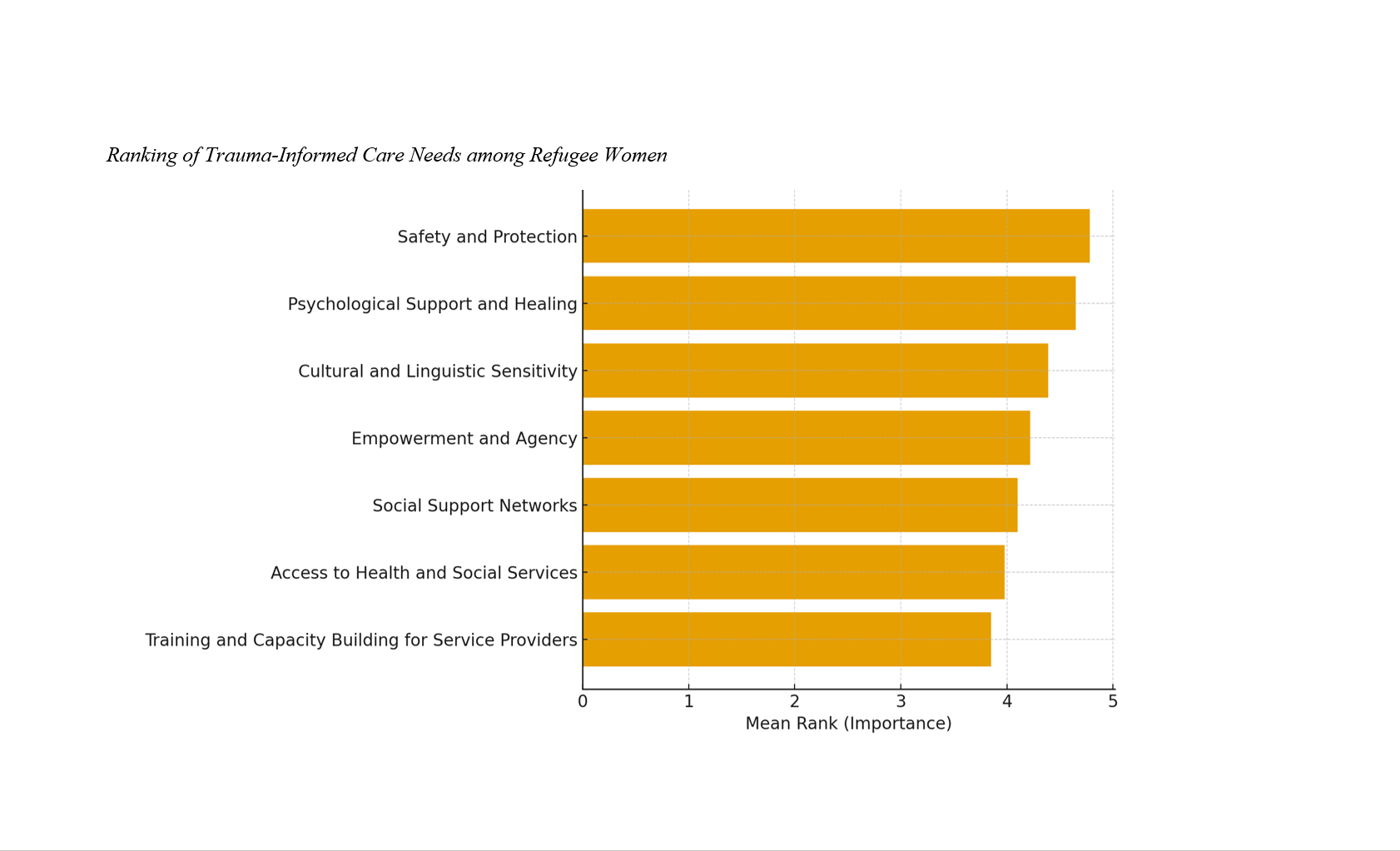
Findings: The Friedman test indicated statistically significant differences in the perceived importance of trauma-informed care dimensions (p < 0.001). Safety and protection achieved the highest mean rank (4.78), followed by psychological support and healing (4.65) and cultural and linguistic sensitivity (4.39). Empowerment and agency (4.22) and social support networks (4.10) were moderately ranked, while access to health and social services (3.98) and training and capacity building for service providers (3.85) ranked lower.
Conclusion: Findings highlight the multidimensional nature of trauma-informed care, emphasizing that safety, psychological healing, and cultural alignment are essential for effective refugee support.
Downloads
References
Abdullatif, G., Kim, S. Y., & Kim, H. H. (2025). Understanding Post-Traumatic Stress Disorder (PTSD) and Integration Challenges Among Afghan Special Contributors in South Korea. Psychiatry and Behavioral Health, 3(1). https://doi.org/10.33425/2833-5449.0019
Ahmad, A., & Reynolds, R. (2024). Survivors of War and Conflict Need Contextualised Trauma Informed Perinatal Care. bmj, q2838. https://doi.org/10.1136/bmj.q2838
Baker, S., & Naidoo, L. (2023). Developing Trauma-Informed University Supports for Refugee Background Students in Australia: Refocusing Through an Ethics of Care Lens. The Australian Educational Researcher, 51(2), 799-814. https://doi.org/10.1007/s13384-023-00625-9
Bobyn, J., Abraham, B., Kain, N., Williams, K. A., Coakley, A., & Watterson, R. (2025). “We Cannot Live Like Canadian”: Yazidi Refugees’ Perspectives on Mental Health, Coping Strategies and Barriers to Care. Frontiers in Psychiatry, 16. https://doi.org/10.3389/fpsyt.2025.1623358
Dzongowski, E., & Dhar, H. (2020). Mental Health, System Barriers, and Implicit Bias in the Treatment of Refugees and Newcomers: An Interview With Dr. Javeed Sukhera. University of Western Ontario Medical Journal, 52-53. https://doi.org/10.5206/uwomj.v88i1.6104
Guo, P., Alajarmeh, S., Alarja, G., Alrjoub, W., Al-Essa, A., Abusalem, L., Mansour, A., Sullivan, R., Shamieh, O., & Harding, R. (2021). Compounded Trauma: A Qualitative Study of the Challenges for Refugees Living With Advanced Cancer. Palliative Medicine, 35(5), 916-926. https://doi.org/10.1177/02692163211000236
Hambly, J., & Sanmuhanathan, N. (2024). Plaintiff S99: Rewriting Refugee Law Through a Trauma-Informed Lens. Refugee Survey Quarterly. https://doi.org/10.1093/rsq/hdae003
Hearn, F., Biggs, L., Brown, S., Krastev, A., Szwarc, J., & Riggs, E. (2023). Trauma-Informed Care and Equity in Group Pregnancy Care for Women of Refugee Background: Reflections From the Workforce. Trauma Care, 3(3), 161-176. https://doi.org/10.3390/traumacare3030016
Im, H., Rodriguez, C., & Grumbine, J. M. (2021). A Multitier Model of Refugee Mental Health and Psychosocial Support in Resettlement: Toward Trauma-Informed and Culture-Informed Systems of Care. Psychological Services, 18(3), 345-364. https://doi.org/10.1037/ser0000412
Im, H., & Swan, L. E. T. (2020). Capacity Building for Refugee Mental Health in Resettlement: Implementation and Evaluation of Cross-Cultural Trauma-Informed Care Training. Journal of Immigrant and Minority Health, 22(5), 923-934. https://doi.org/10.1007/s10903-020-00992-w
Im, H., & Swan, L. E. T. (2021). Working Towards Culturally Responsive Trauma-Informed Care in the Refugee Resettlement Process: Qualitative Inquiry With Refugee-Serving Professionals in the United States. Behavioral Sciences, 11(11), 155. https://doi.org/10.3390/bs11110155
Isakov, A. B., & Marković, V. (2024). Systematic Review of Trauma-Informed Approaches and Trauma-Informed Care for Forced Migrant Families: Concepts and Contexts. Trauma Violence & Abuse, 25(5), 3999-4015. https://doi.org/10.1177/15248380241266161
Larson, K. L., Choufani, M. R., & Płaszewska‐Żywko, L. (2024). An Educational Approach to Develop Intercultural Nursing Care for Refugees From Ukraine: A Qualitative Study. International Nursing Review, 72(1). https://doi.org/10.1111/inr.13016
Larson, K. L., Płaszewska‐Żywko, L., Sira, N., & Leibowitz, J. (2025). Nursing Praxis on Intercultural Care With War-Affected Refugees. Global Qualitative Nursing Research, 12. https://doi.org/10.1177/23333936251336109
Lee, J. H. (2022). The Effects of Trauma Types at Pre-Migration, Transit, and Post-Migration Stages on Depression and PTSD Among North Korean Refugees in South Korea. Challenges, 13(2), 31. https://doi.org/10.3390/challe13020031
Mathis, C., Steiner, J. J., Mazzio, A. K., Bagwell‐Gray, M. E., Wachter, K., Johnson‐Agbakwu, C. E., Messing, J. T., & Nizigiyimana, J. (2024). Sexual and Reproductive Healthcare Needs of Refugee Women Exposed to Gender-Based Violence: The Case for Trauma-Informed Care in Resettlement Contexts. International journal of environmental research and public health, 21(8), 1046. https://doi.org/10.3390/ijerph21081046
Moustafa, A. A., & Hamza, E. A. (2025). Trauma-Informed &Amp;amp; Culturally Responsive Practices for the Care and Support of Refugees: The Case of Middle East and North Africa. https://doi.org/10.31234/osf.io/hpbgt_v1
Nafari, J., & Ruebottom, T. (2025). A Trauma-Informed Approach: Temporal Reorientation, Identity Reconstruction and Preventing Retraumatisation in Refugee Entrepreneurship Support. International Small Business Journal Researching Entrepreneurship. https://doi.org/10.1177/02662426251320321
Nkodo, E. N. E., & Fadul, N. (2025). A Trauma-Informed Care Model for HIV Prevention and Care for Refugee Women in the United States: Perspectives and Implementation Framework. Frontiers in Medicine, 12. https://doi.org/10.3389/fmed.2025.1537930
Pan, X. (2025). Hearing Refugee Voices: Preliminary Findings on Trauma‐Informed Refugee Services in Public Libraries. Proceedings of the Association for Information Science and Technology, 62(1), 1619-1621. https://doi.org/10.1002/pra2.1486
Pottie, K., Kassam, A., & Gruner, D. (2021). Community-Based Mental Health Care and Narrative Exposure Therapy. 305-310. https://doi.org/10.1093/med/9780198833741.003.0035
Rivers, L. (2020). A Refugee Child With Lead Poisoning. Journal of Pediatric Surgical Nursing, 9(3), 79-82. https://doi.org/10.1097/jps.0000000000000246
Shahawy, S., Onwuzurike, C., Premkumar, A., Henricks, A., & Simon, M. A. (2022). Perspectives of Women of Refugee Background on Healthcare Needs in a Major Urban Metropolitan Community in The US : A Qualitative Needs Assessment. Health & Social Care in the Community, 30(6). https://doi.org/10.1111/hsc.13989
Sharma, E., Howard, N., & Duclos, D. (2020). Navigating New Lives: A Scoping Review and Thematic Synthesis of Forced Migrant Women's Perinatal Experiences. Journal of Migration and Health, 1-2, 100014. https://doi.org/10.1016/j.jmh.2020.100014
Siddiq, H., & Rosenberg, J. (2021). Clinicians as Advocates Amid Refugee Resettlement Agency Closures. Journal of Public Health Policy, 42(3), 477-492. https://doi.org/10.1057/s41271-021-00296-9
Toke, S., Correa‐Velez, I., & Riggs, E. (2024). Exploring Trauma- And Violence-Informed Pregnancy Care for Karen Women of Refugee Background: A Community-Based Participatory Study. International journal of environmental research and public health, 21(3), 254. https://doi.org/10.3390/ijerph21030254
Yalim, A. C., Boyd, K. C., & Sualp, K. (2022). “Sometimes That Takes You Going the Extra Mile”: The Role of Providers’ Self-Efficacy in Refugee Mental Health Services. Community Mental Health Journal, 59(3), 512-522. https://doi.org/10.1007/s10597-022-01035-4
Downloads
Additional Files
Publication Timeline
- Submitted
- Revised
- Accepted