Prediction of Difficulties in Emotion Regulation Based on Internal Locus of Control with the Mediating Role of Emotion-Focused Coping Strategies in Infertile Women
DOI:
https://doi.org/10.61838/kman.pwj.4695Keywords:
Infertility, Internal Locus of Control, Emotion Regulation, Emotion-Focused Coping, Structural Equation Modeling.Abstract
Objective: The present study aimed to predict difficulties in emotion regulation based on internal locus of control through the mediating role of emotion-focused coping strategies among infertile women in Tehran.
Methods and Materials: This research employed a descriptive–correlational design using structural equation modeling (SEM). The statistical population consisted of infertile women referring to infertility treatment centers in Tehran in 2025. Based on Krejcie and Morgan’s sample size determination table, 400 participants were selected through convenience sampling. Data were collected using standardized instruments: the Difficulties in Emotion Regulation Scale (DERS; Gratz & Roemer, 2004), the Rotter’s Internal–External Locus of Control Scale (Rotter, 1966), and the Coping Inventory for Stressful Situations (CISS; Endler & Parker, 1990). Data analysis was performed using SPSS-27 for descriptive and correlational statistics and AMOS-21 for structural equation modeling. Model fit was evaluated using χ²/df, GFI, AGFI, CFI, TLI, and RMSEA indices.
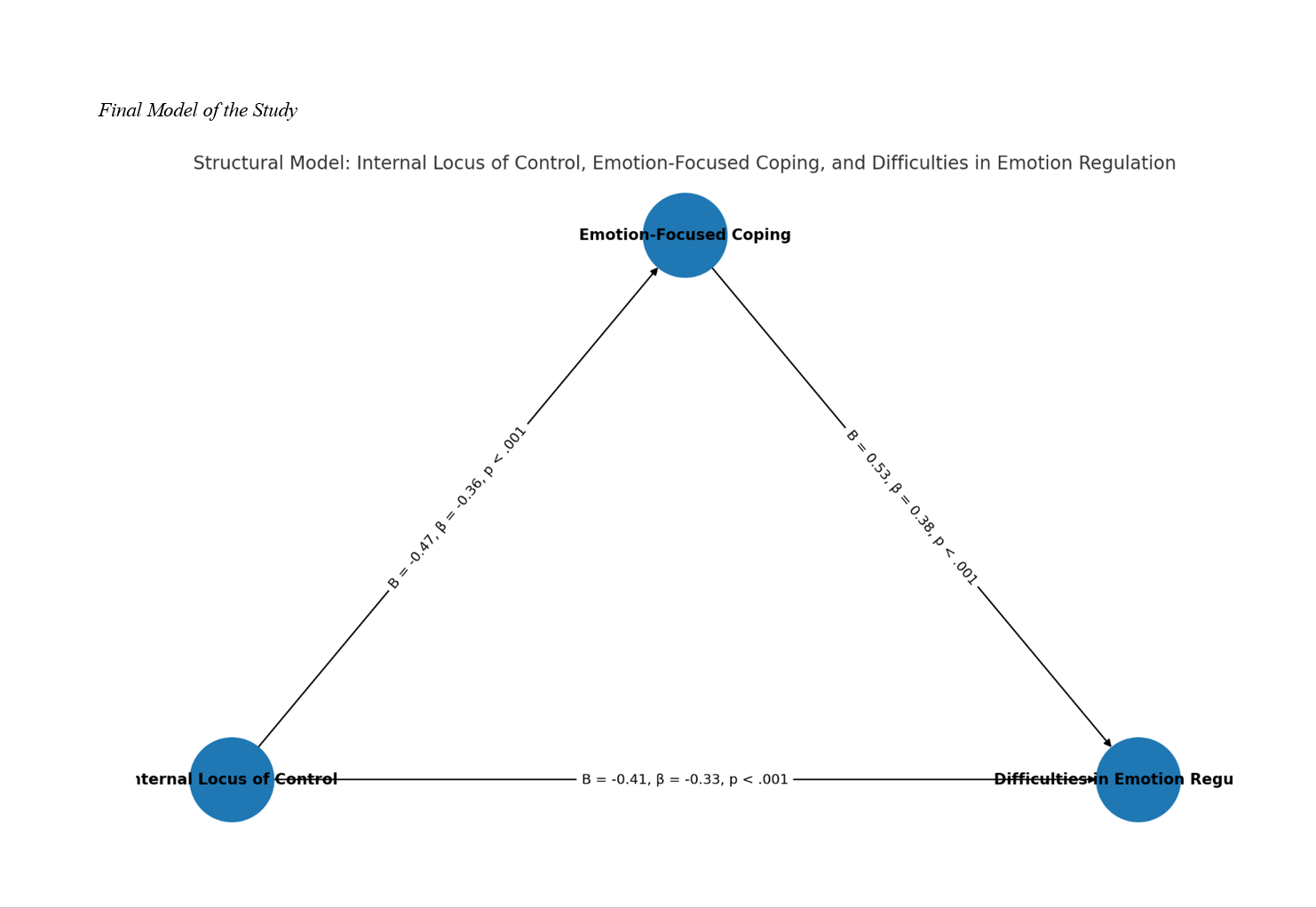
Findings: Results showed that internal locus of control was significantly and negatively correlated with difficulties in emotion regulation (r = –.48, p < .001) and emotion-focused coping (r = –.36, p < .001), while emotion-focused coping was positively correlated with difficulties in emotion regulation (r = .42, p < .001). The SEM results confirmed that internal locus of control had a direct negative effect on emotion regulation difficulties (β = –0.33, p < .001) and an indirect effect through emotion-focused coping (β = –0.14, p < .01). The model fit indices (χ²/df = 1.73, GFI = 0.94, CFI = 0.96, RMSEA = 0.042) indicated an excellent model fit.
Conclusion: Internal locus of control plays a crucial protective role in reducing emotional regulation difficulties among infertile women, both directly and indirectly, through the regulation of emotion-focused coping strategies. Strengthening internal control beliefs and promoting adaptive emotional coping can enhance psychological resilience in infertility-related distress.
Downloads
References
Åsberg, K., & Renk, K. (2012). Perceived Stress, External Locus of Control, and Social Support as Predictors of Psychological Adjustment Among Female Inmates With or Without a History of Sexual Abuse. International journal of offender therapy and comparative criminology, 58(1), 59-84. https://doi.org/10.1177/0306624x12461477
Barden, E. P., Mattson, R. E., Mastroleo, N. R., & Balderrama‐Durbin, C. (2024). The Impact of Emotion Regulation and Dyadic Coping Within Posttraumatic Stress Symptoms and Risky Drinking Patterns on Relationship Distress Among Trauma‐exposed Individuals. Journal of Traumatic Stress, 37(6), 890-900. https://doi.org/10.1002/jts.23057
Besharat, R., Soltani Azemat, E., & Mohammadian, A. (2018). A Comparative Study of Rumination, Healthy Locus of Control, and Emotion Regulation in Children of Divorce and Normal Children [Applicable]. Practice in Clinical Psychology, 6(4), 207-214. https://doi.org/10.32598/jpcp.6.4.207
Coyne, L. W., & Thompson, A. D. (2011). Maternal Depression, Locus of Control, and Emotion Regulatory Strategy as Predictors of Preschoolers’ Internalizing Problems. Journal of Child and Family Studies, 20(6), 873-883. https://doi.org/10.1007/s10826-011-9455-2
Darshani, A. R. (2014). A review of personality types and locus of control as moderators of stress and conflict management. International Journal of Scientific and Research Publications, 4(2), 1-8. https://www.researchgate.net/publication/330959078_Exploring_the_Role_of_A_B_C_and_D_Personality_Types_on_IndividualsWork-Related_Behaviors_and_Health_Problems_A_Theoretical_Model
Dyar, C., Herry, E., & Pirog, S. (2024). Emotion regulation strategies and coping self-efficacy as moderators of daily associations between transgender and gender diverse (TGD) enacted stigma and affect among TGD young adults assigned female at birth. Social Science & Medicine, 358, 117261. https://doi.org/10.1016/j.socscimed.2024.117261
Gaus, N. G. N. (2014). Locus of control job satisfaction job stress among female headteachers at primary schools in Makassar, Indonesia. Advancing Women in Leadership Journal, 34, 19-27. https://doi.org/10.21423/awlj-v34.a117
Ghorbani, F., Parafkand, B., Heydari, A., Alamardani, S. S., & Heydari-Rad, H. (2017). The relationship between emotion regulation and locus of control with cognitive self-control in substance-dependent individuals. Clinical Psychology and Personality-Former Behavior Scientist, 3(2), 13-25. http://jpcp.uswr.ac.ir
Karaman, M. A., & Watson, J. C. (2017). Examining associations among achievement motivation, locus of control, academic stress, and life satisfaction: A comparison of US and international undergraduate students. Personality and individual differences, 111, 106-110. https://doi.org/10.1016/j.paid.2017.02.006
Masaed, A. S. A. (2013). Relationships of Positive and Negative Psychological Stress Coping Strategies With Locus of Control and Some Variables Among a Sample of Al-Al Bayt University Students. Journal of Educational and Psychological Studies [JEPS], 7(3), 256. https://doi.org/10.24200/jeps.vol7iss3pp256-274
Masters, M., Zimmer-Gembeck, M. J., Farrell, L. J., & Modecki, K. L. (2023). Coping and emotion regulation in response to social stress tasks among young adolescents with and without social anxiety. Applied Developmental Science, 27(1), 18-33. https://doi.org/10.1080/10888691.2021.1990060
Rizza, F., Gison, A., Bonassi, S., Dall’Armi, V., Tonto, F., & Giaquinto, S. (2017). ‘Locus of control’, health-related quality of life, emotional distress and disability in Parkinson’s disease. Journal of Health Psychology, 22(7), 844-852. https://doi.org/10.1177/1359105315616471
Roushanzamir Madbari, F. (2018). Investigating the relationship between emotional regulation and locus of control with cognitive self-control in substance-dependent individuals Master's thesis, Faculty of Humanities, Islamic Azad University, Rasht Unit].
Sari, A. L., Purwaningsih, H., & Istiqomah, N. (2024). Management Interventions for Enhancing Emotional Regulation in Children With Autism Spectrum Disorders: Scoping Review. Observasi, 2(2), 70-81. https://doi.org/10.61132/observasi.v2i3.386
Shabannejad, A., Fazlali, M., & Mirzaeian, B. (2021). The mediating role of difficulty in emotion regulation in the relationship between psychological flexibility and loneliness in infertile women. Journal of psychiatric nursing, 9(4), 74-83. https://ijpn.ir/article-1-1800-en.html
Simonič, B., Poljak Lukek, S., Valenta, T., Jerebic, D., Jerebic, S., Rijavec Klobučar, N., & Pate, T. (2024). The Role of Emotion Dysregulation in Problematic Alcohol Use and Coping with Problems. European Journal of Mental Health, 19, 1-15. https://doi.org/10.5708/EJMH.19.2024.0018
Singh, L. B., Kumar, A., & Srivastava, S. (2021). Academic burnout and student engagement: a moderated mediation model of internal locus of control and loneliness. Journal of International Education in Business, 14(2), 219-239. https://doi.org/10.1108/JIEB-03-2020-0020
Sukarno, F. I., Djawoto, D., & Prijati, P. (2022). The Effect of Motivation, Work Stress, and Self Esteem on Employee Performance Through Locus of Control. Manajemen Dan Bisnis, 21(2), 85. https://doi.org/10.24123/jmb.v21i2.566
Villacura-Herrera, C., Ávalos-Tejeda, M., Gaete, J., Robinson, J., & Núñez, D. (2025). The underlying dynamics of a suicidal ideation latent network model: The role of hopelessness, psychopathology, emotion regulation, and behavioral coping skills in adolescents from the general population. Journal of affective disorders, 379, 540-548. https://doi.org/10.1016/j.jad.2025.02.101
Yadolahi, S., Mirzaei, S. H., & Soleimianian, A. A. (2025). Comparing the efficacy of counseling based on acceptance commitment approach and the compassion approach in a group way on emotion regulation and the quality of marital relationship in infertile women. Journal of Psychological Science, 24(149), 287-305. https://psychologicalscience.ir/article-1-2488-en.html
Downloads
Additional Files
Publication Timeline
- Submitted
- Revised
- Accepted