Contexts of Loneliness in Women Choosing Voluntary Singlehood: A Qualitative Study in Mexico
DOI:
https://doi.org/10.61838/kman.pwj.4594Keywords:
Voluntary singlehood, loneliness, women, cultural expectationsAbstract
Objective: This study aimed to explore the emotional, sociocultural, and existential contexts of loneliness among women in Mexico who have consciously chosen voluntary singlehood.
Methods and Materials: This research employed a qualitative exploratory design using semi-structured interviews to capture the lived experiences of women identifying as voluntarily single. A total of 22 participants aged between 27 and 49 years were recruited through purposive sampling from various regions in Mexico, including Mexico City, Guadalajara, Puebla, and Monterrey. Interviews were conducted in Spanish, recorded with consent, and transcribed verbatim. Data collection continued until theoretical saturation was reached. The data were analyzed using thematic analysis following Braun and Clarke’s framework, supported by NVivo 14 software for systematic coding and organization. Rigor was ensured through member checking, peer debriefing, and maintenance of an audit trail throughout the analysis process.
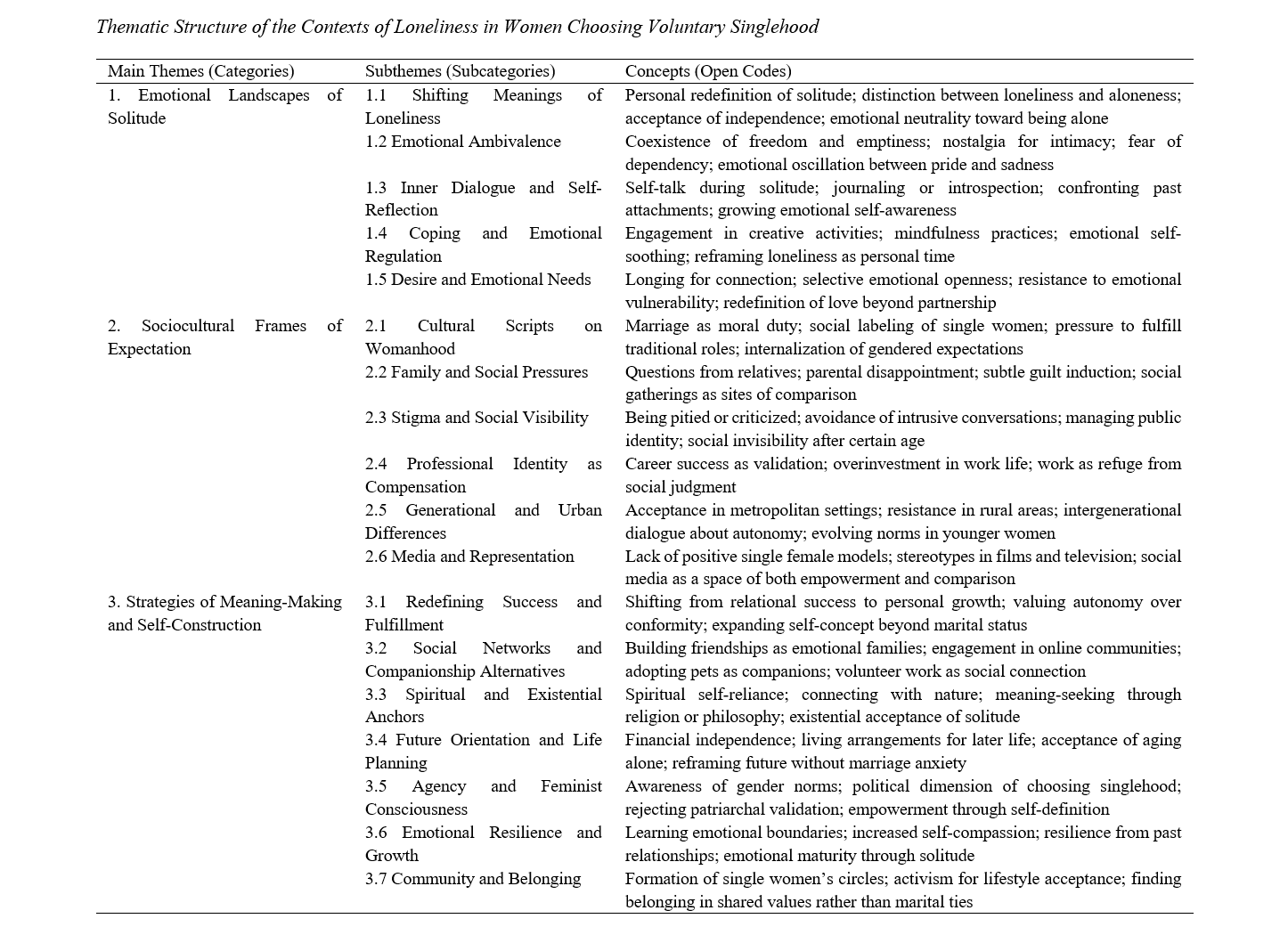
Findings: Three overarching themes emerged: (1) Emotional Landscapes of Solitude, describing women’s redefinition of loneliness as reflective solitude balanced with emotional ambivalence; (2) Sociocultural Frames of Expectation, capturing the influence of cultural scripts, family pressure, and stigma in shaping the social experience of singlehood; and (3) Strategies of Meaning-Making and Self-Construction, reflecting participants’ agency in redefining fulfillment, establishing supportive social networks, and framing singlehood as a feminist and existential choice.
Conclusion: Voluntary singlehood among women in Mexico represents a complex psychosocial process of self-definition within traditional cultural boundaries. Loneliness in this context is best understood not as deprivation but as an evolving emotional state rooted in agency, meaning-making, and resistance to normative gender expectations.
Downloads
References
Adamczyk, K. (2016). Voluntary and Involuntary Singlehood and Young Adults’ Mental Health: An Investigation of Mediating Role of Romantic Loneliness. Current Psychology, 36(4), 888-904. https://doi.org/10.1007/s12144-016-9478-3
Arnoso, A., Arnoso, M., Astondoa, E. E., Asla, N., Aiertza, M., Bengoetxea, A., & Pizarro, M. (2022). Meanings of Loneliness for Women Using Social Services in Spain: An Intersectional Analysis. Affilia, 38(1), 91-110. https://doi.org/10.1177/08861099221108724
Ausín, B., Muñoz, M., & Castellanos, M. Á. (2017). Loneliness, Sociodemographic and Mental Health Variables in Spanish Adults Over 65 Years Old. The Spanish journal of psychology, 20. https://doi.org/10.1017/sjp.2017.48
Bąk-Grabowska, D., Cierniak–Emerych, A., Dziuba, S., & Grzesik, K. (2021). Women Working in Nonstandard Forms of Employment: Meeting Employee Interests. European Research Studies Journal, XXIV(Issue 3B), 299-324. https://doi.org/10.35808/ersj/2466
Beutel, M. E., Klein, E. M., Brähler, E., Reiner, I., Jünger, C., Michal, M., Wiltink, J., Wild, P. S., Münzel, T., Lackner, K. J., & Tibubos, A. N. (2017). Loneliness in the General Population: Prevalence, Determinants and Relations to Mental Health. BMC psychiatry, 17(1). https://doi.org/10.1186/s12888-017-1262-x
Huda, M. N., Hossain, S. Z., Dune, T., Amanullah, A. S. M., & Renzaho, A. M. N. (2022). The Involvement of Bangladeshi Girls and Women in Sex Work: Sex Trafficking, Victimhood, and Agency. International journal of environmental research and public health, 19(12), 7458. https://doi.org/10.3390/ijerph19127458
Kislev, E. (2020). How Do Relationship Desire and Sociability Relate to Each Other Among Singles? Longitudinal Analysis of the Pairfam Survey. Journal of Social and Personal Relationships, 37(8-9), 2634-2650. https://doi.org/10.1177/0265407520933000
Kredl, K. F., Kubin, D., & Lydon, J. E. (2025). Knowing What You Want: The Role of Relationship Clarity in Single Young Adults' Loneliness and Well‐Being. Personal Relationships, 32(3). https://doi.org/10.1111/pere.70023
Kumar, P., & Mukherjee, A. (2025). Reimagining Singlehood in Urban India Through Intersectional Narratives and Support Systems: An Ethnographic Study. Journal of marital and family therapy, 51(3). https://doi.org/10.1111/jmft.70049
Lee, J., Park, J., & Son, S. (2025). Latent Profiles of Koreans' Attitudes Toward Alternatives to Traditional Marital Formation. Journal of marriage and family, 87(4), 1387-1406. https://doi.org/10.1111/jomf.13098
Lesch, E., & Alberta, S. J. v. d. W. (2018). Living Single: A Phenomenological Study of a Group of South African Single Women. Feminism & Psychology, 28(3), 390-408. https://doi.org/10.1177/0959353517731435
Luhmann, M., & Hawkley, L. C. (2016). Age Differences in Loneliness From Late Adolescence to Oldest Old Age. Developmental Psychology, 52(6), 943-959. https://doi.org/10.1037/dev0000117
Mynarska, M., & Rytel, J. (2017). From Motives Through Desires to Intentions: Investigating the Reproductive Choices of Childless Men and Women in Poland. Journal of Biosocial Science, 50(3), 421-433. https://doi.org/10.1017/s0021932017000190
Nicolaisen, M., & Thorsen, K. (2023). Gender Differences in Loneliness Over Time: A 15-Year Longitudinal Study of Men and Women in the Second Part of Life. The International Journal of Aging and Human Development, 98(1), 103-132. https://doi.org/10.1177/00914150231194243
Parlak, S., & Tekin, I. (2020). A Phenomenological Study on Voluntarily Childless Women. Psikoloji Çalışmaları / Studies in Psychology, 161-186. https://doi.org/10.26650/sp2019-0034
Shaw, R. (2010). Women's Experiential Journey Toward Voluntary Childlessness: An Interpretative Phenomenological Analysis. Journal of Community & Applied Social Psychology, 21(2), 151-163. https://doi.org/10.1002/casp.1072
Shiovitz‐Ezra, S., & Ayalon, L. (2011). Use of Direct Versus Indirect Approaches to Measure Loneliness in Later Life. Research on Aging, 34(5), 572-591. https://doi.org/10.1177/0164027511423258
Símonardóttir, S. (2024). “Unless I Could Be Like the Typical Dad”: Exploring Parenthood Through the Perspective of the Voluntarily Childfree. Acta Sociologica, 67(4), 463-477. https://doi.org/10.1177/00016993241260608
Stahnke, B., Cooley, M. E., & Blackstone, A. (2023). Life Dissatisfaction in an Older Childless Woman: A Case Study. The Family Journal, 32(2), 188-195. https://doi.org/10.1177/10664807231212932
Stickley, A., & Ueda, M. (2022). Loneliness in Japan During the COVID-19 Pandemic: Prevalence, Correlates and Association With Mental Health. Psychiatry research, 307, 114318. https://doi.org/10.1016/j.psychres.2021.114318
Træen, B., & Kvalem, I. L. (2022). Satisfaction With Singlehood and Sexual Activity. Sexuality & Culture, 26(5), 1621-1638. https://doi.org/10.1007/s12119-022-09961-x
Valle, V. I., Corchón, S., Zaharia, G., & Cauli, O. (2022). Social and Emotional Loneliness in Older Community Dwelling-Individuals: The Role of Socio-Demographics. International journal of environmental research and public health, 19(24), 16622. https://doi.org/10.3390/ijerph192416622
Wickens, C. M., McDonald, A. J., Elton‐Marshall, T., Wells, S., Nigatu, Y. T., Jankowicz, D., & Hamilton, H. A. (2021). Loneliness in the COVID-19 Pandemic: Associations With Age, Gender and Their Interaction. Journal of psychiatric research, 136, 103-108. https://doi.org/10.1016/j.jpsychires.2021.01.047
Yodovich, N., & Lahad, K. (2017). ‘I Don’t Think This Woman Had Anyone in Her Life’: Loneliness and Singlehood in Six Feet Under. European Journal of Women S Studies, 25(4), 440-454. https://doi.org/10.1177/1350506817702411
Yoshida, A. (2023). Anomie, Gender, and Inequality: Developing Sociological Theory of Singlehood From Japanese Experiences. Journal of Family Theory & Review, 15(3), 542-561. https://doi.org/10.1111/jftr.12493
Downloads
Additional Files
Publication Timeline
- Submitted
- Revised
- Accepted