Comparison of the Effectiveness of Solution-Focused Brief Therapy and Compassion-Focused Therapy on Marital Adjustment of Married Women
DOI:
https://doi.org/10.61838/kman.pwj.4550Keywords:
marital adjustment, solution-focused brief therapy (SFBT), compassion-focused therapy (CFT), married womenAbstract
Objective: This study aimed to compare the effectiveness of Compassion-Focused Therapy (CFT) and Solution-Focused Brief Therapy (SFBT) in improving marital adjustment among married women.
Methods and Materials: This applied and experimental study used a pretest–posttest–two-month follow-up design with a control group. The statistical population included married women who attended the Hazrat Zainab Cultural Center in Mashhad, Iran, during 2022–2023. Sixty eligible participants were selected through convenience sampling and randomly assigned to three groups (CFT, SFBT, and control), but due to attrition, 16 participants remained in the CFT group, 18 in the SFBT group, and 18 in the control group. The Dyadic Adjustment Scale (DAS; Spanier, 1976) was used to measure marital adjustment. The CFT group attended twelve 90-minute weekly sessions based on Gilbert’s model, while the SFBT group participated in six 90-minute sessions following the Diamond approach. Data were collected at three time points (pretest, posttest, and two-month follow-up) and analyzed using repeated measures analysis of variance with SPSS-27.
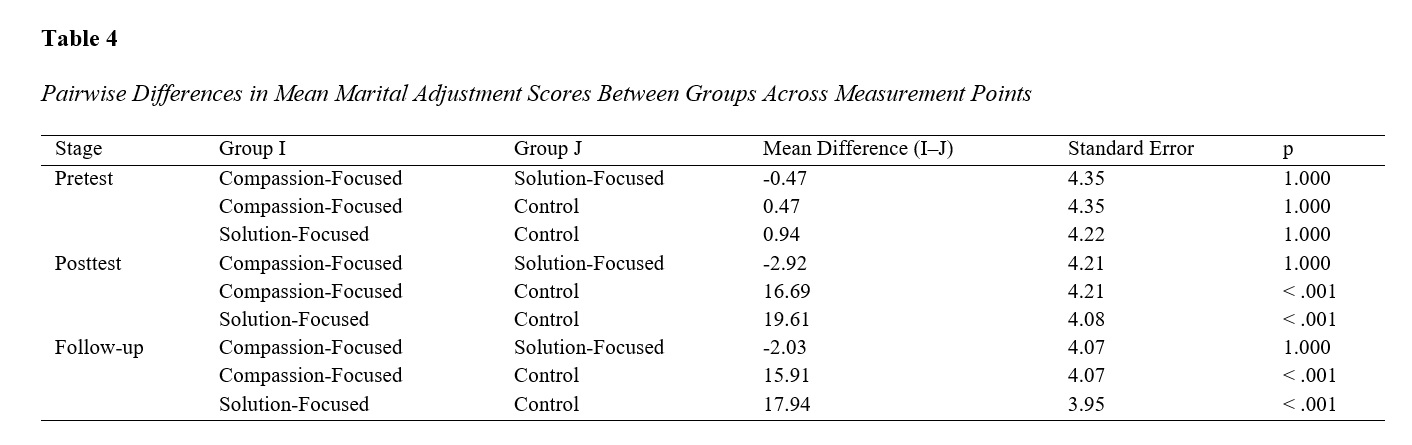
Findings: The results indicated significant main effects of time (p < .001, η² = .76) and group (p = .004, η² = .20) as well as a significant time × group interaction (p < .001, η² = .59) for marital adjustment. Post hoc Bonferroni tests showed that both the CFT and SFBT groups had significantly higher marital adjustment scores at posttest and follow-up compared with the control group (p < .001). However, no significant difference was found between the CFT and SFBT groups at either posttest or follow-up (p > .05).
Conclusion: Both Compassion-Focused Therapy and Solution-Focused Brief Therapy effectively improved and sustained marital adjustment in married women, with comparable therapeutic impact.
Downloads
References
Araghian, S. H., Nejat, H., Toozandejani, H., & Bagherzadeh Golmakani, Z. (2020). Comparison of the effectiveness of quality of life therapy and compassion-focused therapy in the distress tolerance and meaning in life of women with marital conflicts. Psychological Methods and Models, 39, 121-138. https://www.sid.ir/paper/996780/en
Bandura, A. (2023). Cultivate self-efficacy for personal and organizational effectiveness In Principles of organizational behavior: The handbook of evidence-based management (3rd ed., pp. 113-135). In. Wiley. https://doi.org/10.1002/9781394320769.ch6
Bussey, K., Luo, A., Fitzpatrick, S., & Allison, K. (2020). Defending victims of cyberbullying: The role of self-efficacy and moral disengagement. Journal of School Psychology, 78, 1-12. https://doi.org/10.1016/j.jsp.2019.11.006
Carr, D., & Utz, R. L. (2020). Families in later life: A decade in review. Journal of marriage and family, 82(1), 346-363. https://doi.org/10.1111/jomf.12609
Connie, E. E., & Froerer, A. S. (2023). The solution focused brief therapy diamond: A new approach to SFBT that will empower both practitioner and client to achieve the best outcomes. Hay House. https://books.google.com/books?hl=fa&lr=&id=Jxt_EAAAQBAJ&oi=fnd&pg=PR13&dq=The+solution+focused+brief+therapy+diamond:+A+new+approach+to+SFBT+that+will+empower+both+practitioner+and+client+to+achieve+the+best+outcomes&ots=x40vvxSBQN&sig=KN6wsddZ6q2xilFncH0_gT3ygjE
Craig, C., Hiskey, S., & Spector, A. (2020). Compassion focused therapy: A systematic review of its effectiveness and acceptability in clinical populations. Expert Review of Neurotherapeutics, 20(4), 385-400. https://doi.org/10.1080/14737175.2020.1746184
EffatDoost Sani, Z., Zarbakhsh Bahri, M., & Homayouni, A. (2024). The effectiveness of self-compassion treatment on failure tolerance and emotional control among adolescents in family-analogous centers of Tehran. Clinical Psychology Studies, 15(55), 30-47. https://journals.atu.ac.ir/article_18017_dca5e19e0a8a7a49f900ea503a28e395.pdf
Emirza, E. G., & Bilgili, N. (2024). The effect of mindfulness-based empowerment program on self-compassion, self-esteem and ways of coping with stress of women experienced violence: A randomised controlled study. International journal of mental health nursing, 33(6), 2314-2325. https://doi.org/10.1111/inm.13401
Falah Neudehi, M., Rezaei, F., Bozorgi Kazerooni, A., & Ebadi, Z. (2023). Emotion regulation training on irritability, alexithymia, and interpersonal problems of adolescents with disruptive mood dysregulation disorder. Journal of Research in Health, 13(6), 427-436. https://doi.org/10.32598/JRH.13.6.2202.1
Gottman, J. M., & Gottman, J. S. (2020). And baby makes three: The six-step plan for preserving marital intimacy and rekindling romance after baby arrives (Reprint ed.). Harmony Books. https://www.amazon.com/Baby-Makes-Three-Preserving-Rekindling/dp/140009738X
Jenkins, C., & Germaine, C. (2023). Solution oriented learning: An innovative approach that promotes motivation and resilience. Mental Health Practice, 26(2). https://journals.rcni.com/mental-health-practice/cpd/solution-oriented-learning-an-innovative-approach-that-promotes-motivation-and-resilience-mhp.2018.e1291/full
Kermani Mamazandi, Z., & Tavana, S. (2024). Explaining the happiness of married women in Mashhad based on self-compassion and marital conflicts with the mediating role of self-efficacy. Journal of Social and Psychological Studies on Women, 22(4), 220-247. https://jwsps.alzahra.ac.ir/article_8355.html?lang=fa
Khorrami Rounizi, P., & Sajadian, P. (2024). Effectiveness of compassion-based therapy on perception of aging, self-care behaviors, and pain catastrophizing in depressed elderly. Tolo-e Behdasht-e Yazd, 23(5), 1-17. https://joge.ir/article-1-691-fa.pdf
Naimipour, F., Shahgholian, M., & Yariyari, F. (2024). Designing and testing a structural model of self-silencing in married women based on attachment style, emotional expression, and feelings of loneliness with self-compassion as a mediator. Journal of Psychological Sciences, 23(143), 23-40. https://search.ebscohost.com/login.aspx?direct=true&profile=ehost&scope=site&authtype=crawler&jrnl=17357462&AN=181124878&h=SaELPFJ6lEddfOUrPMD3Ur2UzbKMtmsimDdZrfiLrK81m2fe7wE5FtV7J1jthShlFnpecaVP3ED%2B8rbusZe66Q%3D%3D&crl=c
Oqili, S. M., Majidi, F., & Asghari, A. (2023). Comparison of the effectiveness of compassion-based therapy and positive psychology therapy on optimism and life satisfaction in women involved in early marital conflicts. Journal of Cultural-Educational Women and Family, 18(62), 195-215. https://cwfs.ihu.ac.ir/article_207845_en.html?lang=en
Pedro, L., Branquinho, M., Canavarro, M. C., & Fonseca, A. (2019). Self-criticism, negative automatic thoughts and postpartum depressive symptoms: The buffering effect of self-compassion. Journal of Reproductive and Infant Psychology, 37(7), 1-15. https://doi.org/10.1080/02646838.2019.1597969
Rahimi, M., Wahabi Daryakani, A., & Pirkhayafi, A. (2024). The role of perceived social and economic inequality on the mental health of employed women in health and treatment centers in Tehran. Social Psychology Research, 14(53), 123-133. https://www.socialpsychology.ir/article_198040.html
Rastgouftar, T., & Khodadadi, J. (2024). Antecedents and consequences of marital adjustment in couples satisfied with their marital life. Cultural-Educational Journal of Women and Family, 19(66), 79-110. https://jms.ihu.ac.ir/article_208462.html
Razmgar, M., Kimiaei, S. E., & Bigdeli, A. (2023). Comparison of the effectiveness of solution-focused counseling and supportive counseling based on self-compassion on behavior control, emotional, social, and educational adjustment in street children boys. Journal of Knowledge and Research in Applied Psychology, 24(1), 23-37. https://www.noormags.ir/view/en/articlepage/2052119/
Rezazadeh, S., Tavasoloinia, S., & Azimi, D. (2024). Effectiveness of the combined emotion-focused and solution-focused therapy on anger and marital adjustment of women with marital conflicts. Journal of Family Relations Studies, 4(13), 48-57. https://journal.uma.ac.ir/article_2926.html?lang=en
Shariatzadeh Jenidi, G., Arvand, J., Zandi, E., & Kivan, S. (2021). The effectiveness of solution-focused couple therapy on marital satisfaction and adjustment of couples. Journal of Assessment and Research in Counseling and Psychology, 3(2), 38-49. https://doi.org/10.61838/kman.jarac.3.2.4
Shirdel, E., Moieni, M., & Dehghani, A. (2023). Ranking factors influencing the quality of life of employed and housewife married women using the AHP technique. Women in Politics, 21(12), 517-540. https://jwdp.ut.ac.ir/article_90339_en.html
Sünbüla, Z. A., & Güneri, O. Y. (2019). The relationship between mindfulness and resilience: The mediating role of self-compassion and emotion regulation in a sample of under-privileged Turkish adolescents. Personality and individual differences, 139, 337-342. https://doi.org/10.1016/j.paid.2018.12.009
Taghavi, S., Gholamzadeh, M., & Shahbazi, M. (2020). A comparison of the effectiveness of solution-focused therapy and acceptance and commitment therapy on the quality of life and self-efficacy of housewife women. Journal of Analytical-Cognitive Psychology, 11(43), 39-53. https://www.noormags.ir/view/en/articlepage/1725000/
Turns, B., Jordan, S. M., Callahan, K., Whiting, J., & et al. (2019). Assessing the effectiveness of solution-focused brief therapy for couples raising a child with autism: A pilot clinical outcome study. Journal of Couple & Relationship Therapy, 18(3), 257-279. https://doi.org/10.1080/15332691.2019.1571975
Downloads
Additional Files
Publication Timeline
- Submitted
- Revised
- Accepted
Issue
Section
License
Copyright (c) 2025 Masoumeh Kheirkhah (Author); Mustafa Bolghan-Abadi (Corresponding Author); Sepideh Pourheydari (Author)

This work is licensed under a Creative Commons Attribution-NonCommercial 4.0 International License.