A Phenomenological Analysis of Divorced Women’s Experiences with Multiple Sexual Relationships After Divorce
DOI:
https://doi.org/10.61838/kman.pwj.4439Keywords:
Divorce, multiple sexual relationships, phenomenology, women’s lived experiences, identity reconstruction, coping strategiesAbstract
Objective: The objective of this study was to explore and analyze the lived experiences of divorced women who engage in multiple sexual relationships after divorce, focusing on psychological, social, familial, economic, and identity-related dimensions.
Methods and Materials: This research employed a qualitative phenomenological design to capture the subjective meanings of participants’ post-divorce experiences. Ten divorced women attending a family counseling clinic in Shiraz were recruited through purposive sampling, based on criteria including at least one year since divorce, a history of multiple sexual relationships, and willingness to share personal experiences. Data were collected through semi-structured in-depth interviews, complemented by field notes and document analysis. Data analysis followed Strauss and Corbin’s grounded theory methodology, involving open, axial, and selective coding. Trustworthiness was ensured through prolonged engagement, member checking, peer debriefing, and maintaining an audit trail. Ethical principles of informed consent, confidentiality, and participant autonomy were strictly observed.
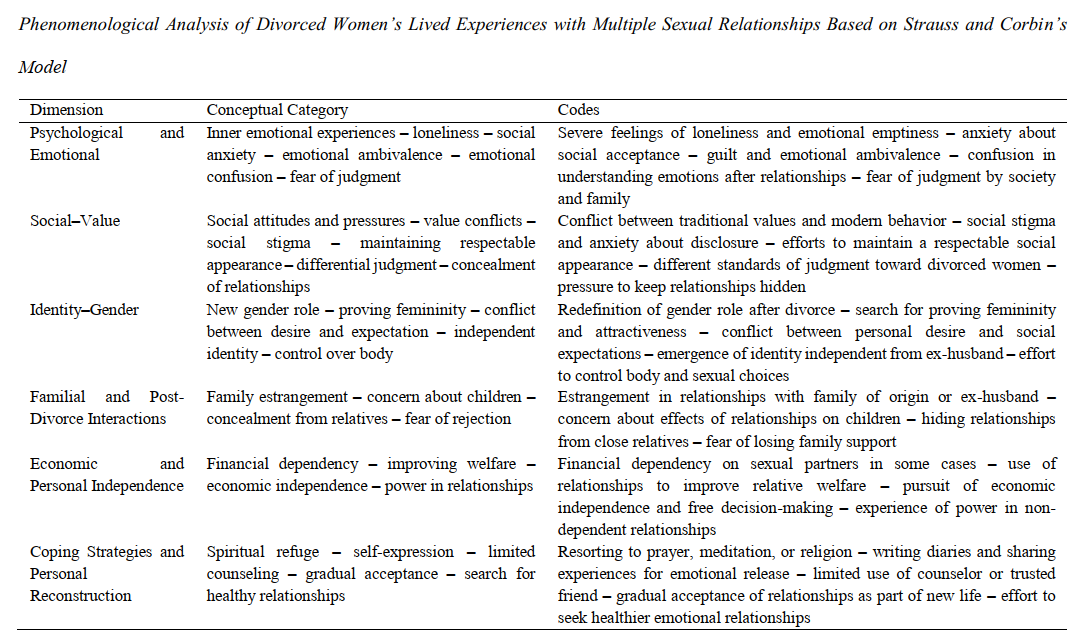
Findings: The analysis revealed six overarching dimensions shaping the experiences of divorced women: (1) psychological and emotional struggles characterized by loneliness, ambivalence, and fear of judgment; (2) social and cultural pressures involving stigma, secrecy, and value conflicts; (3) identity and gender redefinition, including proving femininity, asserting independence, and exercising control over sexuality; (4) familial dynamics, such as estrangement, concealment from relatives, and concern about children; (5) economic realities, with experiences of both dependency and empowerment through financial independence; and (6) coping strategies and personal reconstruction, including spiritual practices, counseling, journaling, and efforts to build healthier relationships.
Conclusion: The study underscores that divorced women’s engagement in multiple sexual relationships is a multifaceted phenomenon shaped by intersecting psychological, social, familial, cultural, and economic forces. These experiences reveal both vulnerability and resilience, emphasizing the need for supportive interventions, culturally sensitive counseling, and policies that reduce stigma while fostering autonomy and well-being.
Downloads
References
Al-shahrani, H. F., & Hammad, M. A. (2023a). Impact of Emotional Divorce on the Mental Health of Married Women in Saudi Arabia. PLoS One, 18(11), e0293285. https://doi.org/10.1371/journal.pone.0293285
Al-shahrani, H. F., & Hammad, M. A. (2023b). Relationship Between Emotional Divorce and Alexithymia Among Married Women in Saudi Arabia. BMC psychology, 11(1). https://doi.org/10.1186/s40359-023-01236-w
Aughinbaugh, A., & Rothstein, D. S. (2024). Patterns of Marriage and Divorce From Ages 15 to 55: Evidence From the NLSY79. Monthly Labor Review. https://doi.org/10.21916/mlr.2024.15
Bariah, O., & Ferianto, F. (2024). Legal Implications of Marriage During the 'Iddah Period: Analytical Study of the Opinions of Fiqh Scholars. International Journal Ihya Ulum Al-Din, 26(1), 10-22. https://doi.org/10.21580/ihya.26.1.20519
Blasutto, F. (2023). Cohabitation vs. Marriage: Mating Strategies by Education in the USA. Journal of the European Economic Association, 22(4), 1723-1761. https://doi.org/10.1093/jeea/jvad065
Cassels, S., Jenness, S. M., & Biney, A. A. E. (2019). Coital Frequency and Male Concurrent Partnerships During Pregnancy and Postpartum in Agbogbloshie, Ghana. AIDS and Behavior, 23(6), 1508-1517. https://doi.org/10.1007/s10461-019-02403-0
Ciritel, A.-A. (2022). Sexual Intimacy and Relationship Happiness in Living Apart Together, Cohabiting, and Married Relationships: Evidence From Britain. Genus, 78(1). https://doi.org/10.1186/s41118-022-00178-2
Desmaisi, Jendrius, J., & Masri, M. (2019). Divorced Woman Than Remarried Again: A Social Practice in Nagari Padang Gantiang. 449-457. https://doi.org/10.1515/9783110678666-060
Gen, D. Y., GÖKtaŞ, M., & ŞEndoĞAn, B. (2021). The Role of Conflict Resolution Styles, Communication Pattern and Sexual Satisfaction as Predictors of How to Consider Divorce in Married Individuals. Journal of Advanced Education Studies, 3(2), 86-107. https://doi.org/10.48166/ejaes.1004805
Hogendoorn, B., & Berg, L. v. d. (2024). The Educational Diffusion of Divorce: The Role of Gender and Context. Journal of marriage and family, 86(3), 738-761. https://doi.org/10.1111/jomf.12980
Hombrados, J. G., & Özcan, B. (2023). Age at Marriage and Marital Stability: Evidence From China. Review of Economics of the Household, 22(1), 297-328. https://doi.org/10.1007/s11150-023-09651-z
Jannah, R. (2023). Determinan Sosial Pernikahan Dini Pada Perempuan Di Kecamatan Jerowaru Di Kabupaten Lombok Timur. Jurnal Ilmu Kedokteran Dan Kesehatan Indonesia, 3(2), 53-64. https://doi.org/10.55606/jikki.v3i2.1598
Kailaheimo-Lönnqvist, S., Fasang, A. E., Jalovaara, M., & Struffolino, E. (2021). Is Parental Divorce Homogamy Associated With a Higher Risk of Separation From Cohabitation and Marriage? Demography, 58(6), 2219-2241. https://doi.org/10.1215/00703370-9489802
Kesselring, K. J., & Stretton, T. (2022). Marriage, Separation, and Divorce in England, 1500-1700. https://doi.org/10.1093/oso/9780192849953.001.0001
Khorami, Z. M., Dokaneifard, F., & Khakpour, R. (2021). Providing a Model for Predicting Emotional Divorce Based on Attachment Style, and Sexual Function Components in Women: The Mediating Role of Emotional Intelligence. Aftj, 2(3), 25-50. https://doi.org/10.61838/kman.aftj.2.3.2
Mbele, S. K. (2024). Factors Associated With Multiple Sexual Partnerships Among Young Women in Southern African Countries: A Pooled Multilevel Analysis. Advances in Public Health, 2024(1). https://doi.org/10.1155/2024/5119652
McLean, E., Dube, A., Slaymaker, E., Sironi, M., Crampin, A. C., & Sear, R. (2024). Divorce and the Transition to Adulthood in Rural Malawi. https://doi.org/10.31235/osf.io/jchs2
Mohamadian, H., Rezaei, M., & Kordzanganeh, J. (2024). A Comprehensive Exploration of Divorce Factors: Insights From Women, Family Counselors, and Judges. https://doi.org/10.21203/rs.3.rs-3824111/v1
Parsakia, K., & Darbani, S. A. (2022). Divorce Counseling. https://doi.org/10.61838/kman.psych.1
Payne, K. K. (2021). Median Age at First Marriage: Geographic Variation 2019. https://doi.org/10.25035/ncfmr/fp-21-13
Ramli, F. F., Tg Mohd Ikhwan Tg Abu Bakar, S., & Mohamed, I. N. (2020). Sexual Inactivity in Methadone Maintenance Treatment Patients. International journal of environmental research and public health, 17(6), 1993. https://doi.org/10.3390/ijerph17061993
Schmauk, S., & Kridahl, L. (2024). Who Receives Most? Gendered Consequences of Divorce on Public Pension Income in West Germany and Sweden. Ageing and Society, 45(5), 831-854. https://doi.org/10.1017/s0144686x23000703
Sinelnikov, A. B. (2019). Transformation of Marriage and Fertility in Russia. Population, 22(2), 26-39. https://doi.org/10.19181/1561-7785-2019-00013
Stokes, J. E., Gallagher, E., Kanyat, R., Bui, C. N., & Beaulieu, C. (2019). For Better or for Worse: Marital Transitions and Sexual Life in Middle and Older Age. Innovation in Aging, 3(Supplement_1), S304-S305. https://doi.org/10.1093/geroni/igz038.1116
Telatar, O. M. (2019). The Relationship Between Women’s Employment and Divorce: An Empirical Analysis on Turkey. Uluslararası Ekonomi Ve Yenilik Dergisi, 6(1), 143-155. https://doi.org/10.20979/ueyd.616875
Torki, M., & Etemadi, O. (2024). A Qualitative Study of Sexual Separation in Married Women. Aftj, 5(4), 13-20. https://doi.org/10.61838/kman.aftj.5.4.3
Tsang, E. Y. (2021). A “Phoenix” Rising From the Ashes: China’s Tongqi, Marriage Fraud, and Resistance. British Journal of Sociology, 72(3), 793-807. https://doi.org/10.1111/1468-4446.12812
Wang, Y., & Mu, Z. (2025). Partnership Trajectories Toward Childlessness in China. Family Relations, 74(2), 901-915. https://doi.org/10.1111/fare.13136
Wayal, S., Gerressu, M., Weatherburn, P., Gilbart, V. L., Hughes, G., & Mercer, C. H. (2020). A Qualitative Study of Attitudes Towards, Typologies, and Drivers of Concurrent Partnerships Among People of Black Caribbean Ethnicity in England and Their Implications for STI Prevention. BMC public health, 20(1). https://doi.org/10.1186/s12889-020-8168-0
Zhang, C. (2022). The Effect of Parental Divorce on the Sexual Life and Marital Well-Being of Offspring in China. Chinese Journal of Sociology, 8(3), 398-420. https://doi.org/10.1177/2057150x221105125
Downloads
Additional Files
Publication Timeline
- Submitted
- Revised
- Accepted
Issue
Section
License
Copyright (c) 2025 Maliheh Esfandiari (Author); Nazanin Honarparvaran (Corresponding Author)

This work is licensed under a Creative Commons Attribution-NonCommercial 4.0 International License.