Development of a Mindfulness-Based Coping Skills Training Package for Cancer and Its Effectiveness on Reducing Stress, Blood Cortisol Levels, and Psychological Self-Efficacy in Women with Breast Cancer in Bandar Abbas (A Mixed-Methods Study)
DOI:
https://doi.org/10.61838/kman.pwj.4435Keywords:
Mindfulness, coping skills training, stress reduction, cortisol, psychological self-efficacy, breast cancerAbstract
Objective: This study aimed to design and evaluate the effectiveness of a mindfulness-based psychological coping skills training package in reducing stress and cortisol levels and enhancing psychological self-efficacy among women with breast cancer.
Methods and Materials: The study employed a mixed-methods design in two phases. In the qualitative phase, semi-structured interviews with 12 patients and psychology experts, alongside thematic analysis and literature review, were conducted to identify core dimensions of coping needs. The content and structure of the package were developed and validated using the Delphi method with 15 experts. The final program comprised ten 90-minute sessions focusing on mindfulness practice, adaptive coping strategies, and stress management skills. In the quantitative phase, a quasi-experimental design with pretest–posttest, control group, and two-month follow-up was applied. Thirty women with breast cancer, aged 20–45, were purposively sampled and randomly assigned to experimental (n = 15) and control (n = 15) groups. Data collection involved the Perceived Stress Scale, the Psychological Self-Efficacy Scale, and blood cortisol measurement. Data were analyzed using repeated measures ANOVA in SPSS 26.
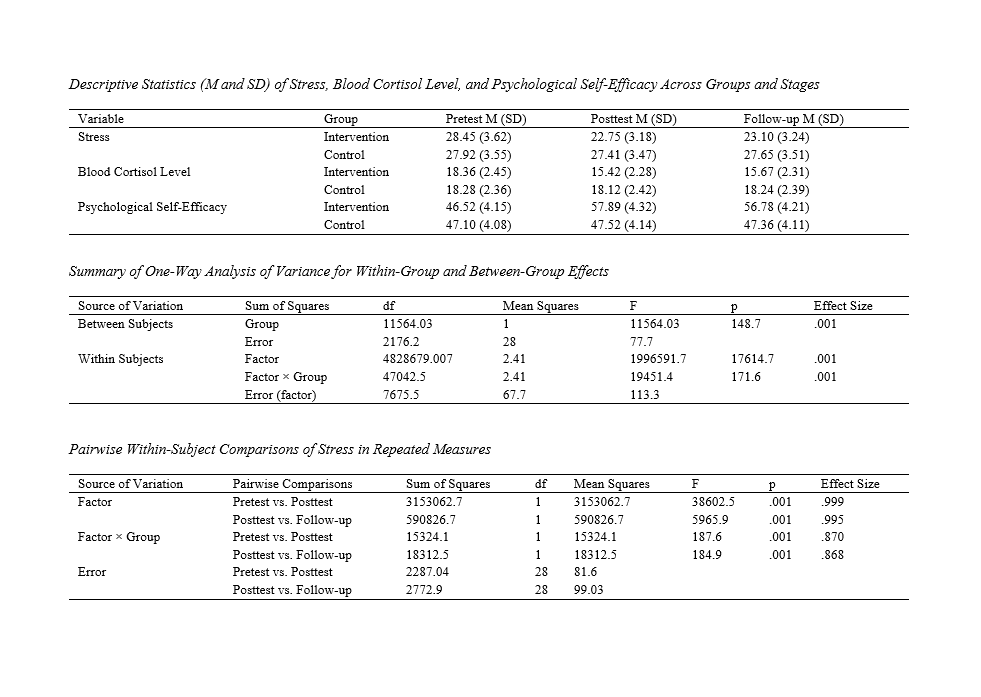
Findings: The intervention group showed a significant reduction in perceived stress scores compared to the control group (p < .001), with improvements sustained at follow-up. Cortisol levels also decreased significantly in the experimental group across posttest and follow-up (p < .001). Psychological self-efficacy scores increased markedly after the intervention (p < .001), indicating enhanced coping capacity. The interaction effects confirmed that improvements were specific to the experimental group.
Conclusion: The mindfulness-based coping skills training package effectively reduced stress and cortisol levels and improved psychological self-efficacy in women with breast cancer, underscoring its potential as a complementary intervention to enhance psychological adaptation and overall quality of life in oncology care.
Downloads
References
Arefian, M., Asgari-Mobarake, K., Fazilatpour, M., Zanguri, V., & Akrami, M. (2023). Proposing and evaluating a model of depression, stress, resilience and spirituality in relation to pain in women with breast cancer: Investigating the mediating role of mindfulness. European Journal of Oncology Nursing, 62, 102268. https://doi.org/10.1016/j.ejon.2023.102268
Avery, E. (2024). Immediate diep breast reconstruction in a trans woman with breast cancer. Plastic and Reconstructive Surgery Global Open, 12(5), e5834. https://doi.org/10.1097/GOX.0000000000005834
Ayyar, P., Mousavi, S. K., & Seyed al-Shohadaei, M. (2021). Investigating the Effect of Coping Skills Training on the Caregiver Burden of Family Caregivers of Cancer Patients Undergoing Chemotherapy. Health Education and Health Promotion, 9(3), 235-245. https://doi.org/10.52547/ijhehp.9.3.235
Benchekroun, M., Velmovitsky, P., Istrate, D., Zalc, V., Morita, P., & Lenne, D. (2023). Cross dataset analysis for generalizability of hrv-based stress detection models. Sensors, 23(4), 1807. https://doi.org/10.3390/s23041807
Chang, Y. C., Chiu, C. F., Wang, C. K., Wu, C. T., Liu, L. C., & Wu, Y. C. (2022). Short-term effect of internet-delivered mindfulness-based stress reduction on mental health, self-efficacy, and body image among women with breast cancer during the COVID-19 pandemic. Frontiers in psychology, 13, 949446. https://doi.org/10.3389/fpsyg.2022.949446
Dahabre, R. (2024). Can mindfulness facilitate posttraumatic growth in breast cancer patients? the mediating role of illness perceptions and positive emotions. Journal of Health Psychology, 29(5), 438-451. https://doi.org/10.1177/13591053231223484
Ding, X., Zhao, F., Zhu, M., Wang, Q., Wei, S., Xue, J., & Li, Z. (2023). A systematic review and meta-analysis of interventions to reduce perceived stress in breast cancer patients. Complementary Therapies in Clinical Practice, 101803. https://doi.org/10.1016/j.ctcp.2023.101803
Harley, J. (2018). The role of attention in therapy for children and adolescents who stutter: Cognitive behavioral therapy and mindfulness-based interventions. American Journal of Speech-Language Pathology, 27(3S), 1139-1151. https://doi.org/10.1044/2018_AJSLP-ODC11-17-0196
Hedhili, L. (2024). Ippia alba essential oil: a promising complementary therapy for breast cancer. Chemistry & Biodiversity, 21(4). https://doi.org/10.1002/cbdv.202301510
Horesh, D., Kohavi, S., Shilony-Nalaboff, L., Rudich, N., Greenman, D., Feuerstein, J., & Abbasi, M. (2022). Virtual reality combined with artificial intelligence (vr-ai) reduces hot flashes and improves psychological well-being in women with breast and ovarian cancer: a pilot study. Healthcare, 10(11), 2261. https://doi.org/10.3390/healthcare10112261
Ihdalumam, A., Noviekayati, I., & Santi, D. E. (2025). The Effectiveness of Mindfulness Parenting to Reduce Parenting Stress in Single Mothers as Measured by Resilience. International Journal of Research and Scientific Innovation, XII(I), 718-731. https://doi.org/10.51244/ijrsi.2025.12010062
JarAllah, S., Al-Fartusie, F., & Zageer, D. (2023). Assessment of insulin and cortisol levels in iraqi women with breast cancer. Al-Mustansiriyah Journal of Science, 34(1), 32-36. https://doi.org/10.23851/mjs.v34i1.1233
Li, J. (2022). Designing technologies to support everyday mindfulness beyond meditation for mental well-being.
Lu, C., Shi, W., Hu, W., Zhao, Y., Zhao, X., Dong, F., & Liu, C. (2022). Endoplasmic reticulum stress promotes breast cancer cells to release exosomes circ_0001142 and induces M2 polarization of macrophages to regulate tumor progression. Pharmacological Research. https://doi.org/10.1016/j.phrs.2022.106098
Lucas, A., Pan, J., E, I., Hall, D., Ja, T., Levine, B., & Wagner, L. (2023). Validation of the lee‐jones theoretical model of fear of cancer recurrence among breast cancer survivors using a structural equation modeling approach. Psycho-Oncology, 32(2), 256-265. https://doi.org/10.1002/pon.6076
Mahmoudzadeh, S., & Rajabi, S. (2022). A Comparison of Mindfulness and Health Anxiety in Women with Breast Cancer and Healthy Individuals. Health System Research, 18(4), 314-320. https://hsr.mui.ac.ir/article-1-1324-en.html
Mohammadi, S. (2020). Predicting Teachers' Job Stress Based on Basic Psychological Needs, Perceived Stress, and Early Maladaptive Schemas Payame Noor University of East Azerbaijan Province, Payame Noor Center of Tabriz].
Olyaee, Z., Mohammadi, M., Anvari, K., & Hosseini, S. E. (2022). The Effectiveness of Mindfulness-Based Cognitive Therapy (MBCT) on Depression, Quality of Life, and Serum Cortisol Levels in Women with Breast Cancer. Journal of Mashhad University of Medical Sciences Faculty of Medicine, 65(2), 785-801. https://jfmh.mums.ac.ir/article_21513.html
Oner Cengiz, H., Bayir, B., Sayar, S., & Demirtas, M. (2023). Effect of mindfulness-based therapy on spiritual well-being in breast cancer patients: a randomized controlled study. Supportive Care in Cancer, 31(7), 438. https://doi.org/10.1007/s00520-023-07904-2
Rechenberg, K. (2024). "diabetes is really simple on paper, but really complicated when you actually have it": understanding the daily stressors of adolescents living with type 1 diabetes. Journal for Specialists in Pediatric Nursing, 29(2). https://doi.org/10.1111/jspn.12424
Reis, J., Travado, L., Sousa, B., & Antoni, M. (2023). Perceived efficacy of stress management skills, emotional distress, and diurnal cortisol in women with metastatic breast cancer. International Journal of Stress Management, 30(1), 16-26. https://doi.org/10.1037/str0000260
Romeo, A., Benfante, A., Castelli, L., & Tella, M. (2021). Psychological distress among italian university students compared to general workers during the covid-19 pandemic. International journal of environmental research and public health, 18(5), 2503. https://doi.org/10.3390/ijerph18052503
Rouhani, F., & Mousavian Kajour, S. M. (2021). Investigating the Relationship Between Social Self-Efficacy and Spiritual Intelligence with Happiness Among Students of Islamic Azad University, Sari Branch. The First National Conference on Applied Studies in Education Processes,
Sabouripour, F., Roslan, S., Ghiami, Z., & Memon, M. (2021). Mediating role of self-efficacy in the relationship between optimism, psychological well-being, and resilience among iranian students. Frontiers in psychology, 12. https://doi.org/10.3389/fpsyg.2021.675645
Sakki, S. E., Penttinen, H. M., Hilgert, O. M., Volanen, S. M., Saarto, T., & Raevuori, A. (2022). Mindfulness is associated with improved psychological well-being but no change in stress biomarkers in breast cancer survivors with depression: a single group clinical pilot study. BMC Women's Health, 22(1), 518. https://doi.org/10.1186/s12905-022-02116-y
Savitsky, B., Findling, Y., Ereli, A., & Hendel, T. (2020). Anxiety and coping strategies among nursing students during the covid-19 pandemic. Nurse Education in Practice, 46, 102809. https://doi.org/10.1016/j.nepr.2020.102809
Shalikari, M., Mirzaeian, B., & Abbasi, G. (2023). Comparing the Effects of Written Exposure Therapy and Mindfulness-Based Stress Reduction on Post-Traumatic Stress Symptoms and Fear of Recurrence in Patients with Breast Cancer. Journal of psychiatric nursing, 11(1), 76-93. https://ijpn.ir/browse.php?a_code=A-10-1364-2&sid=1&slc_lang=en
Sheikh Mohammadi, F., Rezaei, A., Barzegar, M., & Bagholi, H. (2023). The Effectiveness of Group Counseling with Compassion-Focused Therapy (CFT) on Social Relationships and Emotional Pain in Women with Breast Cancer. Ravanshenasi- e Nashenakhti (Growth Psychology), 12(4), 139-148. https://frooyesh.ir/article-1-4473-en.html
Talayri, A., & Bavi, S. (2023). Comparing the Effectiveness of Mindfulness-Based Stress Reduction (MBSR) and Emotional Schema Therapy on Perceived Stress and Distress Tolerance in Women Undergoing Drug Treatment for Psoriasis in Ahvaz. Journal of psychiatric nursing, 11(5), 40-52. https://ijpn.ir/article-1-2197-en.html
Timajchi, M., Aghahheris, M., Rafiepoor, A., & Nikoozadeh, E. K. (2025). The Effectiveness of Mindfulness-Based Stress Reduction Training on Psychological Distress Tolerance, Sexual Function, and Psychosocial Distress in Diabetic Patients. Ijbmc, 12(2), 104-112. https://doi.org/10.61838/ijbmc.v12i2.779
Wang, J. (2023). A cohort study on the association between changing occupational stress, hair cortisol concentration, and hypertension. PLoS One, 18(5), e0285623. https://doi.org/10.1371/journal.pone.0285623
Williams, S., Clarke, S., & Edginton, T. (2023). Mindfulness for the self‐management of negative coping, rumination and fears of compassion in people with cancer: An exploratory study. Cancer Reports, 6(3), e1761. https://doi.org/10.1002/cnr2.1761
Wu, C., Hou, G., Lin, Y., Sa, Z., Yan, J., Zhang, X., & Lang, H. (2022). Exploring links between chinese military recruits' psychological stress and coping style from the person-environment fit perspective: the chain mediating effect of self-efficacy and social support. Frontiers in psychology, 13. https://doi.org/10.3389/fpsyg.2022.996865
Yin, X., Wang, D., Li, Z., & Huang, Y. (2021). Psychological difficulties mediate and self-efficacy moderates the relationship between family cumulative risk and hope among chinese children from low-income families. Frontiers in psychology, 12. https://doi.org/10.3389/fpsyg.2021.709320
Zangiabadi, M., Sadeghi, M., & Ghadampour, E. (2018). The Effectiveness of Teaching Emotion-Focused Therapy (EFT) Processing Strategies on Academic Emotion and Self-Efficacy of Female High School Students. Quarterly Journal of Psychological Science, 17(67), 399-406. https://psychologicalscience.ir/browse.php?a_id=134&sid=1&slc_lang=en
Zhang, J., Wang, X., Xu, T., Li, J., Li, H., Wu, Y., & Li, Y. (2021). The effect of resilience and self‐efficacy on nurses' compassion fatigue: a cross‐sectional study. Journal of Advanced Nursing, 78(7), 2030-2041. https://doi.org/10.1111/jan.15113
Zhong, Z. M., Jiang, H., Wang, H., & Liu, Y. (2025). The Association Between Mindfulness and Athletes’ Distress Tolerance: The Mediating Roles of Cognitive Reappraisal and Mental Toughness. Behavioral Sciences, 15(3), 298. https://doi.org/10.3390/bs15030298
Downloads
Additional Files
Publication Timeline
- Submitted
- Revised
- Accepted