The Mediating Role of Forgiveness and Marital Self-Regulation in the Relationship Between Experiential Avoidance and Marital Burnout in Married Women
DOI:
https://doi.org/10.61838/kman.pwj.4373Keywords:
marital burnout, experiential avoidance, forgiveness, marital Self-RegulationAbstract
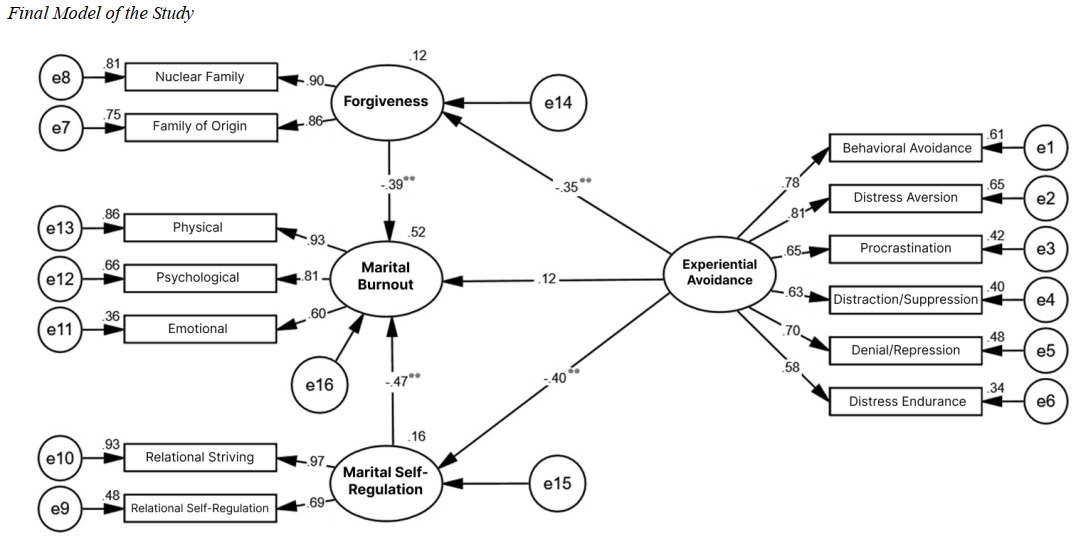
Objective: This study aimed to investigate the mediating roles of forgiveness and marital self-regulation in the relationship between experiential avoidance and marital burnout among married women.
Methods and Materials: The research employed an applied, descriptive-correlational design. The statistical population consisted of married women in Tehran with 5–15 years of marital life who had not remarried and voluntarily agreed to participate. Using convenience sampling, 300 participants were recruited from counseling centers. The instruments included the Marital Burnout Questionnaire (Pines, 1996), the Experiential Avoidance Questionnaire (Gámez et al., 2011), the Marital Self-Regulation Scale (Wilson et al., 2009), and the Family Forgiveness Scale (Pollard et al., 1998). After eliminating invalid responses, data were analyzed using Pearson correlation coefficients and structural equation modeling (SEM) with maximum likelihood estimation in AMOS 26.
Findings: Experiential avoidance was found to be a positive and significant predictor of marital burnout. However, forgiveness and marital self-regulation significantly and negatively mediated this relationship. The direct path between experiential avoidance and marital burnout was nonsignificant (β = .123, p = .069), while the indirect effects through forgiveness (β = .137, p = .001) and marital self-regulation (β = .188, p = .001) were both positive and significant. The total effect of experiential avoidance on marital burnout (β = .447, p = .001) indicated a substantial contribution, with the overall model explaining 52% of the variance in marital burnout. Model fit indices demonstrated acceptable fit (χ²/df = 2.74, GFI = .921, CFI = .945, RMSEA = .076).
Conclusion: The findings highlight that forgiveness and marital self-regulation act as protective mechanisms that mitigate the negative impact of experiential avoidance on marital burnout.
Downloads
References
Aspara, J., Wittkowski, K., & Luo, X. (2018). Types of intelligence predict likelihood to get married and stay married: Large-scale empirical evidence for evolutionary theory. Personality and individual differences, 122, 1-6. https://doi.org/10.1016/j.paid.2017.09.028
Braithwaite, S. R., Selby, E. A., & Fincham, F. D. (2019). Forgiveness and relationship satisfaction: Mediating mechanisms. Journal of Family Psychology, 4, 551-559. https://doi.org/10.1037/a0024526
Dehghan, A., Gholamali Lavasani, M., & Madani, Y. (2018). The Relationship between Relationship Beliefs and Couple Burnout: The Mediating Role of Mindfulness. Journal of Psychology, 22(3), 344-357. magiran.com/p1908299
Dollahite, D. C., Marks, L. D., & Wurm, G. J. (2019). Generative devotion: A theory of sacred relational care in families of faith. Journal of Family Theory & Review, 11(3), 429-448. https://doi.org/10.1111/jftr.12339
Elmimanesh, N., & Zhaleh, M. (2018). Effectiveness of positivist psychotherapy on the psychological well-being, forgiveness and marital burnout in the women exposed to divorce. Family Pathology, Counseling & Enrichment, 4(1), 89-102. http://fpcej.ir/article-1-209-en.htmls
Fahd, S., & Hanif, R. (2019). Determinants of marital flourishing among married individuals: an asian perspective. Review of Economics and Development Studies, 5(1), 95-108. https://doi.org/10.26710/reads.v5i1.513
Fatehi, N., Gholami Hosnaroudi, M., & Abed, N. (2021). The Mediating Role of Marital Forgiveness and Mental Well-being in the Relationship Between Mindfulness and Sexual Satisfaction in Married Women and Men of Tehran City: A Descriptive Study. J Rafsanjan Univ Med Sci, 20(6), 645-660. http://journal.rums.ac.ir/article-1-6008-en.html
Harasymchuk, C., Peetz, J., Fehr, B., & Chowdhury, S. (2020). Worn out relationship? The role of expectations in judgments of relational boredom. Personal Relationships, 28(1), 80-98. https://doi.org/10.1111/pere.12354
Hosseini, S. Z., Esmaeilpour, K., & Heshmati, R. (2024). Prediction of marital burnout based on marital conflicts and communication beliefs in couples applying for divorce. Razi J(84). https://doi.org/10.47176/rjms.31.84
Karimi, J., Homayuni, A., & Homayuni, F. (2019). The Prediction of Health Anxiety based on Experiential Avoidance and Anxiety Sensitivity among Non-Clinical Population. Research in Psychological Health, 12(4), 66-79. https://sid.ir/paper/134046/en
Kazemian Moghadam, K., Mehrabizadeh, M., Kiamanesh, A., & Hosseinian, S. (2017). The role of differentiation, mean-ing in life, and forgiveness in predicting marital boredom among married female students. Women's Cultural Psychology, 9(33), 35-50. https://www.ijfpjournal.ir/article_245519.html
Kazemian Moghaddam, K., Mehrabizadeh Honarmand, M., Kiamanesh, A., & Hosseiniyan, S. (2021). The role of differentiation, meaningfulness in life and forgiveness in predicting martial satisfaction. Iranian Journal of Family Psychology, 3(2), 71-82. https://sanad.iau.ir/Journal/jwc/Article/919996
Li, H., & Lu, J. (2017). The neural association between tendency to forgive and spontaneous brain activity in healthy young adults. Frontiers in human neuroscience, 11, 561. https://doi.org/10.3389/fnhum.2017.00561
Liceaga, M. D. (2021). “You stay, no matter how bad”: Women voice the trajectory of marital disaffection San Diego State University].
Moradi, A., Yazdanbakhsh, K., & Basati, A. (2017). Prediction of marital conflicts according to schemes attachment styles and impunity. Journal of Psychological Sciences, 15(60), 518-531. http://psychologicalscience.ir/article-1-169-en.html
Nazeran, Z., Haghayegh, S. A., Raeisi, Z., & Dehghani, A. (2023). The relationship between marital attributions and marital burnout the mediating role of couple forgiveness. Rooyesh, 12(1), 187-196. https://frooyesh.ir/article-1-4221-fa.html
Neal, A. M., & Lemay, E. P. (2019). The wandering eye perceives more threats: Projection of attraction to alternative partners predicts anger and negative behavior in romantic relationships. Journal of Social and Personal Relationships, 36(2), 450-468. https://doi.org/10.1177/0265407517734398
Piri, M., & Shirazi, P. D. M. (2018). The Role of Marital Offence-Specific Forgiveness and Semantic Differential of Sex Roles in Marital Satisfaction of Married Teachers in Zahedan. 15(2), 109-128. https://qjfr.ir/article-1-694-fa.html
Pouya, F. H., Gharamaleki, N. S., & Mirzahosseini, H. (2025). The Structural Model for Predicting Marital Burnout Based on Attachment Styles With the Mediating Role of Marital Self-Regulation and Marital Intimacy in Married Individuals. Aftj, 6(1), 29-36. https://doi.org/10.61838/kman.aftj.6.1.4
Ragabi, G., Harizavi, M., & Taghipour, M. (2017). Evaluating the model of the relationship between self-compassion, marital empathy, and depression with mediating marital forgiveness in Female. Biannual Journal of Applied Counseling, 6(2), 1-22. https://doi.org/10.22055/jac.2017.21290.1422
Riaz, M., Ashraf, M., Sheikh, I., Hyat, U., Khan, Z. K., & Ahmad, N. u. a. (2024). Role of Marital Status in the Impact of Forgiveness on Psychological Resilience Among Women. Bbe, 12(3), 799-802. https://doi.org/10.61506/01.00127
Roush, J. F., Brown, S. L., Mitchell, S. M., & Cukrowicz, K. C. (2019). Experiential Avoidance, Cognitive Fusion, and Suicide Ideation among Psychiatric Inpatients: The Role of Thwarted Interpersonal Needs. Psychotherapy Research, 29(4), 514-523. https://doi.org/10.1080/10503307.2017.1395923
Seçer, İ., & Ulaş, S. (2021). An Investigation of the Effect of COVID-19 on OCD in Youth in the Context of Emotional Reactivity, Experiential Avoidance, Depression and Anxiety. Int J Ment Health Addiction, 19, 2306-2319. https://doi.org/10.1007/s11469-020-00322-z
Sharifi, B., Raeisi, F., & Haji Hassani, M. (2024). The relationship between self-compassion and forgiveness with marital burnout: The mediating role of self-criticism in married individuals. Rooyesh-e-Ravanshenasi Journal (Psychology Rising), 13(9), 21-30. https://frooyesh.ir/article-1-5199-en.html
Sultanali Zadeh, M., Nemati, N., & Montazeri, M. (2019). Predicting marital boredom based on rumination and acceptance and action (experiential avoidance) in infertile women Tehran, Iran. https://civilica.com/doc/1156816/
Vahedinia, M., Akbari Daghi, H., & Gharib, H. (2019). The relationship between irrational thoughts and communication beliefs with marital boredom among teacher (Master's Married teachers in Gonbad County, Master's thesis, Gonbad, Iran Payame Noor University]. Gonbad, Iran. https://ganj.irandoc.ac.ir/#/articles/f918674e2139bebb3d32488e419e6407
Walsh, C. M. (2019). Emotional capital and the benefits for personal well-being: how positive moments with you might help me too University of Canterbury]. https://repositories.lib.utexas.edu/items/2883b870-bfdc-4545-956e-ab0037ebf02a
Wong, D. (2020). Why Forgiveness Is So Elusive. In E. Nahmias, T. Polger, & W. Zhao (Eds.), The Natural Method: Essays on Mind, Ethics, and Self in Honor of Owen Flanagan (pp. 193-225). MIT Press. https://doi.org/10.7551/mitpress/10567.003.0010
Yousefi, H., Sheibani, H., & Majdabadi, Z. (2018). Examining the relationship between emotional dysregulation and experiential avoidance with marital boredom among couples on the verge of divorce in Qaen Payame Noor University]. Semnan Province. https://ganj.irandoc.ac.ir/#/articles/5f7a68a65d534f19fe8cf6f98eb26bfb
Yousefi, V., Samani, S., & Goudarzi, M. (2024). Effectiveness of a Communication Skills Training Protocol on Improving Marital Burnout. Aftj, 5(3), 151-158. https://doi.org/10.61838/kman.aftj.5.3.16
Zali, Z., Ahmadi, S., & Sarami Foroshani, G. (2019). The mediating role of marital forgiveness in the relationship between psychological hardiness and marital burnout. 5(1), 107-124. https://fpcej.ir/article-1-205-fa.html
Downloads
Additional Files
Publication Timeline
- Submitted
- Revised
- Accepted
Issue
Section
License
Copyright (c) 2025 Hourieh Masoumirad (Author); Pantea Jahangir (Corresponding Author); Simindokht Rezakhani (Author)

This work is licensed under a Creative Commons Attribution-NonCommercial 4.0 International License.