Predictive Indicators of Psychological Inflexibility in Women Engaged in High-Risk Romantic Relationships
DOI:
https://doi.org/10.61838/kman.pwj.4329Keywords:
psychological inflexibility, high-risk relationships, intimate partner violence, emotional avoidance, cognitive rigidity, traumaAbstract
Objective: This study aimed to identify the core psychological patterns and experiential indicators that predict psychological inflexibility in women involved in high-risk romantic relationships.
Methods and Materials: A qualitative research design was employed, utilizing semi-structured, in-depth interviews with 20 women from Kenya who were currently or recently engaged in romantic relationships characterized by emotional, psychological, or physical risk. Participants were recruited through purposive sampling, and interviews were conducted until theoretical saturation was reached. Data were transcribed verbatim and analyzed using thematic analysis in NVivo 14 software, following Braun and Clarke’s six-phase approach. The trustworthiness of the analysis was ensured through member checking, peer debriefing, and an audit trail.
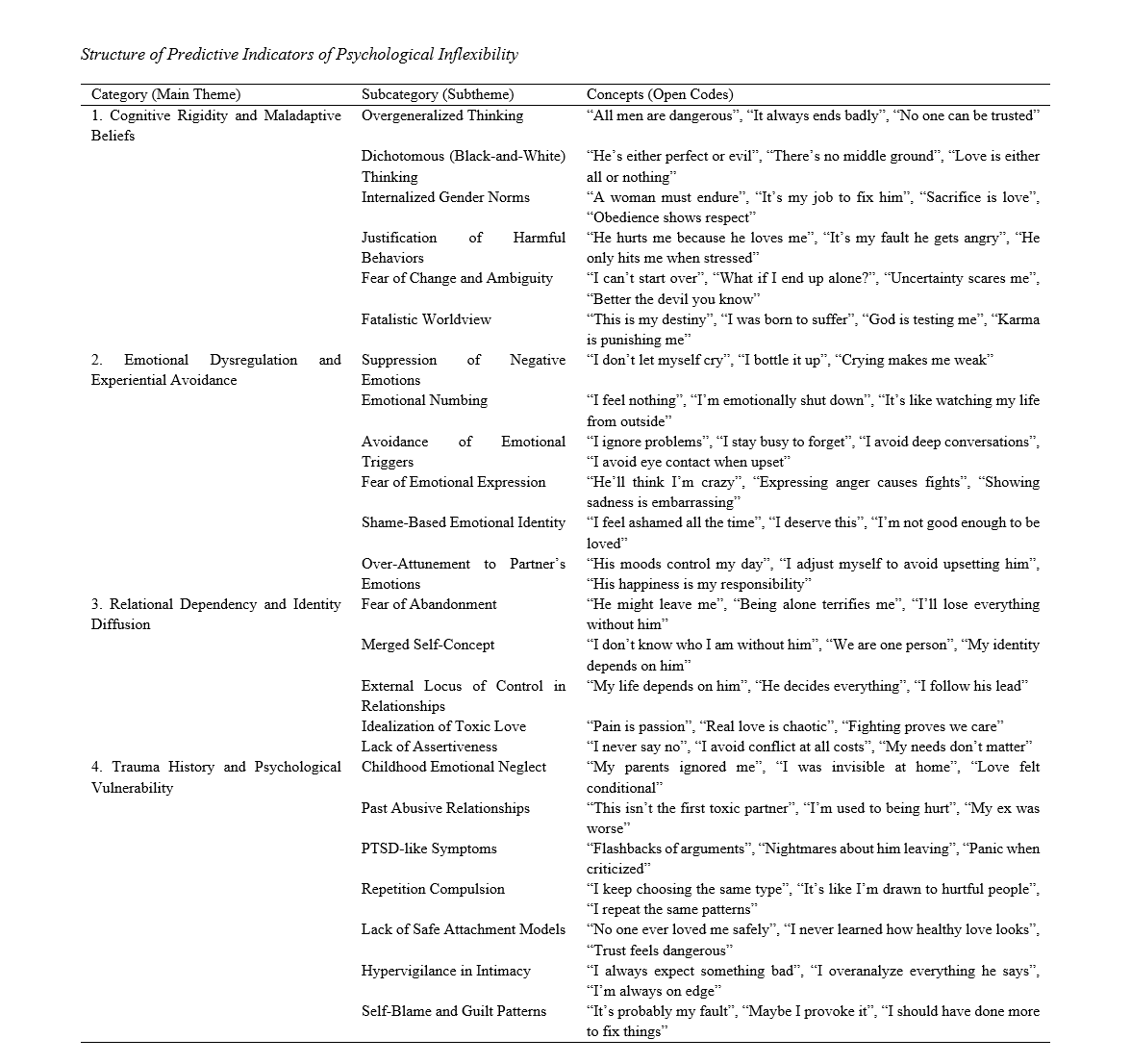
Findings: Thematic analysis revealed four overarching categories reflecting the predictive indicators of psychological inflexibility: (1) Cognitive Rigidity and Maladaptive Beliefs, including overgeneralization, black-and-white thinking, and fatalistic worldviews; (2) Emotional Dysregulation and Experiential Avoidance, such as emotional suppression, fear of expression, and numbing; (3) Relational Dependency and Identity Diffusion, marked by fused identities, fear of abandonment, and lack of assertiveness; and (4) Trauma History and Psychological Vulnerability, including unresolved childhood trauma, repetition of abusive patterns, and hypervigilance in intimacy. Participants’ narratives revealed how these patterns sustained psychological inflexibility and impaired their ability to exit or reframe harmful relationships.
Conclusion: Psychological inflexibility in women engaged in high-risk romantic relationships is shaped by a convergence of cognitive rigidity, emotional avoidance, relational enmeshment, and unresolved trauma.
Downloads
References
Bektaş-Aydın, C., & Yüksel-Şahin, F. (2025). Effectiveness of Acceptance and Commitment Therapy on Post-Traumatic Stress Symptoms, Psychological Inflexibility, and Self-Compassion in IPV Survivor University Women. Journal of interpersonal violence. https://doi.org/10.1177/08862605251318283
Blix, I., Glad, K. A., Undset, A., Wentzel‐Larsen, T., Berg, A. O., Jensen, T. K., & Dyb, G. (2024). ‘My Child Could Have Died’: Counterfactual Thoughts and Psychological Distress in Parents of Trauma Survivors. European Journal of Psychotraumatology, 15(1). https://doi.org/10.1080/20008066.2024.2326736
Borghi, E. (2024). Engaging With Trauma: From Reflections on a Survivor’s Experience of Child Sexual Abuse to Developing a Trauma-Informed Approach for Anthropological Teaching and Research. Teaching Anthropology, 13(2), 63-74. https://doi.org/10.22582/ta.v13i2.722
Bryngeirsdottir, H. S., Arnault, D. S., & Halldórsdóttir, S. (2022). The Post-Traumatic Growth Journey of Women Who Have Survived Intimate Partner Violence: A Synthesized Theory Emphasizing Obstacles and Facilitating Factors. International journal of environmental research and public health, 19(14), 8653. https://doi.org/10.3390/ijerph19148653
Giang, T.-V., Le, D.-H., Nguyen, T.-H., Huynh, V.-S., & Nguyen-Thi, D.-M. (2021). Case Report: The resiliency journey of A Vietnamese female sexual abuse survivor: an exploration In life history. F1000research, 10, 1071. https://doi.org/10.12688/f1000research.55227.2
Grau, P. P., Adams, T. G., & Wetterneck, C. T. (2022). An Analysis of the Relationship Between Self-Compassion, Psychological Inflexibility, Psychological Health, and PTSD Severity in a Partial Hospitalization Program. Violence and Victims, 37(6), 768-782. https://doi.org/10.1891/vv-2021-0063
Gray, B., Dewey, L., & Fondacaro, K. M. (2020). Torture, Psychological Inflexibility, and Mental Health Outcomes Among Resettled Refugees in the United States. Journal of Refugee Studies, 34(4), 3948-3961. https://doi.org/10.1093/jrs/feaa044
Jackson, L., Power, K., Mitchell, K., Duncan, K., Graham, L. L., & Wilson, K. A. (2023). Understanding Female Survivors of Interpersonal Trauma and Their Experience of the ‘Survive &Amp; Thrive’ Course. Group Analysis, 57(1), 23-49. https://doi.org/10.1177/05333164221150408
Jobson, L., Willoughby, C., Specker, P., Wong, J., Draganidis, A., Lau, W., & Liddell, B. J. (2022). Investigating the Associations Between Cognitive Appraisals, Emotion Regulation and Symptoms of Posttraumatic Stress Disorder Among Asian American and European American Trauma Survivors. Scientific reports, 12(1). https://doi.org/10.1038/s41598-022-22995-3
Kato, T. (2020). Effect of Psychological Inflexibility on Depressive Symptoms and Sleep Disturbance Among Japanese Young Women With Chronic Pain. International journal of environmental research and public health, 17(20), 7426. https://doi.org/10.3390/ijerph17207426
Kazmi, S. F., Dil, S., & Bashir, R. (2022). Prevalence of Posttraumatic Stress Disorder Among Trauma Survivors in Khyber Pakhtunkhwa. Pakistan Journal of Social Research, 04(01), 812-819. https://doi.org/10.52567/pjsr.v4i1.947
Maathz, P., Flink, I., Engman, L., & Ekdahl, J. (2020). Psychological Inflexibility as a Predictor of Sexual Functioning Among Women With Vulvovaginal Pain: A Prospective Investigation. Pain Medicine, 21(12), 3596-3602. https://doi.org/10.1093/pm/pnaa042
Nath, P., Das, A., & Das, S. S. (2024). The Quality of Life (Qol) Among Survivors of Sexual Assault – A Descriptive Study in a Medical College of Kolkata. JFMT, 41(1), 78-82. https://doi.org/10.48165/jfmt.2024.41.1.15
Saadati, N., Kılıçaslan, F., & Salami, M. O. (2023). The Psychosomatic Effects of Childhood Trauma: Insights From Adult Survivors. JPPR, 2(2), 34-40. https://doi.org/10.61838/kman.jppr.2.2.6
Serafi, S. M. E., Wahsh, M., & Haikal, N. (2023). Congolese Women's War Trauma in Lynn Nottage's Ruined. Miṣriqiyā, 3(1), 27-52. https://doi.org/10.21608/misj.1999.298771
Shamsudeen, S., Gupta, P., Sayeed, N., & Munda, S. K. (2024). Narrative Exposure Therapy for the Treatment of Trauma-Related Symptoms Among Adolescent Survivors of Sex Trafficking: A Pilot Study. Indian Journal of Psychiatry, 66(10), 918-928. https://doi.org/10.4103/indianjpsychiatry.indianjpsychiatry_248_24
Stene, L. E., Thoresen, S., Wentzel‐Larsen, T., & Dyb, G. (2022a). Changes in Healthcare Utilization After Mass Trauma: A Register-Based Study of Young Survivors’ Utilization of Primary Care and Mental Health Services Before and After the Utøya Attack in Norway. European journal of public health, 32(Supplement_3). https://doi.org/10.1093/eurpub/ckac129.336
Stene, L. E., Thoresen, S., Wentzel‐Larsen, T., & Dyb, G. (2022b). Healthcare Utilization After Mass Trauma: A Register-Based Study of Consultations With Primary Care and Mental Health Services in Survivors of Terrorism. BMC psychiatry, 22(1). https://doi.org/10.1186/s12888-022-04358-4
Szoko, N., Franklin, B., Slade, E., Fuhrman, B. J., Murphy, C. E., Booth, K., & Miller, E. (2025). Perceived Discrimination, Experiences of Trauma, and Psychological Functioning Among Juvenile Court‐Involved Youth. Journal of adolescence. https://doi.org/10.1002/jad.12491
Taha, P. H., & Abdurrahman, S. M. H. (2020). Traumatic Events and Posttraumatic Stress Among Iraqi Kurdish “Anfal” Survivors. Duhok Medical Journal, 14(1), 77-91. https://doi.org/10.31386/dmj.2020.14.1.8
TaŞÖRen, A. B. (2022). Childhood Maltreatment and Emotional Distress: The Role of Beliefs About Emotion and Psychological Inflexibility. Current Psychology, 42(16), 13276-13287. https://doi.org/10.1007/s12144-021-02594-7
Timblin, H., & Hassija, C. M. (2022). How Will I Be Perceived: The Role of Trauma-Related Shame in the Relationship Between Psychological Distress and Expectations of Disclosure Among Survivors of Sexual Victimization. Journal of interpersonal violence, 38(7-8), 5805-5823. https://doi.org/10.1177/08862605221127209
Tran, A., Brickman, S., Jordan, J. T., & Samuelson, K. W. (2020). Predictors of Posttraumatic Stress Disorder, Anxiety, and Depression Symptoms in Survivors of Torture Living in the United States. The Journal of Nervous and Mental Disease, 208(8), 593-599. https://doi.org/10.1097/nmd.0000000000001197
Downloads
Additional Files
Publication Timeline
- Submitted
- Revised
- Accepted
Issue
Section
License
Copyright (c) 2025 Luis Morales (Author); Grace Mwangi

This work is licensed under a Creative Commons Attribution-NonCommercial 4.0 International License.