Exploring the Cognitive-Affective Components of Body Image Disturbance in Adolescent Girls
DOI:
https://doi.org/10.61838/kman.pwj.6.1.18Keywords:
Body image disturbance, adolescent girls, cognitive-affective processesAbstract
Objective: This study aimed to explore the cognitive and affective components of body image disturbance (BID) in adolescent girls.
Methods and Materials: A qualitative research design based on a phenomenological approach was employed to investigate the lived experiences of 20 adolescent girls aged 13–18 from various regions in Malaysia. Participants were selected through purposive sampling and took part in in-depth, semi-structured interviews, which were conducted in private settings to ensure confidentiality and comfort. Data collection continued until theoretical saturation was achieved. Interviews were transcribed verbatim and analyzed thematically using NVivo 14 software. The analysis followed Braun and Clarke’s six-step method, incorporating both inductive and deductive coding strategies to identify recurrent cognitive, emotional, and behavioral patterns.
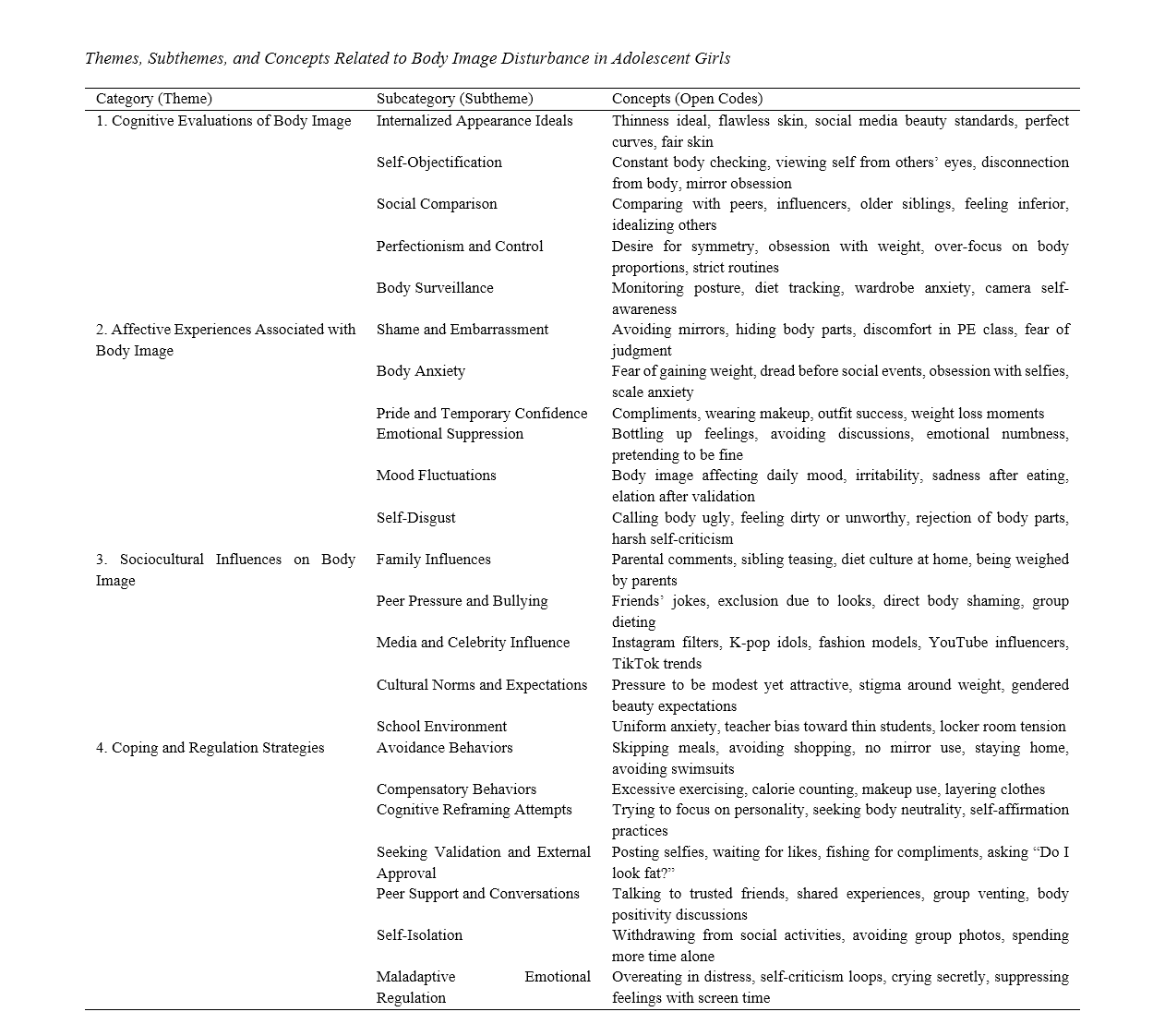
Findings: Four overarching themes emerged: (1) Cognitive Evaluations of Body Image, including internalized ideals, social comparison, and self-objectification; (2) Affective Experiences, such as shame, anxiety, and body-related emotional fluctuations; (3) Sociocultural Influences, encompassing family, peer, media, and cultural pressures; and (4) Coping and Regulation Strategies, which ranged from avoidance and compensatory behaviors to cognitive reframing and peer support. Participants described a dynamic and often distressing relationship with their bodies, marked by internalized societal expectations and emotionally charged self-appraisal.
Conclusion: This study highlights the interrelated cognitive and affective processes underlying BID in adolescent girls, emphasizing the role of sociocultural context in shaping these experiences. The findings underscore the need for holistic, culturally sensitive interventions that address not only distorted thoughts but also emotional regulation and social influences.
Downloads
References
Akram, U., Allen, S., Stevenson, J. C., Lazuras, L., Ackroyd, M., Chester, J., Longden, J., Peters, C., & Irvine, K. (2021). Homogeneity of Cognitive and Behavioural Processes Underlying the Relationship Between Insomnia and Body Image Disturbance. Cognitive Processing, 22(4), 701-709. https://doi.org/10.1007/s10339-021-01039-0
Altman, J., Zimmaro, L. A., & Woodruff‐Borden, J. (2017). Targeting Body Compassion in the Treatment of Body Dissatisfaction: A Case Study. Clinical Case Studies, 16(6), 431-445. https://doi.org/10.1177/1534650117731155
Brizzi, G., & Riva, G. (2024). Playing With Spatial Frames: Altering the Body Matrix Through Multisensory Egocentric and Allocentric Body Illusions. Human Behavior and Emerging Technologies, 2024(1). https://doi.org/10.1155/2024/7316063
Carey, M., & Preston, C. (2019). Investigating the Components of Body Image Disturbance Within Eating Disorders. Frontiers in Psychiatry, 10. https://doi.org/10.3389/fpsyt.2019.00635
Ertl, M. M., & Ajayi, A. A. (2025). A Brief Theory-Based Measure of Body Image Disturbance: Scale Construction and Initial Validation. https://doi.org/10.31234/osf.io/tu3ka
Ghai, A., Milosevic, I., Laliberté, M., Taylor, V. H., & McCabe, R. E. (2014). Body Image Concerns in Obese Women Seeking Bariatric Surgery. Ethnicity and Inequalities in Health and Social Care, 7(2), 96-107. https://doi.org/10.1108/eihsc-11-2013-0044
Giuliano, M. D., Cruz, F. d. l., Schumann, A., Zopf, R., & Bär, K. J. (2025). Behavioral, Neuronal, and Physiological Facets of Multidimensional Body Image in Anorexia Nervosa: A Scoping Review. Journal of eating disorders, 13(1). https://doi.org/10.1186/s40337-025-01191-4
Groves, K. (2017). A Brief Examination of Maladapted Visual Processing Mechanisms as an Endophenotype of Body Image Disturbance. Psypag Quarterly, 1(102), 11-15. https://doi.org/10.53841/bpspag.2017.1.102.11
Hamamoto, Y., Oba, K., Ishibashi, R., Ding, Y., Nouchi, R., & Sugiura, M. (2024). Reduced Body-Image Disturbance by Body-Image Interventions Is Associated With Neural-Response Changes in Visual and Social Processing Regions: A Preliminary Study. Frontiers in Psychiatry, 15. https://doi.org/10.3389/fpsyt.2024.1337776
Hamamoto, Y., Suzuki, S., & Sugiura, M. (2022). Two Components of Body-Image Disturbance Are Differentially Associated With Distinct Eating Disorder Characteristics in Healthy Young Women. PLoS One, 17(1), e0262513. https://doi.org/10.1371/journal.pone.0262513
He, Y., Liu, R., Mu, Z. e., & Nie, J. (2021). A Review of Body Image Disturbance in Binge Eating Disorder. https://doi.org/10.2991/assehr.k.211220.441
Ho, J. T., & Lenggenhager, B. (2021). Neural Underpinnings of Body Image and Body Schema Disturbances. 267-284. https://doi.org/10.1093/oso/9780198851721.003.0016
Junne, F., Zipfel, S., Wild, B., Martus, P., Giel, K. E., Resmark, G., Friederich, H. C., Teufel, M., Zwaan, M. d., Dinkel, A., Herpertz, S., Burgmer, M., Tagay, S., Rothermund, E., Zeeck, A., Ziser, K., Herzog, W., & Löwe, B. (2016). The Relationship of Body Image With Symptoms of Depression and Anxiety in Patients With Anorexia Nervosa During Outpatient Psychotherapy: Results of the ANTOP Study. Psychotherapy, 53(2), 141-151. https://doi.org/10.1037/pst0000064
Karsan, S., Diaz‐Fong, J. P., Ly, R., Hellemann, G., & Feusner, J. D. (2024). Quantifying Body Size Estimation Accuracy and Body Dissatisfaction in Body Dysmorphic Disorder Using a Digital Avatar. https://doi.org/10.1101/2024.02.21.24303163
Legenbauer, T., Thiemann, P., & Vocks, S. (2014). Body Image Disturbance in Children and Adolescents With Eating Disorders. Zeitschrift fur Kinder- und Jugendpsychiatrie und Psychotherapie, 42(1), 51-59. https://doi.org/10.1024/1422-4917/a000269
Lewer, M., Bauer, A., Hartmann, A. S., & Vocks, S. (2017). Different Facets of Body Image Disturbance in Binge Eating Disorder: A Review. Nutrients, 9(12), 1294. https://doi.org/10.3390/nu9121294
Lewer, M., Kosfelder, J., Michalak, J., Schroeder, D., Nasrawi, N., & Vocks, S. (2017). Effects of a Cognitive-Behavioral Exposure-Based Body Image Therapy for Overweight Females With Binge Eating Disorder: A Pilot Study. Journal of eating disorders, 5(1). https://doi.org/10.1186/s40337-017-0174-y
Lewer, M., Nasrawi, N., Schroeder, D., & Vocks, S. (2015). Body Image Disturbance in Binge Eating Disorder: A Comparison of Obese Patients With and Without Binge Eating Disorder Regarding the Cognitive, Behavioral and Perceptual Component of Body Image. Eating and Weight Disorders - Studies on Anorexia Bulimia and Obesity, 21(1), 115-125. https://doi.org/10.1007/s40519-015-0200-5
Porras-García, B., Ferrer‐García, M., Yilmaz, L., Sen, Y. O., Olszewska, A., Ghiţă, A., Serrano‐Troncoso, E., Treasure, J., & Gutiérrez‐Maldonado, J. (2020). Body‐related Attentional Bias as Mediator of the Relationship Between Body Mass Index and Body Dissatisfaction. European Eating Disorders Review, 28(4), 454-464. https://doi.org/10.1002/erv.2730
Skubisz, C., & Blancher, E. (2022). Eating Disorders: Media. 1-3. https://doi.org/10.1002/9781119678816.iehc0813
Spinoni, M., Solorzano, C. S., & Grano, C. (2023). A Prospective Study on Body Image Disturbances During Pregnancy and Postpartum: The Role of Cognitive Reappraisal. Frontiers in psychology, 14. https://doi.org/10.3389/fpsyg.2023.1200819
Vocks, S., & Bauer, A. (2015). Wie Relevant Sind Diagnostik Und Behandlung Der Körperbildstörung? PPMP - Psychotherapie · Psychosomatik · Medizinische Psychologie, 65(01), 25-27. https://doi.org/10.1055/s-0034-1394407
Wayda-Zalewska, M., Kostecka, B., & Kucharska, K. (2021). Body Image in Borderline Personality Disorder: A Systematic Review of the Emerging Empirical Literature. Journal of clinical medicine, 10(18), 4264. https://doi.org/10.3390/jcm10184264
Wendler-Bödicker, C., Reinckens, J., Höfler, M., & Hoyer, J. (2021). Is Childhood Maltreatment Associated With Body Image Disturbances in Adulthood? A Systematic Review and Meta-Analysis. Journal of Child & Adolescent Trauma, 15(3), 523-538. https://doi.org/10.1007/s40653-021-00379-5
Zainab, W., & Ahmad, S. (2021). Body Image and Disturbed Eating Attitudes Among Adolescents. Pakistan Journal of Psychological Research, 36(3), 413-430. https://doi.org/10.33824/pjpr.2021.36.3.23
Downloads
Additional Files
Publication Timeline
- Submitted
- Revised
- Accepted
Issue
Section
License

This work is licensed under a Creative Commons Attribution-NonCommercial 4.0 International License.