Effectiveness of Acceptance and Commitment-Based Schema Therapy on Depression and Treatment Adherence in Women with Multiple Sclerosis: A Quasi-Experimental Study
DOI:
https://doi.org/10.61838/Keywords:
Schema Therapy, Acceptance and Commitment, Treatment Adherence, Multiple Sclerosis, WomenAbstract
Objective: The aim of the present study was to examine the effectiveness of acceptance and commitment-based schema therapy on treatment adherence and depression in women with Multiple Sclerosis (M.S).
Materials and Methods: This research was a quasi-experimental study using a pre-test–post-test control group design. The statistical population included all women aged 20 to 50 with Multiple Sclerosis who had referred to the MS Association of Rafsanjan in 2024. After obtaining ethical approval, 30 participants were randomly selected and assigned to experimental and control groups. The experimental group received an intervention consisting of eight 45-minute therapeutic sessions, whereas the control group received no intervention. The instruments used in the study included the Beck Depression Inventory-II (BDI-II) and the Treatment Commitment Questionnaire (TCQ).
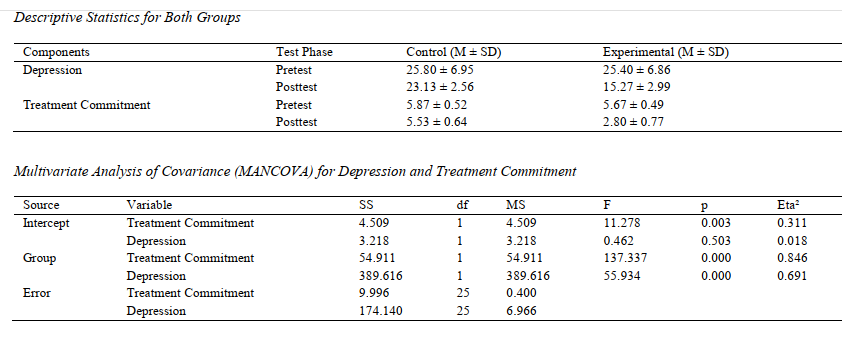
Findings: The results indicated that the interaction effect for the post-test scores of treatment adherence (Group * Treatment Adherence) was 337.137 with an estimated error of 0.001, suggesting a statistically significant difference in the post-test scores of the experimental group in the variable of treatment adherence among women with MS. Similarly, the F-statistic for the interaction effect on depression (Group * Depression) was 934.55 with an estimated error of 0.001, also indicating a statistically significant difference in the post-test scores of the experimental group in the variable of depression among women with MS.
Conclusion: The findings of the present study demonstrated that acceptance and commitment-based schema therapy is effective in improving treatment adherence and reducing depression in women with Multiple Sclerosis. Therefore, the use of this approach is recommended to enhance treatment commitment and alleviate depression in this population.
Downloads
References
Abbasian Hadadan, M. (2024). The Effectiveness of Schema Therapy on Psychological Distress and Emotional Regulation in Individuals with Borderline Personality Disorder. Journal of Psychological Dynamics in Mood Disorders (PDMD), 3(1), 160-174. https://doi.org/10.22034/pdmd.2024.454880.1088
Batihan, G., & Kaya, M. C. (2024). Schema Therapy and Depression. 119-138. https://doi.org/10.69860/nobel.9786053359456.7
Chengizian, P. (2023). Investigating the effectiveness of schema therapy on anxiety, depression, and impulsivity in individuals with borderline personality disorder. Fifth National Conference on Professional Research in Psychology and Counseling from the Teacher's Perspective,
Dīnparast, A., Rasouli, N., & Qotb, A. (2023). Comparison of the Effects of Schema Therapy and Mindfulness Techniques on Sleep Disorders in Individuals with Multiple Sclerosis. Journal of Islamic Lifestyle with a Focus on Health, 7(2), 257-267. https://www.sid.ir/paper/1135816/fa
Ebrahimi, F., Amini, N., & Keykhosrovani, M. (2023). Effectiveness of Schema Therapy on Symptoms of Love Trauma, Depression, and Anxiety in Young Women With Experience of Emotional Failure. PWJ, 4(4), 156-163. https://doi.org/10.61838/kman.pwj.4.4.19
Egli, S., Badenbach, T., Emmerik, A. v., Stefan, A. M., & Kopf‐Beck, J. (2024). Emotion Regulation and Attachment as Mechanisms of Change in Schema Therapy and Cognitive Behaviour Therapy for Depression. https://doi.org/10.31219/osf.io/67vhn
Farhadi, M., Pasandideh, M. M., & Vaziri, S. (2022). Evaluation of the effectiveness of schema therapy on reducing stress, anxiety, depression and increasing self-efficacy in patients with multiple sclerosis. Clinical Psychology and Personality, 19(2), 57-69. https://doi.org/10.22070/cpap.2021.14285.1082
Fereydooni, F., & Sheykhan, R. (2024). The Effectiveness of Schema Therapy on Depression, Self-Esteem, and Distress Tolerance in Fatherless Depressed Adolescents. Jayps, 5(8), 87-96. https://doi.org/10.61838/kman.jayps.5.8.10
Ghasempour, H., Darzi Azadbani, M., Mirzaian, B., Sangani, A., & Shakarian, S. (2022). Modeling the effect of early maladaptive schemas on treatment adherence with the mediating role of emotional regulation and resilience in coronary heart disease patients. Nursing Education, 11(4), 13-24. https://jne.ir/article-1-1360-en.html
Heidari, M., Mami, S., Ahmadi, V., & Khamoushian, K. (2023). The effectiveness of schema therapy combined with cognitive-behavioral therapy on self-efficacy and quality of life in women with multiple sclerosis. Applied Family Therapy, 4(1), 554-570. https://doi.org/10.61838/kman.aftj.4.1.27
Kopf-Beck, J., Müller, C. L., Tamm, J., Fietz, J., Rek, N., Just, L., & Egli, S. (2024). Effectiveness of Schema Therapy versus Cognitive Behavioral Therapy versus Supportive Therapy for Depression in Inpatient and Day Clinic Settings: A Randomized Clinical Trial. Psychotherapy and psychosomatics, 1-12. https://doi.org/10.1159/000535492
Malekzadeh, l., Emadi, S. Z., & naghsh, z. (2024). The Effectiveness of Group Schema Therapy on Cognitive Emotion Regulation and Emotional Behavior Regulation in Mothers with Children with Learning Disabilities. Psychology of Exceptional Individuals, 14(53), 201-227. https://doi.org/10.22054/jpe.2023.71499.2524
Nazari, A., Saedi, S., & Abdi, M. (2022). Comparing the effectiveness of schema therapy and acceptance and commitment therapy on the tolerance of emotional distress, sexual dysfunction and psychological capital of patients with multiple sclerosis. Journal of Applied Family Therapy, 3(1), 461-485. https://doi.org/10.22034/aftj.2022.313070.1240
Nazari, A., Saedi, S., & Abdi, M. (2023). Comparing the effectiveness of schema therapy and acceptance and commitment therapy on chronic fatigue syndrome in patients with multiple sclerosis. Journal of Personality and Psychosomatic Research (JPPR), 1(1), 25-28. https://doi.org/10.61838/kman.jppr.1.1.6
Nitta, Y. (2023). The Patient’s Experiential Process During Imagery Rescripting: Task Analysis of Videos of Schema Therapy for Chronic Depression. https://doi.org/10.31234/osf.io/mf42a
Rezaei, S., Mojtabaei, M., & Shomali Oskoei, A. (2023). Comparison of the Effectiveness of Intensive Short-Term Dynamic Psychotherapy and Schema Therapy on Depression, Anxiety in Mothers with Autistic Children. Journal of Applied Psychology, 17(4), 143-168. https://www.magiran.com/paper/2658910
Ritter, V., Schüller, J., Berkmann, E. M., von Soosten-Höllings-Lilge, L., & Stangier, U. (2023). Efficacy of Cognitive Therapy for Body Dysmorphic Disorder: A Randomized Controlled Pilot Trial. Behavior therapy, 54(1), 65-76. https://www.sciencedirect.com/science/article/pii/S0005789422000910
Shahab, A., Ahadi, H., Jomehri, F., & Kraskian-Mujembari, A. (2020). The effectiveness of group emotional schema therapy on subjective, well-being, fatigue of patients with multiple sclerosis in Shiraz. Psychological Models and Methods, 10(38), 77-96. https://jpmm.marvdasht.iau.ir/article_4236.html
https://jpmm.marvdasht.iau.ir/article_4236_b763ec6d98a9a0cc05d9bbd842303d43.pdf
Downloads
Additional Files
Publication Timeline
- Submitted
- Revised
- Accepted
Issue
Section
License
Copyright (c) 2025 Somayeh Hadad Ranjbar (Corresponding Author); Fahimeh Zare (Author)

This work is licensed under a Creative Commons Attribution-NonCommercial 4.0 International License.