Comparison of the Effectiveness of Group-Based Acceptance and Commitment Therapy and Compassion-Focused Therapy on Psychological Capital in Infertile Women
DOI:
https://doi.org/10.61838/kman.pwj.6.3.16Keywords:
Psychological capital, compassion, acceptance and commitment, infertile couplesAbstract
Objective: The present study aimed to compare the effects of group counseling based on Acceptance and Commitment Therapy (ACT) and Compassion-Focused Therapy (CFT) on the psychological capital of infertile women.
Methods and Materials: This research was a quasi-experimental study with a pretest-posttest design and a control group. The study population included all infertile women in Bojnord in 2023. A total of 45 participants were selected using purposive sampling and randomly assigned to three groups of 15 individuals (two experimental groups and one control group). The experimental interventions—one based on ACT and the other on CFT—were conducted in eight sessions lasting 120 minutes each for the experimental groups. The research instrument was the Psychological Capital Questionnaire developed by Luthans (2007).
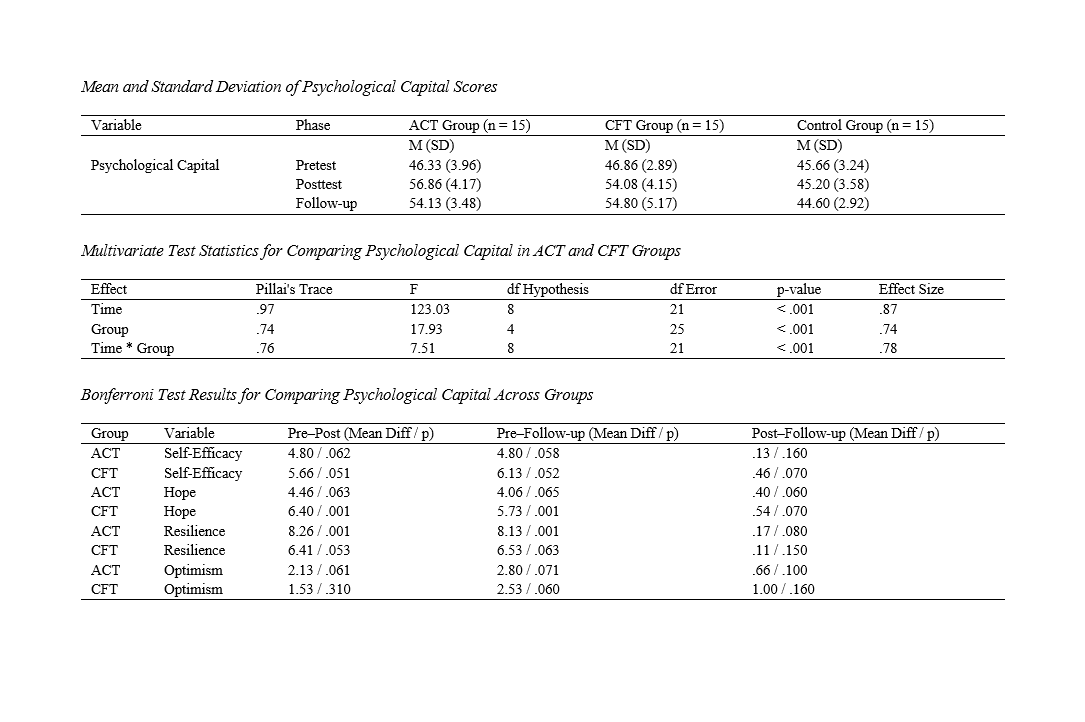
Findings: The findings indicated that the effects of time, group, and the interaction between time and group were all statistically significant (p < .001). Pairwise comparisons revealed no significant difference between the two therapeutic approaches (ACT and CFT) in the posttest. However, both experimental groups showed statistically significant improvements compared to the control group in all dimensions of psychological capital—hope, self-efficacy, optimism, and resilience (p < .01).
Conclusion: The results suggest that group counseling based on ACT and CFT can be used to improve the psychological capital of infertile women, thereby potentially reducing the psychological and familial consequences of infertility, as well as the risk of increased conflict and divorce.
Downloads
References
Adeleye, A., Cruz, K., Pasch, L., & Huddleston, H. (2020). Differences in perceived stress during ovarian stimulation between women with infertility and those pursuing oocyte cryopreservation. Journal Fertility and Sterility, 114(5), 1076-1084. https://doi.org/10.1016/j.fertnstert.2020.05.025
Ahmadpour Dizji, J., Zahrakar, K., & Kiamanesh, A. (2017). Comparing the effectiveness of compassion-focused therapy and well-being therapy on the psychological capital of female students with emotional breakdown. Scientific Journal of Women and Culture, 9(31), 21EP - 27. https://journals.iau.ir/article_532089.html
Avey, J. B., Luthans, F., & Jensen, S. M. (2009). Psychological capital: A positive resource for combating employee stress and turnover. Human Resource Management, 48(5), 677-693. https://doi.org/10.1002/hrm.20294
Borhani, F. S., Chin-Aveh, M., & Fereydouni, S. (2010). The effectiveness of combining commitment and acceptance-based group counseling with reality therapy on cognitive emotion regulation strategies and self-efficacy in infertile women. Iranian Journal of Nursing Research, 15(6), 75-85. https://ijnr.ir/article-1-2541-fa.html
Einbeigi, A., Soleimaniyan, A., & Jajarami, M. (2019). Comparing the effectiveness of acceptance and commitment therapy and existential therapy on increasing psychological capital in the elderly. Psychology of Gerontology, 6(2), 178-165. https://jap.razi.ac.ir/article_1521.html
Gilbert, P. (2009). Introducing compassion-focused therapy. Advances in psychiatric treatment, 15(3), 199-208. https://doi.org/10.1192/apt.bp.107.005264
Gilbert, P. (2014). The origins and nature of compassion focused therapy. British Journal of Clinical Psychology, 53(1SP - 6), 41. https://doi.org/10.1111/bjc.12043
Hassan, S., Bhatti, M. I., Habib, S., Fatima, S., Bhader, S., Khan, N. H., & Jiang, E. (2023). How Fear of Intimacy Affects Infertile Men’s Neuropsychological Functioning Through Mental Toughness. Frontiers in Psychiatry, 14. https://doi.org/10.3389/fpsyt.2023.1049008
İnam, Ö. (2024). The Effect of Mindfulness-Based Nursing Support on the Psychosocial Status of Women Receiving Infertility Treatment. https://doi.org/10.21203/rs.3.rs-4490798/v1
Kim, M., Moon, S., & Kim, J. (2020). Effect of psychological intervention for Korean infertile women under in vitro fertilization on infertility stress, depression, intimacy, sexual satisfaction and datigue. Journal Archives of Psychiatric Nursing, 34(4), 211-217. https://doi.org/10.1016/j.apnu.2020.05.001
Luthans, F., & Broad, J. D. (2022). Positive psychological capital to help combat the mental health fallout from the pandemic and VUCA environment. Organizational Dynamics, 51(2), 100817. https://doi.org/10.1016/j.orgdyn.2020.100817
Nasiri, A., Sharifi, T., Ghazanfari, A., & Cherami, M. (2019). Comparing the effectiveness of schema therapy and reality therapy on the psychological capital of preschool teachers. Quarterly Journal of Applied Psychology, 15(3), 536-511. https://doi.org/10.52547/apsy.2021.222264.1060
Ryan, R. M., & Deci, E. L. (2001). On happiness and human potentials: A review of research on hedonic and eudaimonic well-being. Annual Review of PsychologyVL - 52, 141-166. https://doi.org/10.1146/annurev.psych.52.1.141
Schuette, S., Andrade, F. C., Woodward, J., & Smoski, M. J. (2023). Identifying Modifiable Factors Associated With Psychological Health in Women Experiencing Infertility. Journal of Health Psychology, 28(12), 1143-1156. https://doi.org/10.1177/13591053231185549
Shahi Sonobari, S., Moeinizadeh, M., Aghamohammadian, H., & Nofarsti, A. (2022). The Effectiveness of Optimism Training Based on Benevolence on Life Satisfaction and Hopefulness of Infertile Women. Journal of Modern Psychological Researches, 17(66), 189-199.
Sharifpour shirazi, A., & Ghaderi, Z. (2022). The predictive role of self compassion and psychological capital for family functioning in married women in shiraz city. Quarterly Journal of Woman and Society, 13(50), 139-150. https://doi.org/10.30495/jzvj.2022.28378.3607
Swift, A., Reis, P., & Swanson. (2021). Infertility Stress, cortisol, coping and quality of life in U.S. women who undergo infertility treatments. Journal of Obstetric, Gynecologic Neonatal Nursing, 50(3), 275-288. https://doi.org/10.1016/j.jogn.2020.12.004
Xie, Y., Ren, Y., Niu, C., Zheng, Y., Yu, P., & Li, L. (2023). The impact of stigma on mental health and quality of life of infertile women: A systematic review. Frontiers in psychology, 13, 1093459. https://doi.org/10.3389/fpsyg.2022.1093459
Zhang, C. Q., Leeming, E., Smith, P., Chung, P. K., Hagger, M., & Hayes, S. (2018). Acceptance and commitment therapy for health behavior change: A contextually-driven approach. Psychotherapy Integration, 25(3), 175-182. https://doi.org/10.3389/fpsyg.2017.02350ER -
Downloads
Additional Files
Publication Timeline
- Submitted
- Revised
- Accepted
Issue
Section
License
Copyright (c) 2025 Sara Yadolahi (Author); Seyed Hassan Mirzaei (Corresponding Author); Ali Akbar Soleimanian (Author)

This work is licensed under a Creative Commons Attribution-NonCommercial 4.0 International License.